

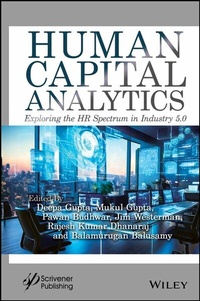
Human Capital Analytics
Description

The book equips readers with essential insights and strategies for leveraging cutting-edge technology and human capital analytics, ensuring organizations thrive in the era of human-robot collaboration and sustainable workforce development.
Human Capital Analytics: Exploring the HR Spectrum in Industry 5.0 provides a comprehensive investigation into the ever-changing junction of human capital and cutting-edge technology in the context of the Fifth Industrial Revolution. This volume emphasizes the revolutionary role that human capital analytics plays in changing workforce management, talent development, and HR strategies. This position is particularly relevant as organizations transition into Industry 5.0, where human-robot collaboration is the norm. The purpose of this book is to provide a forward-looking perspective on how data-driven human resource strategies will become vital for boosting worker potential and driving organizational success. This is accomplished by integrating developing technologies such as artificial intelligence, machine learning, and robots.
Readers will find that this book:
- Explores the transformative role of human-robot collaboration, emerging technologies, and strategic HR planning in the context of the Fifth Industrial Revolution;
- Provides a comprehensive overview of how predictive analytics and human capital analytics can enhance workforce management, employee engagement, and performance measurement;
- Focuses on how HR 5.0 contributes to advancing the United Nations Sustainable Development Goals, driving both social and business impact;
- Includes empirical studies, case studies, and real-world examples of implementing Industry 5.0 in organizations;
- Provides actionable strategies for HR professionals to navigate the digital transformation of human resource management, incorporating AI, robotics, and data-driven approaches.
Audience
Human resource developers, analysts, professionals, business executives, data scientists, consultants, professors, academics, and students exploring ways to leverage technology for Industry 5.0.
More details
Other editions
Additional editions
Persons
Deepa Gupta, PhD is a distinguished academician with over 24 years of experience in management studies, currently serving as Dean at GL Bajaj Institute of Management. Her expertise extends to organizational development, corporate relations, and international collaboration.
Mukul Gupta, PhD is a professor at GL Bajaj Institute of Management with over 25 years of experience in teaching and the corporate sector. His research and expertise in consumer behavior are invaluable for understanding the human-centric aspects of Human Capital Analytics, offering insights into user behavior, adoption, and interaction with AI-driven systems and services.
Pawan Budhwar, PhD is a professor of International Human Resource Management and the Associate Deputy Vice Chancellor International at Aston Business School. His research interests include personnel and human resource management, organizational performance, and artificial intelligence.
Jim Westerman, PhD is a professor in the Department of Management at Appalachian State University, Boone, North Carolina, USA. His areas of expertise include human resource management, organizational behavior, leadership, sustainable business, and business ethics.
Rajesh Kumar Dhanaraj, PhD is a professor at Symbiosis International University. His research in areas such as machine learning, cyber-physical systems, and wireless sensor networks is directly relevant to the core technologies underpinning computational intelligence in HR.
Balamurugan Balusamy, PhD is an Associate Dean of Students at Shiv Nadar University with 12 years of teaching experience. He has published over 200 papers and over 80 books in collaboration with professors worldwide. His research interests include engineering education, blockchain, and data sciences.
Content
Preface xvii
Part 1: Foundation and Strategic Framework of Human Capital Analytics in Industry 5.0 1
1 Human Capital Analytics in Industry 5.0: Opportunities and Challenges 3
Veena Grover, Manju Nandal, Divya Sahu and Mahima Dogra
2 Human Capital Analytics and Emerging Technologies in Industry 5.0 31
Harpreet Kaur Channi and Surinder Kaur
3 Fifth Industrial Revolution and an Overview of its Impact on Human Resources 65
Aduku Alex Akubo, Okpanachi Linus Odiji and Muhammed Bature Muhammed
4 Human Capital Transformation - Revolutionizing HR Practices with Advanced Technologies and Ethical Insights 81
Vijeyata, Chitra Jha and Sunil Tegwal
5 HR 5.0 Strategic Planning and Evolution of HR Functions in the Business Environment 101
M. Bharathi, K. Praveena, M. Dharani, V. Madhurima, Krithikaa Mohanarangam, G. Sandhya Kumari and Saleha Tabassum
Part 2: Analytical Techniques and Applications in Workforce Management 111
6 Investigating the Transformative Effects of AI, Machine Learning, and Robotics on Human Capital Analytics - An Empirical Study 113
Gagandeep, Jyoti Verma and Deepa Gupta
7 Unleashing Human Capital Analytics for Data-Driven Workforce Management 143
Princi Gupta, Deepa Gupta and Mukul Gupta
8 Mastering the Art of HR Data Collection and Management Techniques 165
Deepa Gupta, Mukul Gupta, Priti Rai, Karishma Sharma and Parth Mukul Gupta
9 Communicating Human Capital Analytics Insights to Decision-Makers Effectively 201
Sandeep Singh Chandel, Astha Shukla, Sakshi Shukla and Shivansu Sachan
10 Predictive Analytics - Next Chapter in Talent Management 219
Swati Rai, Rakesh Kumar Yadav and Rajesh Kumar Dhanaraj
11 Employee Engagement and Performance Management - Critical Role of Employee Potentials 237
Asma Bano and Ayesha Khatun
12 Performance Evaluation and Measurement of Human Capital Analytics in the Information Technology (IT) Sector in India 261
Manoj Kumar, Pratibha Maurya and Rinki Verma
13 Data-Driven Strategies to Improve Workplace Diversity, Equality and Inclusion (DEI) 283
Arkja Singh, Rakesh Kumar Yadav and Deepa Gupta
Part 3: Future Trends, Challenges, and Sustainable Development in HR Practices 303
14 Role of Human Capital Analytics and Industry 5.0 in Advancing the United Nations' Sustainable Development Goals 305
Agagu A. A., Odiji O. L. and Akubo A. A.
15 Transforming Workplaces with Human-Robot Collaboration 325
B. Swathi
16 Human Capital Analytics in Industry 5.0 for Sustainable Growth 337
Channi Sachdeva, Veena Grover and Veer P. Gangwar
17 HR 5.0 -- Demystifying the Way Forward 347
Ritu Saxena, Priyanshi Jindal and Harshit Gouri
18 The Digital Transformation of HRM: Comparing Traditional and Technology-Based Practices 359
Pardeep Kaur
19 Technological Implementation of Industry 5.0 at Kinara Capital -- A People's Welfare Organization 373
Kala Raja Mohan, R. Narmada Devi, Nagadevi Bala Nagaram, Sathish Kumar Kumaravel and Regan Murugesan
References 381
Index 383
1
Human Capital Analytics in Industry 5.0: Opportunities and Challenges
Veena Grover1*, Manju Nandal2, Divya Sahu1 and Mahima Dogra1
1Department of School of Management, Noida Institute of Engineering & Technology, Greater Noida, Uttar Pradesh, India
2Department of Management, Chandigarh University, Chandigarh, India
Abstract
For the past 10 years, the industry has been provided with Industry 4.0 to address the challenges and shortcomings; ultimately, the time has come for Industry 5.0. It is concerned with augmenting the digital shift with more effective and efficient collaboration between humans, machines, and systems within their digital ecosystem. Human capital analytics (HCA) incorporates this technology to make the most efficient use of a limited but valuable part of resources. The HCA is a traditional method for analyzing and effectively utilizing people's data by shifting from viewing HR as an organization's supporting arm to viewing HR as a source of revenue. The objective of this chapter is to describe the most significant potential for HC analytics in Industry 5.0 using the fundamental concepts of key technologies, such as artificial intelligence (AI), the Internet of Things (IoT), and big data analytics. This article discusses a few essential aspects and difficulties that every firm may encounter when it comes to Industry 5.0. There is also a discussion of the benefits and drawbacks of Industry 5.0, as well as future research prospects and applications made obtainable by Industry 5.0. Finally, this chapter discusses the difficulty in recognizing the connected concerns, as well as how HCA has run its course and people analytics is emerging as a preferable strategy for using human capital.
Keywords: Human capital analytics (HCA), human-centered, technologies, robotics, digitalization, 6G systems
Abbreviations
HCA Human capital analytics IOT Internet of Things AI Artificial intelligence KPI Key performance indicators ROI Return on investment IT Information technology HR Human resource CV Curriculum vitae GDP Gross domestic product R&D Research and development CSTI Council for Science, Technology, and Innovation
1.1 Introduction
Human capital has become more important than ever in this era of Industry 5.0, which revolves around the integration of today's technologies like cyber-physical systems, artificial intelligence (AI), and the Internet of Things (IoT). HCA is included as a critical technique in any organization that is willing to optimize its workforce and use the whole efficiency of its human resources (HRs). HCA utilizes analytics and data-driven insights to improve different HR practices such as employee engagement, workforce management, talent acquisition, and performance management in decision-making processes. As we make a shift toward Industry 5.0, using HCA becomes important for businesses wanting to prosper where humans and intelligent machines are more linked. Integrating HCA as organizations traverse the intricacies of Industry 5.0 gives both possibilities for growth and obstacles to overcome. Success in this endeavor necessitates a strategic and ethical approach, with an emphasis on optimizing human-technology collaboration for a more productive and sustainable future.
Many HR managers today deal with greater complexity and difficult questions than their predecessors. These new inquiries, rather than focusing on traditional "personnel" issues, address essential business issues: Where should we locate our plant? Which M&A target will provide the necessary skills? Where should we put a new R&D facility? Why is our turnover rate so high in China [1]? Answering questions like this necessitates new information and new ideas. Today's HR executive must think like an economist, someone who studies and oversees the allocation of limited resources. One of the rare resources in the global economy is talent. Embracing that perspective is half the battle. The other half is gathering relevant information. Companies are accustomed to monitoring internal "leading indicators," but the economist-minded HR chief must also look outward [1]. Macroeconomic metrics such as GDP (gross domestic product), employment movements, and public infrastructure spending are crucial in guiding corporate decisions. By calibrating the limited talent expenditures that organizations can make, these leaders want to make their workforce more responsive to their organization's current and future demands. Finally, HR decisions are like many other business decisions. Humanity is going through the Fourth Industrial Revolution, commonly known as "Industry 4.0," which is based on the broad adoption of information technology (IT) in various domains of industry, process automation, and the spread of AI technologies [2].
Each decade, the magnitude of humanity's economic, environmental, and social challenges grows. Industry 5.0 is a novel approach, and there is significant doubt regarding what it will offer and how it will impact business and manufacturing. People must prepare for changes that will be more complicated than those that humanity has previously encountered. Before moving on to Industry 5.0, it is important to understand what is wrong with Industry 4.0 and why it needs to be replaced. The need to boost industrial efficiency while simultaneously lowering production costs has resulted in the active implementation of automation in all its forms. The integration of physical, network, and computational processes inside a shared cyber-physical system is, by definition, complex [2]. We can conclude that several modifications are required, which will ultimately free us of most, if not all, of the difficulties. Primarily, it will enhance the significance of mankind, diminishing a substantial quantity of risks and dissatisfaction. Ultimately, he is the focal point of the cosmos; without his existence, there would be a void, therefore we cannot just exclude him from any future advancement. There should be a strong correlation between humans and machines, along with a widespread growth in trust in technology. These objectives can be achieved during the upcoming Industrial Revolution. Industry 5.0 refers to the fifth generation of development of industry, characterized by advanced technologies and automation [2]. At the April 2021 "international scientific conference on economic and social development problems", the concept of Industry 5.0 was introduced. This word suggests a combination of human intelligence and the advanced capabilities of machines, resulting in a collective intelligence that will drive technological advancements, enhance human capabilities, and prevent technological singularity. During the Aveva World digital event on June 17, 2021, a comparable perspective was shared. It emphasized the ability to merge Industry 4.0 technologies with the human-centric concepts of Industry 5.0. These changes over time aim to facilitate the seamless connection between human intelligence and cognitive computing [2]. Industry 5.0 and HC analytics should be merged to succeed in a dynamic, world-class, and cutthroat competition. Industry 5.0 reflects a transition from a focus on value to the economy to a focus on social worth, as well as a transition from a focus on welfare to a focus on well-being. The concept of Industry 5.0 is not limited to only industry but is also being used in the organization and different sectors of the market. Industry 5.0 presents itself as a plan that fixes the worker's well-being at the place of production, along with more resilient and environment-friendly production systems. Industry 5.0 is necessary for obtaining economic growth for the factory and competitive advantages in today's business environment characterized by paid advancements in technology. It discusses analyzing the prospective applications and benefits of Industry 5.0 for organizations to increase their return on investment (ROI). The seismic shift of Industry 5.0 indicates the human and machine collaboration to increase the production efficacy of industrial goods. Leveraging HCA as organizations traverse the intricacies of Industry 5.0 gives both possibilities for growth and obstacles to overcome. Success in this endeavor necessitates a strategic and ethical approach, with an emphasis on optimizing human-technology collaboration for a more productive and sustainable future.
1.2 Evolution of Industry 5.0
The very first revolution in the industry was Industry 1.0, which took place in the 18th century. It comprised of utilization of machines to invent and create products or items with the help of tools and techniques. In 1760, the Industrial Revolution started in England and eventually reached America by the late 18th century. The arrival of Industry 1.0 noted a transition from a manual labor-based economy to one filled with the usage of equipment. This modification...
