

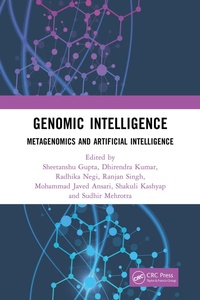
Genomic Intelligence
Metagenomics and Artificial Intelligence
1st Edition
Published on 6. December 2024
340 pages
978-1-040-26951-0 (ISBN)
Description

The field of metagenomics has revolutionized our comprehension of microbial diversity and function across various habitats, from the human body to terrestrial and aquatic environments. Simultaneously, advancements in AI have empowered researchers to analyze vast troves of genomic data with unprecedented speed and precision, facilitating new insights into the complex interplay between microorganisms and their surroundings.
The subject matter in this book provides an overview of metagenomics and discusses the combination of metagenomics and AI and its significant consequences for advancements in science. The chapters examine the approaches, difficulties, and revolutionary uses of AI in metagenomics and provide insight into the convergence of genomics, metagenomics, and AI's potential to revolutionize diverse fields from healthcare to environmental.
Print edition not for sale in India.
The subject matter in this book provides an overview of metagenomics and discusses the combination of metagenomics and AI and its significant consequences for advancements in science. The chapters examine the approaches, difficulties, and revolutionary uses of AI in metagenomics and provide insight into the convergence of genomics, metagenomics, and AI's potential to revolutionize diverse fields from healthcare to environmental.
Print edition not for sale in India.
More details
Edition
1. Auflage
Language
English
Place of publication
London
United Kingdom
Publishing group
Taylor & Francis Ltd
Target group
Professional and scholarly
College/higher education
File size
6,38 MB
ISBN-13
978-1-040-26951-0 (9781040269510)
Copyright in bibliographic data and cover images is held by Nielsen Book Services Limited or by the publishers or by their respective licensors: all rights reserved.
Schweitzer Classification
Other editions
Additional editions
Sheetanshu Gupta | Dhirendra Kumar | Radhika Negi
Genomic Intelligence
Metagenomics and Artificial Intelligence
Book
12/2024
1st Edition
CRC Press
€233.80
Shipment within 10-20 days
Persons
Sheetanshu Gupta is alumnus of G.B. Pant University of Agriculture and Technology, Pantnagar, Uttarakhand, India and works in the field of Biochemistry, Molecular Biology, and Biotechnology. He specializes in environmental problems, aeroponics and hydroponics, and protein biochemistry. He is also involved in innovating farming techniques and exploring novel approaches to plant protection.
Dhirendra Kumar is Assistant Professor in the Department of Botany and Assistant Nodal Officer IPR Cell at Chaudhary Bansi Lal University, Haryana, India. His areas of interest are Plant Biology, Biotechnology, Bioprocess Development, Termite Biology, and Waste Management and he is currently working on green synthesis plants and metal-based nanomaterials.
Radhika Negi works as Subject Matter Specialist (Vegetable Science and Floriculture) at CSK HPKV, KVK, Lahaul, and Spiti 1 at Kukumseri, India. She has completed her post-graduation in Vegetable Science from Dr YSP UHF, Nauni, Solan, Himachal Pradesh, India and qualified ASRB-ICAR NET in Vegetable Science in 2018. She has three years of experience in the field of extension and research and is involved in various projects.
Ranjan Singh works as Associate Professor in the Department of Microbiology at Dr. Ram Manohar Lohia Avadh University, Ayodhya, U.P., India. He holds a Ph.D. in Microbiology from Dr. Ram Manohar Lohia Avadh University, Ayodhya, U.P, India. His areas of research are Applied and Environmental Microbiology and Applied Biotechnology.
Mohammad Javed Ansari is Assistant Professor in the Department of Botany at Hindu College, Moradabad, Uttar Pradesh, India. He holds a Ph.D. in Biotechnology from IIT Roorkee, India and has served as Assistant Professor at King Saud University, Riyadh, Saudi Arabia.
Shakuli Kashyap is Assistant Professor at the College of Agriculture Sciences, Teerthanker Mahaveer University, Moradabad, India. She holds a Ph.D. in Botany from G. B. P. U. A. & T, Pantnagar, India.
Sudhir Mehrotra is Professor at Lucknow University, Uttar Pradesh, India. He holds 32 years of teaching experience and has completed several research projects working in the field of Biochemical Toxicology.
Dhirendra Kumar is Assistant Professor in the Department of Botany and Assistant Nodal Officer IPR Cell at Chaudhary Bansi Lal University, Haryana, India. His areas of interest are Plant Biology, Biotechnology, Bioprocess Development, Termite Biology, and Waste Management and he is currently working on green synthesis plants and metal-based nanomaterials.
Radhika Negi works as Subject Matter Specialist (Vegetable Science and Floriculture) at CSK HPKV, KVK, Lahaul, and Spiti 1 at Kukumseri, India. She has completed her post-graduation in Vegetable Science from Dr YSP UHF, Nauni, Solan, Himachal Pradesh, India and qualified ASRB-ICAR NET in Vegetable Science in 2018. She has three years of experience in the field of extension and research and is involved in various projects.
Ranjan Singh works as Associate Professor in the Department of Microbiology at Dr. Ram Manohar Lohia Avadh University, Ayodhya, U.P., India. He holds a Ph.D. in Microbiology from Dr. Ram Manohar Lohia Avadh University, Ayodhya, U.P, India. His areas of research are Applied and Environmental Microbiology and Applied Biotechnology.
Mohammad Javed Ansari is Assistant Professor in the Department of Botany at Hindu College, Moradabad, Uttar Pradesh, India. He holds a Ph.D. in Biotechnology from IIT Roorkee, India and has served as Assistant Professor at King Saud University, Riyadh, Saudi Arabia.
Shakuli Kashyap is Assistant Professor at the College of Agriculture Sciences, Teerthanker Mahaveer University, Moradabad, India. She holds a Ph.D. in Botany from G. B. P. U. A. & T, Pantnagar, India.
Sudhir Mehrotra is Professor at Lucknow University, Uttar Pradesh, India. He holds 32 years of teaching experience and has completed several research projects working in the field of Biochemical Toxicology.
Content
Preface
About the Editors
1. Exploring the Intersection of Metagenomics and Artificial Intelligence
2. Metagenomics and AI: A Synergistic Approach to Data-Driven Insights
3. Techniques for Metagenomic Data Collection and Sequencing
4. Computational Challenges in Metagenomic Data Analysis
5. Machine Learning for Taxonomic Classification of Microbiomes
6. Predictive Modelling of Microbial Communities Using Deep Learning
7. Functional Profiling of Microbial Communities through AI Approaches
8. Enzyme Annotation and Pathway Reconstruction with Machine Learning
9. Metagenomics and Host-Microbiome Interactions in Disease
10. AI-Powered Predictive Modelling for Disease Diagnostics
11. Metagenomic Insights into Ecosystems and Environmental Dynamics
12. AI-Driven Analysis of Environmental Metagenomic Data
13. Constructing and Analysing Microbial Interaction Networks Using AI
14. Integrative Approaches: Combining Metagenomics and Network Science
15. Mining Metagenomic Data for Novel Functional Genes Using AI
16. AI-driven Bioprospecting of Microbial Resources
17. Ethical Issues in AI-Enhanced Metagenomic Research
18. Legal Frameworks for Data Privacy and Ownership in Metagenomics
19. Emerging Trends in Metagenomics and AI Integration
20. AI-Metagenomics Fusion: Paving the Way for Precision Microbiomics
About the Editors
1. Exploring the Intersection of Metagenomics and Artificial Intelligence
2. Metagenomics and AI: A Synergistic Approach to Data-Driven Insights
3. Techniques for Metagenomic Data Collection and Sequencing
4. Computational Challenges in Metagenomic Data Analysis
5. Machine Learning for Taxonomic Classification of Microbiomes
6. Predictive Modelling of Microbial Communities Using Deep Learning
7. Functional Profiling of Microbial Communities through AI Approaches
8. Enzyme Annotation and Pathway Reconstruction with Machine Learning
9. Metagenomics and Host-Microbiome Interactions in Disease
10. AI-Powered Predictive Modelling for Disease Diagnostics
11. Metagenomic Insights into Ecosystems and Environmental Dynamics
12. AI-Driven Analysis of Environmental Metagenomic Data
13. Constructing and Analysing Microbial Interaction Networks Using AI
14. Integrative Approaches: Combining Metagenomics and Network Science
15. Mining Metagenomic Data for Novel Functional Genes Using AI
16. AI-driven Bioprospecting of Microbial Resources
17. Ethical Issues in AI-Enhanced Metagenomic Research
18. Legal Frameworks for Data Privacy and Ownership in Metagenomics
19. Emerging Trends in Metagenomics and AI Integration
20. AI-Metagenomics Fusion: Paving the Way for Precision Microbiomics
