

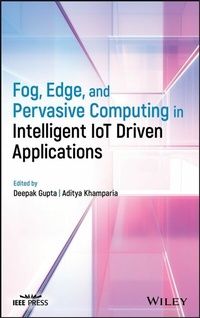
Fog, Edge, and Pervasive Computing in Intelligent IoT Driven Applications
Description

With the rapid development in artificially intelligent and hybrid technologies, IoT, edge, fog-driven, and pervasive computing techniques are becoming important parts of our daily lives. This book focuses on recent advances, roles, and benefits of these technologies, describing the latest intelligent systems from a practical point of view. Fog, Edge, and Pervasive Computing in Intelligent IoT Driven Applications is also valuable for engineers and professionals trying to solve practical, economic, or technical problems. With a uniquely practical approach spanning multiple fields of interest, contributors cover theory, applications, and design methodologies for intelligent systems. These technologies are rapidly transforming engineering, industry, and agriculture by enabling real-time processing of data via computational, resource-oriented metaheuristics and machine learning algorithms. As edge/fog computing and associated technologies are implemented far and wide, we are now able to solve previously intractable problems. With chapters contributed by experts in the field, this book:
* Describes Machine Learning frameworks and algorithms for edge, fog, and pervasive computing
* Considers probabilistic storage systems and proven optimization techniques for intelligent IoT
* Covers 5G edge network slicing and virtual network systems that utilize new networking capacity
* Explores resource provisioning and bandwidth allocation for edge, fog, and pervasive mobile applications
* Presents emerging applications of intelligent IoT, including smart farming, factory automation, marketing automation, medical diagnosis, and more
Researchers, graduate students, and practitioners working in the intelligent systems domain will appreciate this book's practical orientation and comprehensive coverage. Intelligent IoT is revolutionizing every industry and field today, and Fog, Edge, and Pervasive Computing in Intelligent IoT Driven Applications provides the background, orientation, and inspiration needed to begin.
More details
Other editions
Additional editions

Persons
Deepak Gupta, PhD, is an Assistant Professor in the Department of Computer Science and Engineering at the Maharaja Agrasen Institute of Technology, Delhi, India. He has published 158 papers and 3 patents. He is associated with numerous professional bodies, including IEEE, ISTE, IAENG, and IACSIT. He is the convener and organizer of the ICICC, ICDAM Springer Conference Series.
Aditya Khamparia, PhD, is Associate Professor of Computer Science at Lovely Professional University, Punjab, India. He has published more than 45 scientific research publications and is a member of CSI, IET, ISTE, IAENG, ACM and IACSIT.
Content
About the Editors xvii
List of Contributors xix
Preface xxv
Acknowledgments xxxiii
1 Fog, Edge and Pervasive Computing in Intelligent Internet of Things Driven Applications in Healthcare: Challenges, Limitations and Future Use 1
Afroj Alam, Sahar Qazi, Naiyar Iqbal, and Khalid Raza
1.1 Introduction 1
1.2 Why Fog, Edge, and Pervasive Computing? 3
1.3 Technologies Related to Fog and Edge Computing 6
1.4 Concept of Intelligent IoT Application in Smart (Fog) Computing Era 9
1.5 The Hierarchical Architecture of Fog/Edge Computing 12
1.6 Applications of Fog, Edge and Pervasive Computing in IoT-based Healthcare 15
1.7 Issues, Challenges, and Opportunity 17
1.7.1 Security and Privacy Issues 18
1.7.2 Resource Management 19
1.7.3 Programming Platform 19
1.8 Conclusion 20
Bibliography 20
2 Future Opportunistic Fog/Edge Computational Models and their Limitations 27
Sonia Singla, Naveen Kumar Bhati, and S. Aswath
2.1 Introduction 28
2.2 What are the Benefits of Edge and Fog Computing for the Mechanical Web of Things (IoT)? 32
2.3 Disadvantages 34
2.4 Challenges 34
2.5 Role in Health Care 35
2.6 Blockchain and Fog, Edge Computing 38
2.7 How Blockchain will Illuminate Human Services Issues 40
2.8 Uses of Blockchain in the Future 41
2.9 Uses of Blockchain in Health Care 42
2.10 Edge Computing Segmental Analysis 42
2.11 Uses of Fog Computing 43
2.12 Analytics in Fog Computing 44
2.13 Conclusion 44
Bibliography 44
3 Automating Elicitation Technique Selection using Machine Learning 47
Hatim M. Elhassan Ibrahim Dafallaa, Nazir Ahmad, Mohammed Burhanur Rehman, Iqrar Ahmad, and Rizwan khan
3.1 Introduction 47
3.2 Related Work 48
3.3 Model: Requirement Elicitation Technique Selection Model 52
3.3.1 Determining Key Attributes 54
3.3.2 Selection Attributes 54
3.3.2.1 Analyst Experience 55
3.3.2.2 Number of Stakeholders 55
3.3.2.3 Technique Time 56
3.3.2.4 Level of Information 56
3.3.3 Selection Attributes Dataset 56
3.3.3.1 Mapping the Selection Attributes 57
3.3.4 k-nearest Neighbor Algorithm Application 57
3.4 Analysis and Results 60
3.5 The Error Rate 61
3.6 Validation 61
3.6.1 Discussion of the Results of the Experiment 62
3.7 Conclusion 62
Bibliography 65
4 Machine Learning Frameworks and Algorithms for Fog and Edge Computing 67
Murali Mallikarjuna Rao Perumalla, Sanjay Kumar Singh, Aditya Khamparia, Anjali Goyal, and Ashish Mishra
4.1 Introduction 68
4.1.1 Fog Computing and Edge Computing 68
4.1.2 Pervasive Computing 68
4.2 Overview of Machine Learning Frameworks for Fog and Edge Computing 69
4.2.1 TensorFlow 69
4.2.2 Keras 70
4.2.3 PyTorch 70
4.2.4 TensorFlow Lite 70
4.2.4.1 Use Pre-train Models 70
4.2.4.2 Convert the Model 70
4.2.4.3 On-device Inference 71
4.2.4.4 Model Optimization 71
4.2.5 Machine Learning and Deep Learning Techniques 71
4.2.5.1 Supervised, Unsupervised and Reinforcement Learning 71
4.2.5.2 Machine Learning, Deep Learning Techniques 72
4.2.5.3 Deep Learning Techniques 75
4.2.5.4 Efficient Deep Learning Algorithms for Inference 77
4.2.6 Pros and Cons of ML Algorithms for Fog and Edge Computing 78
4.2.6.1 Advantages using ML Algorithms 78
4.2.6.2 Disadvantages of using ML Algorithms 79
4.2.7 Hybrid ML Model for Smart IoT Applications 79
4.2.7.1 Multi-Task Learning 79
4.2.7.2 Ensemble Learning 80
4.2.8 Possible Applications in Fog Era using Machine Learning 81
4.2.8.1 Computer Vision 81
4.2.8.2 ML- Assisted Healthcare Monitoring System 81
4.2.8.3 Smart Homes 81
4.2.8.4 Behavior Analyses 82
4.2.8.5 Monitoring in Remote Areas and Industries 82
4.2.8.6 Self-Driving Cars 82
Bibliography 82
5 Integrated Cloud Based Library Management in Intelligent IoT driven Applications 85
Md Robiul Alam Robel, Subrato Bharati, Prajoy Podder, and M. Rubaiyat Hossain Mondal
5.1 Introduction 86
5.1.1 Execution Plan for the Mobile Application 86
5.1.2 Main Contribution 86
5.2 Understanding Library Management 87
5.3 Integration of Mobile Platform with the Physical Library- Brief Concept 88
5.4 Database (Cloud Based) - A Must have Component for Library Automation 88
5.5 IoT Driven Mobile Based Library Management - General Concept 89
5.6 IoT Involved Real Time GUI (Cross Platform) Available to User 93
5.7 IoT Challenges 98
5.7.1 Infrastructure Challenges 99
5.7.2 Security Challenges 99
5.7.3 Societal Challenges 100
5.7.4 Commercial Challenges 101
5.8 Conclusion 102
Bibliography 104
6 A Systematic and Structured Review of Intelligent Systems for Diagnosis of Renal Cancer 105
Nikita, Harsh Sadawarti, Balwinder Kaur, and Jimmy Singla
6.1 Introduction 106
6.2 Related Works 107
6.3 Conclusion 119
Bibliography 119
7 Location Driven Edge Assisted Device and Solutions for Intelligent Transportation 123
Saravjeet Singh and Jaiteg Singh
7.1 Introduction to Fog and Edge Computing 124
7.1.1 Need for Fog and Edge Computing 124
7.1.2 Fog Computing 125
7.1.2.1 Application Areas of Fog Computing 125
7.1.3 Edge Computing 126
7.1.3.1 Advantages of Edge Computing 127
7.1.3.2 Application Areas of Fog Computing 129
7.2 Introduction to Transportation System 129
7.3 Route Finding Process 131
7.3.1 Challenges Associated with Land Navigation and Routing Process 132
7.4 Edge Architecture for Route Finding 133
7.5 Technique Used 135
7.6 Algorithms Used for the Location Identification and Route Finding Process 137
7.6.1 Location Identification 137
7.6.2 Path Generation Technique 138
7.7 Results and Discussions 140
7.7.1 Output 140
7.7.2 Benefits of Edge-based Routing 143
7.8 Conclusion 145
Bibliography 146
8 Design and Simulation of MEMS for Automobile Condition Monitoring Using COMSOL Multiphysics Simulator 149
Natasha Tiwari, Anil Kumar, Pallavi Asthana, Sumita Mishra, and Bramah Hazela
8.1 Introduction 149
8.2 Related Work 151
8.3 Vehicle Condition Monitoring through Acoustic Emission 151
8.4 Piezo-resistive Micro Electromechanical Sensors for Monitoring the Faults Through AE 152
8.5 Designing of MEM Sensor 153
8.6 Experimental Setup 153
8.6.1 FFT Analysis of Automotive Diesel Engine Sound Recording using MATLAB 155
8.6.2 Design of MEMS Sensor using COMSOL Multiphysics 155
8.6.3 Electrostatic Study Steps for the Optimized Tri-plate Comb Structure 156
8.7 Result and Discussions 157
8.8 Conclusion 158
Bibliography 158
9 IoT Driven Healthcare Monitoring System 161
Md Robiul Alam Robel, Subrato Bharati, Prajoy Podder, and M. Rubaiyat Hossain Mondal
9.1 Introduction 161
9.1.1 Complementary Aspects of Cloud IoT in Healthcare Applications 162
9.1.2 Main Contribution 164
9.2 General Concept for IoT Based Healthcare System 164
9.3 View of the Overall IoT Healthcare System- Tiers Explained 165
9.4 A Brief Design of the IoT Healthcare Architecture-individual Block Explanation 166
9.5 Models/Frameworks for IoT use in Healthcare 168
9.6 IoT e-Health System Model 171
9.7 Process Flow for the Overall Model 172
9.8 Conclusion 173
Bibliography 175
10 Fog Computing as Future Perspective in Vehicular Ad hoc Networks 177
Harjit Singh, Dr. Vijay Laxmi, Dr. Arun Malik, and Dr. Isha
10.1 Introduction 178
10.2 Future VANET: Primary Issues and Specifications 180
10.3 Fog Computing 181
10.3.1 Fog Computing Concept 183
10.3.2 Fog Technology Characterization 183
10.4 Related Works in Cloud and Fog Computing 185
10.5 Fog and Cloud Computing-based Technology Applications in VANET 186
10.6 Challenges of Fog Computing in VANET 188
10.7 Issues of Fog Computing in VANET 189
10.8 Conclusion 190
Bibliography 191
11 An Overview to Design an Efficient and Secure Fog-assisted Data Collection Method in the Internet of Things 193
Sofia, Arun Malik, Isha, and Aditya Khamparia
11.1 Introduction 193
11.2 Related Works 194
11.3 Overview of the Chapter 196
11.4 Data Collection in the IoT 197
11.5 Fog Computing 197
11.5.1 Why fog Computing for Data Collection in IoT? 197
11.5.2 Architecture of Fog Computing 200
11.5.3 Features of Fog Computing 200
11.5.4 Threats of Fog Computing 202
11.5.5 Applications of Fog Computing with the IoT 203
11.6 Requirements for Designing a Data Collection Method 204
11.7 Conclusion 206
Bibliography 206
12 Role of Fog Computing Platform in Analytics of Internet of Things- Issues, Challenges and Opportunities 209
Mamoon Rashid and Umer Iqbal Wani
12.1 Introduction to Fog Computing 209
12.1.1 Hierarchical Fog Computing Architecture 210
12.1.2 Layered Fog Computing Architecture 212
12.1.3 Comparison of Fog and Cloud Computing 213
12.2 Introduction to Internet of Things 214
12.2.1 Overview of Internet of Things 214
12.3 Conceptual Architecture of Internet of Things 216
12.4 Relationship between Internet of Things and Fog Computing 217
12.5 Use of Fog Analytics in Internet of Things 218
12.6 Conclusion 218
Bibliography 218
13 A Medical Diagnosis of Urethral Stricture Using Intuitionistic Fuzzy Sets 221
Prabjot Kaur and Maria Jamal
13.1 Introduction 221
13.2 Preliminaries 223
13.2.1 Introduction 223
13.2.2 Fuzzy Sets 223
13.2.3 Intuitionistic Fuzzy Sets 224
13.2.4 Intuitionistic Fuzzy Relation 224
13.2.5 Max-Min-Max Composition 224
13.2.6 Linguistic Variable 224
13.2.7 Distance Measure In Intuitionistic Fuzzy Sets 224
13.2.7.1 The Hamming Distance 224
13.2.7.2 Normalized Hamming Distance 224
13.2.7.3 Compliment of an Intuitionistic Fuzzy Set Matrix 225
13.2.7.4 Revised Max-Min Average Composition of A and B (A F B) 225
13.3 Max-Min-Max Algorithm for Disease Diagnosis 225
13.4 Case Study 226
13.5 Intuitionistic Fuzzy Max-Min Average Algorithm for Disease Diagnosis 227
13.6 Result 228
13.7 Code for Calculation 229
13.8 Conclusion 233
13.9 Acknowledgement 234
Bibliography 234
14 Security Attacks in Internet of Things 237
Rajit Nair, Preeti Sharma, and Dileep Kumar Singh
14.1 Introduction 238
14.2 Reference Model of Internet of Things (IoT) 238
14.3 IoT Communication Protocol 246
14.4 IoT Security 247
14.4.1 Physical Attack 248
14.4.2 Network Attack 252
14.4.3 Software Attack 254
14.4.4 Encryption Attack 255
14.5 Security Challenges in IoT 256
14.5.1 Cryptographic Strategies 256
14.5.2 Key Administration 256
14.5.3 Denial of Service 256
14.5.4 Authentication and Access Control 257
14.6 Conclusion 257
Bibliography 257
15 Fog Integrated Novel Architecture for Telehealth Services with Swift Medical Delivery 263
Inderpreet Kaur, Kamaljit Singh Saini, and Jaiteg Singh Khaira
15.1 Introduction 264
15.2 Associated Work and Dimensions 266
15.3 Need of Security in Telemedicine Domain and Internet of Things (IoT) 267
15.3.1 Analytics Reports 268
15.4 Fog Integrated Architecture for Telehealth Delivery 268
15.5 Research Dimensions 269
15.5.1 Benchmark Datasets 269
15.6 Research Methodology and Implementation on Software Defined Networking 270
15.6.1 Key Tools and Frameworks for IoT, Fog Computing and Edge Computing 274
15.6.2 Simulation Analysis 276
15.7 Conclusion 282
Bibliography 282
16 Fruit Fly Optimization Algorithm for Intelligent IoT Applications 287
Satinder Singh Mohar, Sonia Goyal, and Ranjit Kaur
16.1 An Introduction to the Internet of Things 287
16.2 Background of the IoT 288
16.2.1 Evolution of the IoT 288
16.2.2 Elements Involved in IoT Communication 288
16.3 Applications of the IoT 289
16.3.1 Industrial 290
16.3.2 Smart Parking 290
16.3.3 Health Care 290
16.3.4 Smart Offices and Homes 290
16.3.5 Augment Maps 291
16.3.6 Environment Monitoring 291
16.3.7 Agriculture 291
16.4 Challenges in the IoT 291
16.4.1 Addressing Schemes 291
16.4.2 Energy Consumption 292
16.4.3 Transmission Media 292
16.4.4 Security 292
16.4.5 Quality of Service (QoS) 292
16.5 Introduction to Optimization 293
16.6 Classification of Optimization Algorithms 293
16.6.1 Particle Swarm Optimization (PSO) Algorithm 293
16.6.2 Genetic Algorithms 294
16.6.3 Heuristic Algorithms 294
16.6.4 Bio-inspired Algorithms 294
16.6.5 Evolutionary Algorithms (EA) 294
16.7 Network Optimization and IoT 295
16.8 Network Parameters optimized by Different Optimization Algorithms 295
16.8.1 Load Balancing 295
16.8.2 Maximizing Network Lifetime 295
16.8.3 Link Failure Management 296
16.8.4 Quality of the Link 296
16.8.5 Energy Efficiency 296
16.8.6 Node Deployment 296
16.9 Fruit Fly Optimization Algorithm 297
16.9.1 Steps Involved in FOA 297
16.9.2 Flow Chart of Fruit Fly Optimization Algorithm 298
16.10 Applicability of FOA in IoT Applications 300
16.10.1 Cloud Service Distribution in Fog Computing 300
16.10.2 Cluster Head Selection in IoT 300
16.10.3 Load Balancing in IoT 300
16.10.4 Quality of Service in Web Services 300
16.10.5 Electronics Health Records in Cloud Computing 301
16.10.6 Intrusion Detection System in Network 301
16.10.7 Node Capture Attack in WSN 301
16.10.8 Node Deployment in WSN 302
16.11 Node Deployment Using Fruit Fly Optimization Algorithm 302
16.12 Conclusion 304
Bibliography 304
17 Optimization Techniques for Intelligent IoT Applications 311
Priyanka Pattnaik, Subhashree Mishra, and Bhabani Shankar Prasad Mishra
17.1 Cuckoo Search 312
17.1.1 Introduction to Cuckoo 312
17.1.2 Natural Cuckoo 312
17.1.3 Artificial Cuckoo Search 313
17.1.4 Cuckoo Search Algorithm 313
17.1.5 Cuckoo Search Variants 314
17.1.6 Discrete Cuckoo Search 314
17.1.7 Binary Cuckoo Search 314
17.1.8 Chaotic Cuckoo Search 316
17.1.9 Parallel Cuckoo Search 317
17.1.10 Application of Cuckoo Search 317
17.2 Glow Worm Algorithm 317
17.2.1 Introduction to Glow Worm 317
17.2.2 Glow Worm Swarm Optimization Algorithm (GSO) 317
17.3 Wasp Swarm Optimization 321
17.3.1 Introduction to Wasp Swarm and Wasp Swarm Algorithm (WSO) 321
17.3.2 Fish Swarm Optimization (FSO) 322
17.3.3 Fruit Fly Optimization (FLO) 322
17.3.4 Cockroach Swarm Optimization 324
17.3.5 Bumblebee Algorithm 324
17.3.6 Dolphin Echolocation 325
17.3.7 Shuffled Frog-leaping Algorithm 326
17.3.8 Paddy Field Algorithm 327
17.4 Real World Applications Area 328
Summary 329
Bibliography 329
18 Optimization Techniques for Intelligent IoT Applications in Transport Processes 333
Muzafer Saracevic, Zoran Loncarevic, and Adnan Hasanovic
18.1 Introduction 333
18.2 Related Works 335
18.3 TSP Optimization Techniques 336
18.4 Implementation and Testing of Proposed Solution 338
18.5 Experimental Results 342
18.5.1 Example Test with 50 Cities 343
18.5.2 Example Test with 100 Cities 344
18.6 Conclusion and Further Works 346
Bibliography 347
19 Role of Intelligent IOT Applications in Fog paradigm: Issues, Challenges and Future Opportunities 351
Priyanka Rajan Kumar and Sonia Goel
19.1 Fog Computing 352
19.1.1 Need of Fog computing 352
19.1.2 Architecture of Fog Computing 353
19.1.3 Fog Computing Reference Architecture 354
19.1.4 Processing on Fog 355
19.2 Concept of Intelligent IoT Applications in Smart Computing Era 355
19.3 Components of Edge and Fog Driven Algorithm 356
19.4 Working of Edge and Fog Driven Algorithms 357
19.5 Future Opportunistic Fog/Edge Computational Models 360
19.5.1 Future Opportunistic Techniques 361
19.6 Challenges of Fog Computing for Intelligent IoT Applications 361
19.7 Applications of Cloud Based Computing for Smart Devices 363
Bibliography 364
20 Security and Privacy Issues in Fog/Edge/Pervasive Computing 369
Shweta Kaushik and Charu Gandhi
20.1 Introduction to Data Security and Privacy in Fog Computing 370
20.2 Data Protection/ Security 375
20.3 Great Security Practices In Fog Processing Condition 377
20.4 Developing Patterns in Security and Privacy 381
20.5 Conclusion 385
Bibliography 385
21 Fog and Edge Driven Security & Privacy Issues in IoT Devices 389
Deepak Kumar Sharma, Aarti Goel, and Pragun Mangla
21.1 Introduction to Fog Computing 390
21.1.1 Architecture of Fog 390
21.1.2 Benefits of Fog Computing 392
21.1.3 Applications of Fog with IoT 393
21.1.4 Major Challenges for Fog with IoT 394
21.1.5 Security and Privacy Issues in Fog Computing 395
21.2 Introduction to Edge Computing 399
21.2.1 Architecture and Working 400
21.2.2 Applications and use Cases 400
21.2.3 Characteristics of Edge Computing 403
21.2.4 Challenges of Edge Computing 404
21.2.5 How to Protect Devices "On the Edge"? 405
21.2.6 Comparison with Fog Computing 405
Bibliography 406
Index 409
Preface
This book focuses on recent advances, roles and benefits of fog, edge, and pervasive computing for intelligent and smart Internet of Things (IoT) enabled applications, aimed at narrowing the increasing gap. This book aims to describe the different techniques of intelligent systems from a practical point of view: solving common life problems. But this book also brings a valuable point of view to engineers and businessmen, trying to solve practical, economical, or technical problems in the field of their company activities or expertise. The purely practical approach helps to transmit the idea and the aim of the author is to communicate the way to approach and to cope with problems that would be intractable in any other way. This book solicits contributions which include theory, applications, and design methods of intelligent systems, Ubiquitous techniques, trends of fog, edge, and cloud applications as embedded in the fields of engineering, computer science, mathematics, and life sciences, as well as the methodologies behind them.
Book Objectives
With the rapid growth and emerging development in artificial technology, novel hybrid and intelligent IoT, edge, fog driven, and pervasive computing techniques are an important part of our daily lives. These technologies are utilized in various engineering, industrial, smart farming, video security surveillance, VANETs and vision augmented driven applications. These applications required real time processing of associated data and work on the principle of computational resource oriented meta heuristic and machine learning algorithms. Due to physical size limitations, small computing IoT and mobile devices are having resource limited constraints with low computing power and are unable to manage good quality of service and related parameters for distinguished applications. To overcome the limitations of such mobile devices edge/fog and pervasive computing have been proposed as a promising research area to carry out high end infrastructure usage and provide computation, storage and task execution effectively for end device users. As edge/fog computing is implemented at network edges, it promises low latency as well as agile computation augmenting services for device users. To successfully support intelligent IoT applications, therefore, there is a significant need for (1) exploring the efficient deployment of edge/fog/pervasive computing services at the network nodes level, (2) identifying the novel algorithm related to fog/edge/pervasive computing for resource allocation with low constraint and power usage, and (3) designing collaborative and distributed architectures specialized for edge/fog/pervasive computing.
Target Audience
The target audience of book is professionals and practitioners in the field of intelligent system, edge computing and cloud enabled applications and ubiquitous computing science paradigm may benefit directly from others' experiences. Graduate and master students of final projects and particular courses in intelligent system, edge and fog based real-life applications or medical domain can take advantage, making the book interesting for engineering and medical university teaching purposes. The research community of intelligent systems, sensor applications and intelligent sensor-based applications, consisting of many conferences, workshops, journals and other books, will take this as a reference book.
Organization
Chapter 1 describes the Internet of Things, fog, edge and pervasive computing are emerging technologies, having several promising applications including healthcare. These technologies are witnessing a paradigm shift in the healthcare sector moving out from traditional ways of visiting hospitals. It connects the doctors, patients, and nurses through smart intelligent sensor devices at low cost with high bandwidth network. In this chapter, authors discussed new computing paradigms precisely and present their applications in ubiquitous healthcare. This chapter also covers various problems and challenges that have been faced by the practitioners in the last few years in the field of cloud computing and IoT that has been solved by fog, edge and pervasive computing.
Chapter 2 discusses difficulties and future headings to investigate the role of fog, edge and pervasive computing. Studies have revealed that fog/edge computing (FEC) based organizations can expect an essential activity in expanding the cloud by means of finishing go-between organizations at the edge of the framework. Dimness/edge computing-based IoT's (FECIoT) appropriated configuration overhauls organization provisioning along the cloud-to-things continuum, thus making it sensible for key applications. Edge and fog registering are firmly related - both allude to the capacity to process information closer to the requester/buyer to lessen idleness cost and increment client experience. Both can channel information before it "hits" a major information lake for further utilization, lessening the measure of information that should be handled.
Chapter 3 addresses the technique selection issue encountered during the requirements elicitation stage, through a proposed machine learning model to transfer the experts' knowledge of elicitation technique selection to the less experienced. Based on the system analysts, stakeholders automate various techniques to provide the best optimization technique nomination.
Chapter 4 covers the advantages and disadvantages of using machine learning in edge/fog/pervasive computing. The various studies carried out by researchers is also covered. Every field has numerous applications, and in this chapter we discuss a few possible applications in this fog era using machine learning techniques. By the end of the chapter you should know about ML frameworks and the various machine learning algorithms used for fog/edge computing.
Chapter 5 provides a description of the software which has three modules: student, librarian and admin. These modules have unique features for searching for library books with the title, author's name, subject, ISBN/ISSN, etc. Within the chapter the interfaces of the software are shown as images which is an abstraction that may be developed on available mobile operating system like iOS, Android, etc. The interfaces are designed bearing in mind that it will be used on cross platform environments fulfilling minimum requirements using the IoT available in the market. Furthermore, overall information is preserved with the help of cloud storage while keeping parallel options for physical storage on the destination master computer. The cloud-based system has given library management a new dimension while giving a new feature referred as "management on the go" as a web or abstract GUI.
Chapter 6 describes a systematic review that was conducted to determine work done by various publishers on kidney cancer and to spot the research gaps between the studies so far. The outcome of this study permitted the effective diagnose of kidney cancer or renal cancer carried out using an adaptive neuro fuzzy method with 94% accuracy. Although, many data mining techniques were applied by researchers, the accuracy of these methods was less than the adaptive neuro fuzzy method. This method is worthwhile to identify the diagnosis of renal cancer better and more rigorously.
Chapter 7 explains a proposed approach to use edge computing in a transportation and route-finding process in order to handle performance issues. Huge demand for centralized cloud computing poses severe challenges such as degraded spectral efficiency, high latency, poor connection, and security issues. To handle these issues, fog computing and edge computing has come into existence. One application of cloud computing is location based services (LBS). Intelligent transport systems being the important application of LBS rely on GPS, sensors, and spatial databases for convenient transport facilities. These location-based applications are highly dependent on external systems like GPS devices and map API's (cloud support) for the spatial data and location information. These applications acquire spatial data using API's from different proprietary service providers. The dependency on the API's and GPS devices, create challenges for effective fleet management and routing process in dead zones. Dead zones are areas where no cellular coverage exists.
Chapter 8 describes the simulation and design of an optimized low-cost comb drive based acoustic MEMS sensor. These sensors would be useful for condition monitoring of automobiles on the basis of changes in sound waves emerging from malfunctioning or defective parts of automobiles. These sensors can be developed from silicon substrates. Simulation is done using COMSOL Multiphysics simulation software based on finite element analysis. This optimized sensor is sensitive for the frequency range of 30-300 Hz. This frequency range was obtained after the FFT analysis of various signals received from engines using MATLAB software.
Chapter 9 offers an outline of developing the Internet of Things (IoT) technology in the area of healthcare as a flourishing research and experimental trend at the present time. The main advantages and benefits are considered in this chapter. In recent times, several studies in the healthcare information system proposed that the disintegration of health information is one of the most significant challenges in the arrangement of patient medical records. As a result, in this chapter, we provide an detailed design...
