

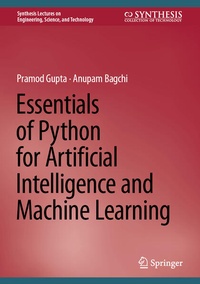
Essentials of Python for Artificial Intelligence and Machine Learning
Description

This book introduces the essentials of Python for the emerging fields of Machine Learning (ML) and Artificial Intelligence (AI). The authors explore the use of Python's advanced module features and apply them in probability, statistical testing, signal processing, financial forecasting, and various other applications. This includes mathematical operations with array data structures, Data Manipulation, Data Cleaning, machine learning, Data pipeline, probability density functions, interpolation, visualization, and other high-performance benefits using the core scientific packages NumPy, Pandas, SciPy, Sklearn/Scikit learn and Matplotlib. Readers will gain a deep understanding with problem-solving experience on these powerful platforms when dealing with engineering and scientific problems related to Machine Learning and Artificial Intelligence. Several examples of real problems using these techniques are provided along with examples. The authors also focus on the best practices in theindustry on using Python for AI and ML. Deployment on a cloud infrastructure is described in detail (with code) to emphasize real scenarios.
More details
Other editions
Additional editions
Persons
Pramod Gupta has more than 20 years of experience as a researcher and academician in various organizations including work with NASA, GE, VISA, and University of California and startups. He has a PhD from McMaster University in Electrical and Computer Engineering with specialization in Neuro-Control of Robotic Manipulators. He has more than 40 publications on these subjects. His research areas include, Neural Networks, Machine Learning, Artificial Intelligence, Data Modeling and Analytics and Data mining. Presently, he is working as adjunct faculty and independent data science consultant.
Anupam Bagchi has more than 20 years of experience working in the Silicon Valley in various roles. He has experience in big companies like IBM and Stanford, as well as start-ups that have produced cutting edge technologies. Though, most of his carrier has primarily been as a software engineer at various seniority levels, he has been working as an active data scientist for the past 10 years. His experience spans various domains such as XML parsing, content management, big data, ecommerce, internet of things (IoT), networking, artificial intelligence applied to bioinformatics and business intelligence applied to travel industry.
Content
Introduction.- Statistical Methods and Models.- Python Language Basics.- Introduction to Numpy.- Introduction to Pandas.- Data Manipulation With Pandas.- Data Visualization With Python.- Machine Learning.- Data Pipelines Using Python.- Mlops: Machine Learning Operations.
