

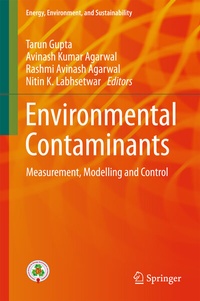
Environmental Contaminants
Description

This book addresses the measurement of environmental contaminants in water, air, and soil. It also presents modifications of and improvements to existing control technologies for remediation of environmental contaminants. It covers improved designs of wastewater systems and innovations in designing newer membranes for water treatment. In addition, it includes two separate sections on the modelling and control of different existing and emerging pollutants. It covers major topics such as: pharmaceutical wastes, paper and pulp waste, poly aromatic hydrocarbons, mining dust, bioaerosols, endosulphan, biomass combustion, and landfill design aspects. It also features chapters on environmental exposure and modelling of aerosol deposition within human lungs. The content of this book will be of interest to researchers, professionals, and policymakers whose work involves environmental contaminants and related solutions.
More details
Other editions
Additional editions
Persons
Dr Tarun Gupta , Professor and PK Kelkar Research Fellow at the Department of Civil Engineering, IIT Kanpur, India. He holds a Doctor of Science (2004) in Environmental Health, Harvard University (USA) and Master of Technology (2000), Environmental Science and Engineering, Indian Institute of Technology Bombay (9-month research stay at the TU Dresden, Germany). He has published more than 95 articles in ISI indexed journals, 4 book chapters, and filed 4 Indian patents. A submicron aerosol sampler designed, developed and evaluated at the IIT Kanpur has since been commercialized by Envirotech (Delhi). He has developed several low-flow-rate and high-flow-rate impaction-based samplers and a non-selective membrane-based diffusion denuder. He is a member of INYAS (2016), PK Kelkar Research Fellowship (2015), NASI Scopus Young Scientist (2015), INSA Young Scientist (2011), INAE Young Engineer (2009), and IEI Young Engineer (2008).
Prof. Avinash K Agarwal joined IIT Kanpur in 2001. His areas of interest are IC engines, combustion, alternative fuels, conventional fuels, optical diagnostics, laser ignition, HCCI, emission and particulate control, and large bore engines. He has published 230+ international journal and conference papers. Prof. Agarwal is a Fellow of SAE (2012), ASME (2013), ISEES (2015) and INAE (2015). He received several awards such as Prestigious Shanti Swarup Bhatnagar Award-2016 in Engineering Sciences, Rajib Goyal prize-2015, NASI-Reliance Industries Platinum Jubilee Award-2012; INAE Silver Jubilee Young Engineer Award-2012; SAE International's Ralph R. Teetor Educational Award-2008; INSA Young Scientist Award-2007; UICT Young Scientist Award-2007; INAE Young Engineer Award-2005.
Dr Rashmi Avinash Agarwal is a young scientist fellow at the Indian Institute of Technology Kanpur (IITK). She completed her doctoral degree at the IITK in 2014 with a dissertation on "Coordination Polymers of Transition Metal Ionswith Benzimidazole Based Ligands: Single-Crystal to Single-Crystal (SC-SC) Transformations, Gas Storage and Magnetic Studies". Her fields of interest include Supramolecular Chemistry, Coordination Chemistry, Coordination Polymers, Organic Synthesis, Inorganic Synthesis, Hydrothermal Synthesis of Coordination Polymers, Crystallization, and Crystal Structure Determination. She has published over 20 journal papers.
Dr Nitin Labhsetwar is a Professor at the AcSIR and Senior Principal Scientist & Head of the Energy & Resource Management Division at the CSIR-National Environmental Engineering Research Institute. He worked as a STA/JSPS Fellow and Visiting Overseas Researcher at NIMS, Tsukuba, Japan and Visiting Professor at Kyushu University, Japan. He has worked on the development of materials and processes including low-cost and nano-materials for their applications in energy and environmental contexts, vehicular emissions, photocatalysis, GHG emission control, cleaner energygeneration, heterogeneous catalyst etc. He has over 155 research publications, 22 international patents and 9 awards for excellence in research and various fellowships in India. He is a reviewer for more than ten SCI journals and is currently involved in more than 15 R&D projects.
