

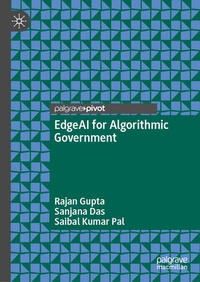
EdgeAI for Algorithmic Government
Description

The book provides various EdgeAI concepts related to its architecture, key performance indicators, and enabling technologies after introducing algorithmic government, large-scale decision-making, and computing issues in the cloud and fog. With advancements in technology, artificial intelligence has permeated our personal lives and the fields of economy, socio-culture, and politics. The integration of artificial intelligence (AI) into decision-making for public services is changing how governments operate worldwide. This book discusses how algorithms help the government in various ways, including virtual assistants for busy civil servants, automated public services, and algorithmic decision-making processes. In such cases, the implementation of algorithms will occur on a massive scale and possibly affect the lives of entire communities. The cloud-centric architecture of artificial intelligence brings out challenges of latency, overhead communication, and significant privacy risks. Due to the sheer volume of data generated by IoT devices, the data analysis must be performed at the forefront of the network. This introduces the need for edge computing in algorithmic government. EdgeAI, the confluence of edge computing and AI, is the primary focus of this book. It also discusses how one can incorporate these concepts in algorithmic government through conceptual framework and decision points. Finally, the research work emphasizes some design challenges in edge computing from applications viewpoint. This book will be helpful for data engineers, data scientists, cloud engineers, data management experts, public policymakers, administrators, research scholars and academicians.
More details
Other editions
Additional editions
Persons
Dr. Rajan Gupta is Vice President and Head of Research and Analytics Division at Analyttica Datalab, India, and has done Postdoc in Data Science and Modelling from CITAM Lab, UNG Slovenia. He has authored 4 books and more than 75 papers in the area of e-governance, algorithmic government, information systems, security and data science.
Ms. Sanjana Das is an AI enthusiast currently enrolled with Deen Dayal Upadhyaya College, University of Delhi, India, for research work. Her research area includes data science, edge computing, and artificial intelligence.
Dr. Saibal K. Pal is a Senior Scientist at Scientific Analysis Group, Defence Research & Development Organization (DRDO), Delhi. He has formerly served as Director of IT and Cyber Security at National Level for DRDO, India, and has authored more than 200 publications in the area of e-governance, algorithmic government, information systems, security and data science.
