

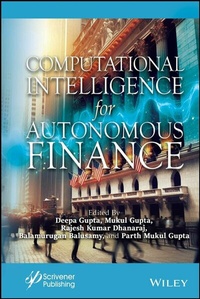
Computational Intelligence for Autonomous Finance
Description

Computational Intelligence for Autonomous Finance recognizes a new age of automatic civilization. The book is a seminal exploration of the dynamic domain of finances and banking. Designed to navigate the intricate interplay between emerging technologies and financial services, this book addresses both the profound opportunities and the intricate challenges that lie ahead. The genesis of this book lies in recognizing the new age of automatic civilization. Not only does it suit academic needs, but this book aims to inspire a new generation of practitioners to embrace the challenges and opportunities presented by autonomous finance.
Each chapter provides a unique lens for the potential of computational intelligence to revolutionize the market. The first section of this book talks about the transformative potential of computational intelligence in finance. The book systematically unfolds the multifaceted aspects of the revolution and provides insights into cutting-edge technologies that shape stock market strategies. In subsequent chapters, the book expands on its exploration of AI and the fintech industry. Delve into discussions of the ongoing evolution of financial technologies. The narrative then shifts towards more specialized applications of AI and ML in finance, with chapters dedicated to autonomous finance in microfinance along with the use of machine learning algorithms.
More details
Other editions
Additional editions
Persons
Deepa Gupta, PhD, is the Dean at GL Bajaj Institute of Management, Greater Noida, India. Her expertise extends to organized development, corporate relations, and international collaborations. Dr. Gupta is an active researcher who has published 15 national/international patents and has contributed more than 45 research papers to various international and national conferences and journals.
Mukul Gupta, PhD, is a principal at GL Bajaj Institute of Management, Greater Noida, India. His research focuses on consumer behavior to help understand the human-centric aspects of autonomous finance systems. He has published 12 national/international patents, more than 40 research papers, and authored books.
Rajesh Kumar Dhanaraj, PhD, is a professor at the School of Computing Science and Engineering at Galgotias University in India. He has authored/edited more than 25 books on various technologies, 21 patents, and 50+ articles and papers in various refereed journals and international conferences.
Balamurugan Balusamy, PhD, is an associate dean of students at Shiv Nadar University at the Delhi-NCR Campus in Noida, India. He has authored/edited more than 80 books and more than 200 contributions to international journals and conferences.
Parth Mukul Gupta, is an innovative entrepreneur and the director at Zarthcorp Tech Pvt. Ltd. and of the Shri Sai Memorial Foundation, Greater Noida, India. He has experience in brand building, organizational development, and global collaborations and spearheads advancements in autonomous finance through technological innovation and strategic growth initiatives.
Content
Preface xvii
1 The Role of Autonomous Finance in the Era of Automatic Civilization 1
Sanjeet Singh, Geetika Madaan and Jaskiran Kaur
1.1 Introduction 2
1.2 The Concept of Autonomous Finance 2
1.3 Autonomous Finance: Prospects and Developments 9
1.4 Key Considerations for Implementing Autonomous Finance 14
1.5 Conclusion 15
2 Analyzing the Latest Tools and Techniques for Stock Market Analysis 21
Ochin Sharma, Raj Gaurang Tiwari, Suvarna Sharma and Annu Priya
2.1 Introduction 21
2.2 Need for Trading Softwares 23
2.3 How Software for Technical Analysis of the Indian Stock Market Operates 23
2.4 Helpful Tools to Analyze Stock Market 24
2.5 Conclusion 39
3 Challenges and Security Issues in Autonomous Finance 43
Mukul Gupta, Deepa Gupta, Nitin Agrawal and Parth Mukul Gupta
3.1 Introduction 44
3.2 A Review of the Literature 45
3.3 Concerns Regarding the Protection of Identity and Privacy in Autonomous Finance 46
3.4 Using Algorithms to Make Decisions Can be Biased 49
3.5 Ensuring Fairness in Autonomous Finance 50
3.6 Compliance with Regulations in the Field of Autonomous Finance 51
3.7 Gaining an Understanding of the Fundamentals of Operational Risk 54
3.8 Risks Encountered in the Operation of Autonomous Finance 55
3.9 Concerns Regarding Ethical Issues in Autonomous Finance 57
3.10 Consumer Trust in Autonomous Finance 59
4 Involvement of Artificial Intelligence in Emerging Fintech Industry 4.0: A TCCM Framework 65
Annu and Ravindra Tripathi
4.1 Introduction 66
4.2 Data and Methodology 69
4.3 Results and Discussion 70
4.4 Finding, Conclusion, and Research Directions 76
4.5 Summary 77
5 Robotic Process Automation in the Financial Sector 81
Neha Sonik, Deepa Gupta and Parul Gupta
5.1 Introduction 81
5.2 How are Financial Institutions Making Use of Robotics and Automation? 83
5.3 Major Use Cases of Robotic Process Automation in Banking and Finance 84
5.4 Minding Gaps in Financial Process Automation 91
5.5 The Key Benefits of Finance Automation 92
5.6 A List of Accounting and Financial Services Companies That are Using RPA 95
5.7 Steps to Deploy RPA in Banking and Finance 97
5.8 Conclusion 99
6 Integration of Fintech with Data Science (DS) and Artificial Intelligence (AI): A Challenging Footstep 101
Ankur Goel, Monisha Awasthi, Anamika Rana and Sushma Malik
6.1 Introduction 102
6.2 Historical Background of Fintech 102
6.3 Advantages of Fintech 104
6.4 Role of Data Science and AI 108
6.5 Data Science and AI (DSAI) Making Smart Fintech 111
6.6 Use Cases of Data Science in Fintech 116
6.7 Conclusion 119
7 Evaluation of Fintech: The Techno-Functional Application in Digital Banking 123
Priyanka Verma, Rajesh Kumar Dhanaraj, Deepa Gupta and Mukul Gupta
7.1 Introduction 123
7.2 Overview of Fintech 124
7.3 Theoretical Overview 136
7.4 Measurement of the Success Factor of Fintech in Digital Banking 137
7.5 Summary 139
8 Real-Time Data Visualization and Autonomous Finance: Uses of Emerging Technologies 143
Govind Singh, Lokesh Verma and Anshika Baliyan
8.1 Introduction 144
8.2 Thriving in the Tech Age: How Businesses Adapt to Emerging Technologies 148
8.3 The Future of Work and Innovation: Emerging Technologies Transforming Businesses 151
8.4 Major Emerging Technologies in Finance 159
8.5 Risk Associated with Emerging Technologies 164
8.6 Conclusion 165
9 AI and ML Modeling and Autonomous Finance in Microfinance: An Overview 167
D. N. Rao and Maheswaran Mahalingam
9.1 Understanding Autonomous Finance and Microfinance 168
9.2 Readiness of MFIs for Autonomous Finance Transformation 170
9.3 Solution Drivers in the Life Cycle Journey of an MFI Customer 173
9.4 Readiness of MFIs for Autonomous Finance Operations 177
9.5 Technology and AI and ML Enablers of Autonomous Finance for MFIs 180
9.6 Critical Business Needs of Autonomous Finance 182
9.7 AI and ML Analytical Models for MFIs 182
9.8 Overall Deployment and Suitability 188
9.9 Roadmap for Autonomous Finance in MFIs 188
9.10 Stage-1: Operation Moonwalk 190
9.11 Stage 2-Operation Sun Shine 192
9.12 Stage 3 Operation Bloomsdale 193
9.13 Improvement Opportunities of Autonomous Finance for MFIs 193
9.14 Embracing Future AI Agents and Robotics of Autonomous Finance 195
10 Application of Machine Learning Models in the Field of Autonomous Finance 199
Umesh Gupta, Shriyash Saxena, Sachin Kumar Yadav and Aditya Bhardwaj
10.1 Overview 199
10.2 Introduction 201
10.3 Reinforcement Learning 203
10.4 Neural Network Basics 209
10.5 Management of Information for Credit Risk 213
10.6 Sentiment Analysis with Data Mining Approach 215
10.7 Conclusion 216
11 Machine Learning Algorithm in Indian Stock Market for Revising and Refining the Equity Valuation Models 221
Nitha K. P., Suraj E. S. and Ranjith Karat
11.1 Introduction 221
11.2 Objectives of the Study 223
11.3 Methodology 223
11.4 Review of Literature 225
11.5 Machine Learning for Equity Valuation Models 228
11.6 Architecture of Refined Equity Models 232
11.7 Analysis-Checking the Valuation Accuracy of Revised and Refined Models Using Machine Learning Approach 234
11.8 Conclusion 240
12 Hyper Automation and its Applicability in Automation Finance 243
Pushpendra Pal Singh, Rakesh Kumar Dixit and Rajesh Kumar Dhanaraj
12.1 Introduction 244
12.2 Background 245
12.3 Hyper Automation: Evolution, Technologies, and Impact in the Digital Era 247
12.4 Automation-(2)-Hyper Automation: Gartner 249
12.5 Could Hyper Automation be a Name for AI Plus RPA? 250
12.6 Sophistication of the Automation 252
12.7 Hyper Automation Process Flow 254
12.8 Banking and Finance Applications 260
12.9 Conclusions 264
13 Pre- and Post-COVID Autonomous Finance: Global Perspective 269
Shikha Singh, Deepa Gupta, Roshan Kumar and Balamurugan Balusamy
13.1 Introduction 270
13.2 Literature Review 271
13.3 Factors Behind the Digitalization of Financial Services During the COVID Pandemic 273
13.4 Challenges/Barriers for FinTech 279
13.5 Advantages and Disadvantages of Market Structure Modifications Towards the Digitalization of FinTech Services 280
13.6 Conclusion 283
14 Emerging Trends and Future Directions in Artificial Intelligence for Next-Generation Computing 289
Rafael Vargas-Bernal
14.1 Introduction 290
14.2 Concepts of Neuromorphic Computing, Artificial Intelligence, and Memristor 291
14.3 Advantages of Two-Dimensional Materials Used in Neuromorphic Computing 294
14.4 Devices Implemented with Two-Dimensional Materials to Evolve Artificial Intelligence 298
14.5 Future Research Directions 308
14.6 Summary 309
Acknowledgments 310
References 310
Index 313
