

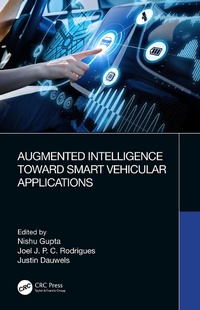
Augmented Intelligence Toward Smart Vehicular Applications
1st Edition
Published on 18. December 2020
224 pages
978-1-000-25995-7 (ISBN)
Description

This up-to-date reference discusses important concepts of vehicular communication in intelligent transportation systems. Augmented Intelligence Toward Smart Vehicular Applications begins by discussing key objectives of intelligent transport systems and vehicular ad-hoc networks (VANETs). It then goes on to discuss challenges, applications and future trends in VANETs. The text focuses on the organization of artificial intelligence (AI) and aspects of deep learning algorithms, particularly multimodal transport. This book will serve as an ideal reference for graduate students and academic researchers in the field of electrical engineering, electronics and communication engineering and transportation engineering.
Features
In-depth coverage of Internet of Things (IoT) in vehicular applications
Discussion on nn-vehicle sensor networks
Implementation of mobile IP and migration of IPv6
Focus on the need of AI in smart vehicular applications
Discussions on advanced concepts in the field of intelligent transport systems
Features
In-depth coverage of Internet of Things (IoT) in vehicular applications
Discussion on nn-vehicle sensor networks
Implementation of mobile IP and migration of IPv6
Focus on the need of AI in smart vehicular applications
Discussions on advanced concepts in the field of intelligent transport systems
More details
Edition
1. Auflage
Language
English
Place of publication
London
United Kingdom
Publishing group
Taylor & Francis Ltd
Target group
College/higher education
Professional and scholarly
Illustrations
24 Tables, black and white; 70 Illustrations, black and white
ISBN-13
978-1-000-25995-7 (9781000259957)
Copyright in bibliographic data and cover images is held by Nielsen Book Services Limited or by the publishers or by their respective licensors: all rights reserved.
Schweitzer Classification
Other editions
Additional editions
Nishu Gupta | Joel Rodrigues | Justin Dauwels
Augmented Intelligence Toward Smart Vehicular Applications
Book
10/2024
1st Edition
CRC Press
€70.20
Shipment within 15-20 days
Nishu Gupta | Joel Rodrigues | Justin Dauwels
Augmented Intelligence Toward Smart Vehicular Applications
Book
12/2020
1st Edition
CRC Press
€206.30
Shipment within 15-20 days
Persons
Nishu Gupta is currently working as an assistant professor, department of electronics and communication engineering at Vaagdevi College of Engineering, Warangal, India. He is specialized in the field of Communication and Networking. His major work is in the area of design and evaluation of MAC protocols to enhance safety applications in vehicular communication. He has published more than 32 research papers in journals of national and international repute. His research interest includes wireless communication, internet of things, internet of vehicles, autonomous vehicles, edge computing, augmented intelligence, vehicular communication, and cognitive radio Ad-hoc network.
Joel J. P. C. Rodrigues is a professor and senior researcher at the National Institute of Telecommunications (Inatel), Brazil and senior researcher at the Instituto de Telecomunicacoes, Portugal. He has been a professor at the University of Beira Interior (UBI), Portugal and visiting professor at the University of Fortaleza (UNIFOR), Brazil. His main research interests include the Internet of Things and Sensor networks, e-health, vehicular communications, and mobile and ubiquitous computing. He is the editor-in-chief of three reputed International Journals and editorial board member of several high-reputed journals (IEEE Communications Magazine, IEEE Wireless Communications, IEEE IoT Journal, IEEE ACCESS, etc.). He has authored or coauthored over 550 papers in refereed international journals and conferences, 3 books, and 2 patents.
Justin Dauwels is presently working as an associate professor of the School of Electrical and Electronic Engineering at the Nanyang Technological University (NTU) in Singapore. His research interests are in data analytics with applications to intelligent transportation systems, autonomous systems, and analysis of human behavior and physiology. He was a postdoctoral fellow at the RIKEN Brain Science Institute (2006-2007) and a research scientist at the Massachusetts Institute of Technology (2008-2010). He has been a JSPS postdoctoral fellow (2007), a BAEF fellow (2008), a Henri-Benedictus Fellow of the King Baudouin Foundation (2008), and a JSPS invited fellow (2010, 2011).
Joel J. P. C. Rodrigues is a professor and senior researcher at the National Institute of Telecommunications (Inatel), Brazil and senior researcher at the Instituto de Telecomunicacoes, Portugal. He has been a professor at the University of Beira Interior (UBI), Portugal and visiting professor at the University of Fortaleza (UNIFOR), Brazil. His main research interests include the Internet of Things and Sensor networks, e-health, vehicular communications, and mobile and ubiquitous computing. He is the editor-in-chief of three reputed International Journals and editorial board member of several high-reputed journals (IEEE Communications Magazine, IEEE Wireless Communications, IEEE IoT Journal, IEEE ACCESS, etc.). He has authored or coauthored over 550 papers in refereed international journals and conferences, 3 books, and 2 patents.
Justin Dauwels is presently working as an associate professor of the School of Electrical and Electronic Engineering at the Nanyang Technological University (NTU) in Singapore. His research interests are in data analytics with applications to intelligent transportation systems, autonomous systems, and analysis of human behavior and physiology. He was a postdoctoral fellow at the RIKEN Brain Science Institute (2006-2007) and a research scientist at the Massachusetts Institute of Technology (2008-2010). He has been a JSPS postdoctoral fellow (2007), a BAEF fellow (2008), a Henri-Benedictus Fellow of the King Baudouin Foundation (2008), and a JSPS invited fellow (2010, 2011).
Content
PART I - INTRODUCTION
CHAPTER 1: Augmented Intelligence and Edge Computing: Introduction and Trending Features
CHAPTER 2: Edge Computing and Embedded Storage
CHAPTER 3: Application of VANET to Avoid the Pedestrian Collision in Automotive Vehicles
PART II - DESIGNING AND EVALUATION
CHAPTER 4: Design of Platoon Controller with V2V Communication for Highways
CHAPTER 5: Using Computer Simulations for Quantifying Impact of Infrastructure changes for Autonomous Vehicles
CHAPTER 6: A Comprehensive Simulation Environment for Testing the Applications of a V2X Infrastructure
CHAPTER 7: A Novel Approach in Communication Security of Internet of Vehicle using the concept of Recurrence Relation and Symmetric Key
PART III - SMART SAFETY MEASURES AND APPLICATIONS
CHAPTER 8: Hybrid Data Structures for fast queuing operations in Vehicular Communication
CHAPTER 9: An IOT Based Accident Detection and Rescue System- A Prototype
CHAPTER 10: Intelligent Mobility for Minimizing the Traffic Incidents' Impact on Transportation Network
CHAPTER 1: Augmented Intelligence and Edge Computing: Introduction and Trending Features
CHAPTER 2: Edge Computing and Embedded Storage
CHAPTER 3: Application of VANET to Avoid the Pedestrian Collision in Automotive Vehicles
PART II - DESIGNING AND EVALUATION
CHAPTER 4: Design of Platoon Controller with V2V Communication for Highways
CHAPTER 5: Using Computer Simulations for Quantifying Impact of Infrastructure changes for Autonomous Vehicles
CHAPTER 6: A Comprehensive Simulation Environment for Testing the Applications of a V2X Infrastructure
CHAPTER 7: A Novel Approach in Communication Security of Internet of Vehicle using the concept of Recurrence Relation and Symmetric Key
PART III - SMART SAFETY MEASURES AND APPLICATIONS
CHAPTER 8: Hybrid Data Structures for fast queuing operations in Vehicular Communication
CHAPTER 9: An IOT Based Accident Detection and Rescue System- A Prototype
CHAPTER 10: Intelligent Mobility for Minimizing the Traffic Incidents' Impact on Transportation Network
