

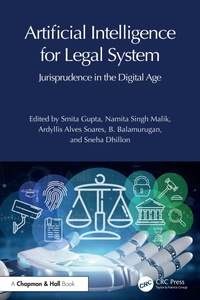
Artificial Intelligence for Legal System
Jurisprudence in the Digital Age
1st Edition
Published on 10. December 2025
216 pages
978-1-040-65379-1 (ISBN)
Description

Artificial intelligence and technological advancements are continuously transforming the discipline of law in contemporary times. This book offers practical insights to the reader as to how technology is influencing the judicial and criminal justice system throughout the world. It includes case studies explaining and depicting real time application of legal technological advancements from different countries.
* Examining how data-driven approaches, such as big data analytics and data mining, are revolutionizing legal practices, including legal research, case prediction, and decision support systems
* Investigating the use of artificial intelligence technologies, such as chatbots, virtual assistants, and document automation, in legal processes, including contract review, legal document drafting, and client interaction
* Exploring how blockchain technology is being implemented in areas such as smart contracts, evidence management, and secure data sharing, enhancing transparency, security, and efficiency in the legal field
* Addressing the ethical considerations and challenges associated with the use of AI in the legal profession, including issues of bias, privacy, accountability, and the need for ethical frameworks and guidelines
* Analyzing the potential influence of emerging technologies, such as quantum computing, internet of things (IoT), and augmented reality, on legal practices, court proceedings, and dispute resolution mechanisms
The book is useful for researchers, scholars and practitioners working in Law & Technology and Information Technology.
* Examining how data-driven approaches, such as big data analytics and data mining, are revolutionizing legal practices, including legal research, case prediction, and decision support systems
* Investigating the use of artificial intelligence technologies, such as chatbots, virtual assistants, and document automation, in legal processes, including contract review, legal document drafting, and client interaction
* Exploring how blockchain technology is being implemented in areas such as smart contracts, evidence management, and secure data sharing, enhancing transparency, security, and efficiency in the legal field
* Addressing the ethical considerations and challenges associated with the use of AI in the legal profession, including issues of bias, privacy, accountability, and the need for ethical frameworks and guidelines
* Analyzing the potential influence of emerging technologies, such as quantum computing, internet of things (IoT), and augmented reality, on legal practices, court proceedings, and dispute resolution mechanisms
The book is useful for researchers, scholars and practitioners working in Law & Technology and Information Technology.
More details
Edition
1. Auflage
Language
English
Place of publication
London
United Kingdom
Publishing group
Taylor & Francis Ltd
Target group
Professional and scholarly
Product notice
Reflowable
Illustrations
1 Tables, black and white; 12 Line drawings, black and white; 12 Illustrations, black and white
File size
2,54 MB
ISBN-13
978-1-040-65379-1 (9781040653791)
Copyright in bibliographic data and cover images is held by Nielsen Book Services Limited or by the publishers or by their respective licensors: all rights reserved.
Schweitzer Classification
Other editions
Additional editions
Smita Gupta | Namita Singh Malik | Ardyllis Alves Soares
Artificial Intelligence for Legal System
Jurisprudence in the Digital Age
Book
approx. 12/2025
1st Edition
Chapman & Hall/CRC
€176.90
Not yet published
Persons
Smita Gupta, PhD, is a Professor at School of law, Galgotias University She has a teaching experience of more than twenty years in interdisciplinary areas of law and social sciences. Her area of interest lies in exploring multifaced dimensions of law with special focus on associative links of sociological perspective. She believes that an interdisciplinary research and teaching will bring far ranging results in academic study of law and in placing lawyer as an social engineer. She has keen interest in exploring areas of socio-legal philosophy, Gender studies, AI & society etc.
Namita Singh Malik, PhD, is working as Professor at School of Law Galgotias University, India. She has nineteen years of experience in the field of Law. Her teaching and research interest lies in the area of Gender Studies, Criminal laws, Forensic Science, Law & Technology. She has more than 25 research paper presentation & publications.
Ardyllis Alves Soares
PhD and Master's Degree in Law from UFRGS, with a doctoral internship at Justus-Liebig-Universitaet Giessen - Germany. Post-Doctoral Internship in International Law from the University Center of Brasilia - CEUB (2019-2023). Specialist in International Law from UFRGS and in Business Law from IBMEC/RJ. Diplome d'Universite in European and French Contract Law from Universite de Savoie - France. He was a Legal Consultant to the Ministry of Justice/SENACON for the themes of Consumer and Tourism, hired by UNESCO, and Consumer Relations and Persons with Disabilities, hired by UNDP. Lawyer. He was a Legal Consultant to the UN Tourism for the themes of Latin American and Caribbean Tourism Law, hired by IDB.
B.Balamurugan completed Ph.D at VIT University, Vellore and currently working as a Professor in Galgotias University, Greater Noida, Uttar Pradesh. He has 15 years of teaching experience in the field of computer science. His area of interest lies in the field of Artificial Intelligence, Internet of Things, Big data, Networking. He has published more than 100 international journals papers and contributed book chapters.
Sneha Dhillon is an Assistant Professor of Law at Bharati Vidyapeeth (deemed to be) University, New Law College, Pune. She works on technology-related legal issues, especially how artificial intelligence affects society, individual rights and the justice system. Her research covers topics like dating apps and algorithms, LGBTQ+ representation in digital media, intellectual property and the delays in arbitration processes. As the editor of this book on Artificial Intelligence for Legal System, she brings a practical and thoughtful approach to understanding how new technologies are shaping legal thinking and everyday life.
Namita Singh Malik, PhD, is working as Professor at School of Law Galgotias University, India. She has nineteen years of experience in the field of Law. Her teaching and research interest lies in the area of Gender Studies, Criminal laws, Forensic Science, Law & Technology. She has more than 25 research paper presentation & publications.
Ardyllis Alves Soares
PhD and Master's Degree in Law from UFRGS, with a doctoral internship at Justus-Liebig-Universitaet Giessen - Germany. Post-Doctoral Internship in International Law from the University Center of Brasilia - CEUB (2019-2023). Specialist in International Law from UFRGS and in Business Law from IBMEC/RJ. Diplome d'Universite in European and French Contract Law from Universite de Savoie - France. He was a Legal Consultant to the Ministry of Justice/SENACON for the themes of Consumer and Tourism, hired by UNESCO, and Consumer Relations and Persons with Disabilities, hired by UNDP. Lawyer. He was a Legal Consultant to the UN Tourism for the themes of Latin American and Caribbean Tourism Law, hired by IDB.
B.Balamurugan completed Ph.D at VIT University, Vellore and currently working as a Professor in Galgotias University, Greater Noida, Uttar Pradesh. He has 15 years of teaching experience in the field of computer science. His area of interest lies in the field of Artificial Intelligence, Internet of Things, Big data, Networking. He has published more than 100 international journals papers and contributed book chapters.
Sneha Dhillon is an Assistant Professor of Law at Bharati Vidyapeeth (deemed to be) University, New Law College, Pune. She works on technology-related legal issues, especially how artificial intelligence affects society, individual rights and the justice system. Her research covers topics like dating apps and algorithms, LGBTQ+ representation in digital media, intellectual property and the delays in arbitration processes. As the editor of this book on Artificial Intelligence for Legal System, she brings a practical and thoughtful approach to understanding how new technologies are shaping legal thinking and everyday life.
Content
1. Artificial Intelligence in the Realm of Justice: Revisit to the Jurisprudential Notions of Justice 2. Safeguarding Personal Data and Privacy (PDP) in The Era of Artificial Intelligence (Ai) Through The Human Rights Lens: Exploring Legal Hurdles And Policy Implications 3. Liability in the Age of AI: Perspectives on Criminal and Civil Responsibility for AI-Induced Harm 4. Constitutional Echoes in the Age of Artificial Intelligence: Bridging Literature, Law, and Technology 5. Enhancing Legal Research Engagement with ChatGPT: An AI Tool Perspective 6. Responsible Application of Artificial Intelligence in the State: The Case of Chile 7. Uncover the Potential of Artificial Intelligence in Legal System Flaking Crime Prevention: Breakthrough New Tools for Law Enforcement in the Digital- Futuristic Arena 8. The Watchful Eye: Exploring Artificial Intelligence as the Contemporary Panopticon in the Criminal Justice System 9. A Small But Digital Step in Cross-Border Judicial Cooperation of EU Member States 10. A Few Critical People to Handle the Truth: AI, Hallucinations and the Labour of Law Clerks 11. Algorithmic Democracy: Exploring The Impact Of Artificial Intelligence on Elections in India - A Case Study in Odisha & West Bengal 12. Justice in the Digital Age: Popular Culture and the Rise of AI-Powered Legal Decision-Making 13. The Intersection of Artificial Intelligence and Procedural Laws: Reimagining Justice in the Digital Era 14. Utility and Efficiency of Ai-Driven Legal System: Illustrations Around The Globe
