

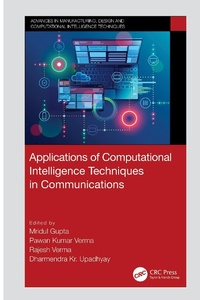
Applications of Computational Intelligence Techniques in Communications
1st Edition
Published on 3. November 2023
210 pages
978-1-000-98361-6 (ISBN)
Description

The book titled "Applications of Computational Intelligence Techniques in Communications" is a one-stop platform for the researchers, academicians, and people from industry to get a thorough understanding of the latest research in the field of communication engineering. Over the past decade, a manyfold increase in the use of computational intelligence techniques has been identified for obtaining the most optimal and timely solution to a problem. The various aspects covering the significant contribution of numerous computational intelligence techniques have been discussed in detail in this book.
Today's era of machine learning and Internet of Things (IoT) is demanding as high as possible data rate which has resulted into tremendous increased speed of communication. To match-up the pace, the computational intelligence is posing to be the most efficient and favourite tool. The book aims to cover the current technological advancements in the field of communication engineering and give a detailed prospect of computational intelligence to its readers.
This book will be a great support to the people working in the field of IoT, machine learning, healthcare, optimization, filter design, 5G and beyond, signal processing etc. The chapters included here will expose its audience to various newly introduced and advanced computational intelligence techniques applicable in communication domain. The readers will be exposed multiple interdisciplinary areas of research in communication and will get the motivation to work in collaboration with other professionals from both the academia and industry.
Today's era of machine learning and Internet of Things (IoT) is demanding as high as possible data rate which has resulted into tremendous increased speed of communication. To match-up the pace, the computational intelligence is posing to be the most efficient and favourite tool. The book aims to cover the current technological advancements in the field of communication engineering and give a detailed prospect of computational intelligence to its readers.
This book will be a great support to the people working in the field of IoT, machine learning, healthcare, optimization, filter design, 5G and beyond, signal processing etc. The chapters included here will expose its audience to various newly introduced and advanced computational intelligence techniques applicable in communication domain. The readers will be exposed multiple interdisciplinary areas of research in communication and will get the motivation to work in collaboration with other professionals from both the academia and industry.
More details
Series
Edition
1. Auflage
Language
English
Place of publication
London
United Kingdom
Publishing group
Taylor & Francis Ltd
Target group
College/higher education
Illustrations
27 Tables, black and white; 60 Line drawings, black and white; 4 Halftones, black and white; 64 Illustrations, black and white
ISBN-13
978-1-000-98361-6 (9781000983616)
Copyright in bibliographic data and cover images is held by Nielsen Book Services Limited or by the publishers or by their respective licensors: all rights reserved.
Schweitzer Classification
Other editions
Additional editions
idul Gupta | Pawan Kumar Verma | Rajesh Verma
Applications of Computational Intelligence Techniques in Communications
Book
06/2025
1st Edition
CRC Press
€76.20
Shipment within 10-20 days
idul Gupta | Pawan Kumar Verma | Rajesh Verma
Applications of Computational Intelligence Techniques in Communications
Book
11/2023
1st Edition
CRC Press
€140.30
Shipment within 10-20 days
Persons
Dr. Mridul Gupta passed his B. Tech in Electronics and communication Engineering in the year 2010 from Uttarakhand Technical University, Uttarakhand, India. He received his M-Tech degree from Motilal Nehru National Institute of Technology, Allahabad, India in the year 2015 and Ph.D. degree from Netaji Subhas Institute of Technology, University of Delhi, India in 2021. He is currently working as an Assistant Professor with Graphic Era Deemed to be University, Dehradun, India. He has published more than 12 research articles in various peer reviewed international journals and conferences. He has also served as a reviewer for some reputed international journals like IEEE Transactions on Microwave Theory and Techniques; Microwaves, Antennas and Wave Propagation, IET; Electronics letters, IET; Microwave and Optical Technology Letters, Wiley; Chaos, Solitons & Fractals, Elsevier. His research areas include optimization techniques, signal processing, fractional-order systems and microwave circuits.
Dr. Pawan Kumar Verma received his B.E. degree in Electronics and Communication from the Agra University, India, and M. Tech. degree in VLSI Design from the C-DAC, Mohali, India in 2005 and 2009 respectively. He has worked as a consultant for 2 years at the Cadence Design Systems, Noida, India. He was a Visiting Research Scholar at the University of Waterloo, Canada during April 2012 up to October 2012. He has completed his PhD from the Motilal Nehru National Institute of Technology, Allahabad, India in December, 2016. Currently, he is working as an Assistant Professor at National Institute of Technology, Jalandhar, India. His main research interests are M2M communications, Internet-of-Things, MANETs, VANETs, wireless networks and mobile computing.
Dr. Rajesh Verma is currently an Associate Professor in the Department of Electrical Engineering at the King Khalid University, Abha, KSA. He completed his B.E., M.E. and PhD in Electronics and Communication Engineering from MNNIT, Prayagraj in 1994, 2001 and 2011 respectively. He has work experience of more than 20 years of teaching and administration at many reputed institutes in India including MNNIT-Prayagraj and many others. He also worked in Telecom industry for 4 years at New delhi, India. His research interests include computer network, MAC protocols, wireless and mobile communication systems, sensor networks, peer-to-peer networks, M-2-M Networks.
Prof. Dharmendra Upadhyay is a Professor in the Department of Electronics and Communication Engineering, Netaji Subhas University of Technology, New Delhi, India. Prof. Upadhyay has guided 6 Ph.D. theses and 36 M. Tech. theses. He has published more than 80 research papers in reputed International Journals (41), Proceedings of International Conferences (42), and Book Chapters. He is a life member of ISTE. His research interests include Analog/Digital/Mixed Signal Processing and Antenna Designs.
Google Scholar Page: https://scholar.google.co.in/citations?user=fotlUiQAAAAJ&hl=en
Dr. Pawan Kumar Verma received his B.E. degree in Electronics and Communication from the Agra University, India, and M. Tech. degree in VLSI Design from the C-DAC, Mohali, India in 2005 and 2009 respectively. He has worked as a consultant for 2 years at the Cadence Design Systems, Noida, India. He was a Visiting Research Scholar at the University of Waterloo, Canada during April 2012 up to October 2012. He has completed his PhD from the Motilal Nehru National Institute of Technology, Allahabad, India in December, 2016. Currently, he is working as an Assistant Professor at National Institute of Technology, Jalandhar, India. His main research interests are M2M communications, Internet-of-Things, MANETs, VANETs, wireless networks and mobile computing.
Dr. Rajesh Verma is currently an Associate Professor in the Department of Electrical Engineering at the King Khalid University, Abha, KSA. He completed his B.E., M.E. and PhD in Electronics and Communication Engineering from MNNIT, Prayagraj in 1994, 2001 and 2011 respectively. He has work experience of more than 20 years of teaching and administration at many reputed institutes in India including MNNIT-Prayagraj and many others. He also worked in Telecom industry for 4 years at New delhi, India. His research interests include computer network, MAC protocols, wireless and mobile communication systems, sensor networks, peer-to-peer networks, M-2-M Networks.
Prof. Dharmendra Upadhyay is a Professor in the Department of Electronics and Communication Engineering, Netaji Subhas University of Technology, New Delhi, India. Prof. Upadhyay has guided 6 Ph.D. theses and 36 M. Tech. theses. He has published more than 80 research papers in reputed International Journals (41), Proceedings of International Conferences (42), and Book Chapters. He is a life member of ISTE. His research interests include Analog/Digital/Mixed Signal Processing and Antenna Designs.
Google Scholar Page: https://scholar.google.co.in/citations?user=fotlUiQAAAAJ&hl=en
Content
1. An Introduction to Swarm Intelligence in Communication. 2. Applications of computational intelligence in societal welfare. 3. Computational Intelligence in Cell Level Healthcare Application. 4. Efficient and Robust Digital Notch Filter implementation Employing Wave Digital Structure. 5. Computationally Efficient Fractional-order Filters. 6. Applications of Reinforcement Learning in the Physical Layer of Wireless Communication. 7. Computational Intelligence in MAC layer protocols of mmWave (5G and beyond) V2X Communication. 8. Design of Smart Sensor-based Insole for Analyzing Gait Parameters of Patients with Knee Arthroplasty. 9. Evaluation of Female Facial Attractiveness and Smile Esthetics using Eye Tracking System: A Photographic Study. 10. IoT-based WBAN: A Survey on Classification and Channel Access Techniques. 11. Internet of Things: Classification, Challenges, and Their Solutions. 12. Cloud-based Ecosystem of IoMT
