

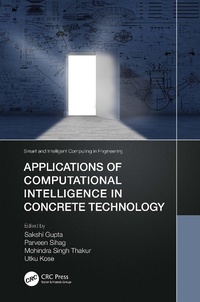
Applications of Computational Intelligence in Concrete Technology
1st Edition
Published on 23. June 2022
320 pages
978-1-000-60054-4 (ISBN)
Description

Computational intelligence (CI) in concrete technology has not yet been fully explored worldwide because of some limitations in data sets. This book discusses the selection and separation of data sets, performance evaluation parameters for different types of concrete and related materials, and sensitivity analysis related to various CI techniques. Fundamental concepts and essential analysis for CI techniques such as artificial neural network, fuzzy system, support vector machine, and how they work together for resolving real-life problems, are explained.
Features:
It is the first book on this fast-growing research field.
It discusses the use of various computation intelligence techniques in concrete technology applications.
It explains the effectiveness of the methods used and the wide range of available techniques.
It integrates a wide range of disciplines from civil engineering, construction technology, and concrete technology to computation intelligence, soft computing, data science, computer science, and so on.
It brings together the experiences of contributors from around the world who are doing research in this field and explores the different aspects of their research.
The technical content included is beneficial for researchers as well as practicing engineers in the concrete and construction industry.
Features:
It is the first book on this fast-growing research field.
It discusses the use of various computation intelligence techniques in concrete technology applications.
It explains the effectiveness of the methods used and the wide range of available techniques.
It integrates a wide range of disciplines from civil engineering, construction technology, and concrete technology to computation intelligence, soft computing, data science, computer science, and so on.
It brings together the experiences of contributors from around the world who are doing research in this field and explores the different aspects of their research.
The technical content included is beneficial for researchers as well as practicing engineers in the concrete and construction industry.
More details
Series
Edition
1. Auflage
Language
English
Place of publication
London
United Kingdom
Publishing group
Taylor & Francis Ltd
Target group
College/higher education
Professional and scholarly
Illustrations
85 Tables, black and white; 142 Line drawings, color; 1 Line drawings, black and white; 142 Illustrations, color; 1 Illustrations, black and white
ISBN-13
978-1-000-60054-4 (9781000600544)
Copyright in bibliographic data and cover images is held by Nielsen Book Services Limited or by the publishers or by their respective licensors: all rights reserved.
Schweitzer Classification
Other editions
Additional editions
Sakshi Gupta | Parveen Sihag | Mohindra Singh Thakur
Applications of Computational Intelligence in Concrete Technology
Book
08/2024
1st Edition
CRC Press
€72.90
Shipment within 10-20 days
Sakshi Gupta | Parveen Sihag | Mohindra Singh Thakur
Applications of Computational Intelligence in Concrete Technology
Book
06/2022
1st Edition
CRC Press
€186.70
Shipment within 10-20 days
Persons
Miss Sakshi Gupta is Assistant Professor in the Department of Civil Engineering, Amity School of Engineering & Technology, Amity University Haryana. She is pursuing PhD from Indian Institute of Technology Delhi, India and has completed M.Tech in Structural Engineering from National Institute of Technology, Kurukshetra, India in the year 2013 and B.Tech from MD University, Rohtak, Haryana, India in 2011. Her areas of interest include building information modeling, concrete technology, sustainable construction, construction technology & management, computation intelligence techniques, and soft computing techniques in civil engineering applications. She is the reviewer and editorial board member of many scientific journals. She has published more than 30 papers in reputed international and national journals and attended various conferences. She had also authored many books and book chapters in Elsevier & Springer.
Dr. Parveen Sihag is presently working as Assistant Professor in Chandigarh University, India. He has completed B. Tech in Civil Engineering, M. Tech in Water Resources Engineering and Ph.D. in civil Engineering Department, National Institute of Technology, Kurukshetra, India. The area of interests is Hydrology, Infiltration, soft computing and optimization. He has published more than 70 research papers in conferences and journals.
Dr. M.S.Thakur has been working as Professor in Department of Civil Engineering, Shoolini University, Solan HP India since 2015. He obtained his B.E..(Civil) from Punjab Engineering College Chandigarh (1980), M.Tech. (Structures) from IIT Bombay (1988) and PhD from Stevens Institute of Technology (2002), Hoboken, New Jersey USA. He has published papers in many international conferences and journals. He is not only an academician but is also an engineer having worked with last posting as Engineer-in Chief in HP Public Works Department in 2015.
Dr. Utku Kose received the B.S. degree in 2008 from computer education of Gazi University, Turkey as a faculty valedictorian. He received M.S. degree in 2010 from Afyon Kocatepe University, Turkey in the field of computer and D.S. / Ph. D. degree in 2017 from Selcuk University, Turkey in the field of computer engineering. Currently, he is an Associate Professor in Suleyman Demirel University, Turkey. He has more than 100 publications including articles, authored and edited books, proceedings, and reports. He is also in editorial boards of many scientific journals and serves as one of the editors of the Biomedical and Robotics Healthcare book series by CRC Press. His research interest includes artificial intelligence, machine ethics, artificial intelligence safety, biomedical applications, optimization, the chaos theory, distance education, e-learning, computer education, and computer science.
Dr. Parveen Sihag is presently working as Assistant Professor in Chandigarh University, India. He has completed B. Tech in Civil Engineering, M. Tech in Water Resources Engineering and Ph.D. in civil Engineering Department, National Institute of Technology, Kurukshetra, India. The area of interests is Hydrology, Infiltration, soft computing and optimization. He has published more than 70 research papers in conferences and journals.
Dr. M.S.Thakur has been working as Professor in Department of Civil Engineering, Shoolini University, Solan HP India since 2015. He obtained his B.E..(Civil) from Punjab Engineering College Chandigarh (1980), M.Tech. (Structures) from IIT Bombay (1988) and PhD from Stevens Institute of Technology (2002), Hoboken, New Jersey USA. He has published papers in many international conferences and journals. He is not only an academician but is also an engineer having worked with last posting as Engineer-in Chief in HP Public Works Department in 2015.
Dr. Utku Kose received the B.S. degree in 2008 from computer education of Gazi University, Turkey as a faculty valedictorian. He received M.S. degree in 2010 from Afyon Kocatepe University, Turkey in the field of computer and D.S. / Ph. D. degree in 2017 from Selcuk University, Turkey in the field of computer engineering. Currently, he is an Associate Professor in Suleyman Demirel University, Turkey. He has more than 100 publications including articles, authored and edited books, proceedings, and reports. He is also in editorial boards of many scientific journals and serves as one of the editors of the Biomedical and Robotics Healthcare book series by CRC Press. His research interest includes artificial intelligence, machine ethics, artificial intelligence safety, biomedical applications, optimization, the chaos theory, distance education, e-learning, computer education, and computer science.
Content
1. Usage of Computational Intelligence Techniques in Concrete Technology, 2. Developing Random Forest Random Tree and Linear Regression Model to Predict Compressive Strength of Concrete Using Glass Fiber, 3. Prediction of Compressive Strength at Elevated Temperatures Using Machine Learning Methods, 4. Implementation of Machine Learning Approaches to Evaluate Flexural Strength of Concrete With Glass Fiber, 5. A Comparative Study Using ANFIS and ANN for Determining the Compressive Strength of Concrete, 6. Prediction of Concrete Mix Compressive Strength Using Waste Marble Powder: A Comparison of ANN, RF, RT, and LR models, 7. Using GA to Predict the Compressive Strength of Concrete Containing Nano-Silica, 8. Evaluation of Models by Soft Computing Techniques for the Prediction of Compressive Strength of Concrete Using Steel Fibre, 9. Using Regression Model to Estimate the Splitting Tensile Strength for the Concrete With Basalt Fiber Reinforced Concrete, 10. Prediction of Compressive Strength of Self-Compacting Concrete Containing Silica's Using Soft Computing Techniques, 11. Using Soft Computing Techniques to Predict the Values of Compressive Strength of Concrete with Basalt Fiber Reinforced Concrete, 12. Soft Computing-Based Prediction of Compressive Strength of High Strength Concrete, 13. Forecasting Compressive Strength of Concrete Containing Nano-Silica Using Particle Swarm Optimization Algorithm and Genetic Algorithm, 14. Prediction of Ultrasonic Pulse Velocity of Concrete, 15. Evaluation of ANN and Tree-Based Techniques for Predicting the Compressive Strength of Granite Powder Reinforced Concrete, 16. Predicting Recycled Aggregates Compressive Strength in High-Performance Concrete Using Artificial Neural Networks, 17. Compressive Strength Prediction and Analysis of Concrete Using Hybrid Artificial Neural Networks
