

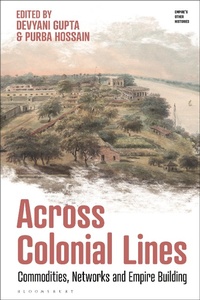
Across Colonial Lines
Commodities, Networks and Empire Building
1st Edition
Published on 9. February 2023
256 pages
978-1-350-32703-0 (ISBN)
Description

Across Colonial Lines takes a multi-perspective approach to the study of empire and commodities, and encourages readers to look at commodity histories in alternative spatial and temporal contexts. It offers a comparative understanding of commodities in the Venetian, Portuguese, Dutch, French and British Empires.
Highlighting the interwoven character of multiple commodity networks, this book situates commodities like gold, coffee, tea and indigo, to name a few, within pre-existing networks of labour, consumption and knowledge production. It explores the nexus between the local and the global, and highlights the role played by individual producers, petty traders, sailors and even consumers in creating regional circulations within a global political economy. In this volume, commodity networks are not just sites of production and trade, but also of political control, social organisation and consumption choices. They provide the impetus for globalisation from as early as the thirteenth century.
Each chapter takes an individual commodity to illustrate the history of commodity transmission within imperial contexts. From early modern Venetian commerce to the trade networks of the Eurasian world; from the trading ambitions of British sailors to Portuguese global imperial ambitions; from the cross-imperial knowledge networks of indigo to the assertion of indigenous agency in Angola; and from the commodification of labour to the experience of tourism in the Caribbean and Indian Ocean World, Across Colonial Lines uses commodity networks as a lens to study empire building across varied yet connected geographies and chronologies.
Highlighting the interwoven character of multiple commodity networks, this book situates commodities like gold, coffee, tea and indigo, to name a few, within pre-existing networks of labour, consumption and knowledge production. It explores the nexus between the local and the global, and highlights the role played by individual producers, petty traders, sailors and even consumers in creating regional circulations within a global political economy. In this volume, commodity networks are not just sites of production and trade, but also of political control, social organisation and consumption choices. They provide the impetus for globalisation from as early as the thirteenth century.
Each chapter takes an individual commodity to illustrate the history of commodity transmission within imperial contexts. From early modern Venetian commerce to the trade networks of the Eurasian world; from the trading ambitions of British sailors to Portuguese global imperial ambitions; from the cross-imperial knowledge networks of indigo to the assertion of indigenous agency in Angola; and from the commodification of labour to the experience of tourism in the Caribbean and Indian Ocean World, Across Colonial Lines uses commodity networks as a lens to study empire building across varied yet connected geographies and chronologies.
More details
Series
Edition
1. Auflage
Language
English
Place of publication
London
United Kingdom
Publishing group
Bloomsbury Publishing PLC
Target group
Professional and scholarly
Illustrations
10 bw illus
ISBN-13
978-1-350-32703-0 (9781350327030)
Copyright in bibliographic data and cover images is held by Nielsen Book Services Limited or by the publishers or by their respective licensors: all rights reserved.
Schweitzer Classification
Other editions
Additional editions
Book
08/2024
Bloomsbury Academic
€55.89
Shipment within 15-20 days
Persons
Devyani Gupta is Associate Professor at Jindal Global University, India, and a Leverhulme Early Career Fellow at University of Leeds, UK. She has held fellowships awarded by the Leverhulme Trust and Volkswagen Stiftung, and has taught at the Universities of Delhi, India, California, USA, and Leeds, UK.
Purba Hossain is Economic History Society Tawney Fellow at the Institute of Historical Research London, UK, and a Visiting Research Fellow at the University of Leeds, UK. She received her PhD from Leeds University, UK, and is a recipient of the Royal Historical Society Marshall Fellowship.
Purba Hossain is Economic History Society Tawney Fellow at the Institute of Historical Research London, UK, and a Visiting Research Fellow at the University of Leeds, UK. She received her PhD from Leeds University, UK, and is a recipient of the Royal Historical Society Marshall Fellowship.
Content
List of Illustrations
List of Contributors
Commodities, Networks and Empire Building: An Introduction, Devyani Gupta (O. P. Jindal Global University, India) and Purba Hossain (University of Cambridge, UK)
1. From Commodity Trade to 'Virtual' Empire: Venice in the Twelfth to Fifteenth Centuries, Andrew Blackler (University of Birmingham, UK)
2. West Africa, the Akan Gold Trade and Portugal's Global Ambitions in the Sixteenth Century, Edmond Smith (University of Manchester, UK)
3. Tea and Empire in the Asian Interior, c. 1750-1900, Jagjeet Lally (University College London, UK)
4. Sailors as Traders: Early Modern Seafarers in Commodity Chains, Commercial Practices and Empire, Richard J. Blakemore (University of Reading, UK)
5. The Social Locations of Colonial Knowledge: Indigo in Bengal, Java and Senegal, Willem van Schendel (University of Amsterdam, Netherlands)
6. What Angolans Got for their Coffee: Connecting Histories of Labour and Consumption in Colonial Africa, c. 1860-1960, Jelmer Vos (University of Glasgow, UK)
7. 'Docile, quiet, orderly': Indian Indenture Trade and the Ideal Labourer, Purba Hossain (University of Cambridge, UK)
8. Globalization Gothic: Unpacking the Commodity Fetish in Caribbean Tourism, Lowell Woodcock (Sussex Centre for World Environmental History, UK)
Conclusion: The Chains of Empire: Some Thoughts on Commodity History as Method, Erika Rappaport (University of California Santa Barbara, USA)
Bibliography
Index
List of Contributors
Commodities, Networks and Empire Building: An Introduction, Devyani Gupta (O. P. Jindal Global University, India) and Purba Hossain (University of Cambridge, UK)
1. From Commodity Trade to 'Virtual' Empire: Venice in the Twelfth to Fifteenth Centuries, Andrew Blackler (University of Birmingham, UK)
2. West Africa, the Akan Gold Trade and Portugal's Global Ambitions in the Sixteenth Century, Edmond Smith (University of Manchester, UK)
3. Tea and Empire in the Asian Interior, c. 1750-1900, Jagjeet Lally (University College London, UK)
4. Sailors as Traders: Early Modern Seafarers in Commodity Chains, Commercial Practices and Empire, Richard J. Blakemore (University of Reading, UK)
5. The Social Locations of Colonial Knowledge: Indigo in Bengal, Java and Senegal, Willem van Schendel (University of Amsterdam, Netherlands)
6. What Angolans Got for their Coffee: Connecting Histories of Labour and Consumption in Colonial Africa, c. 1860-1960, Jelmer Vos (University of Glasgow, UK)
7. 'Docile, quiet, orderly': Indian Indenture Trade and the Ideal Labourer, Purba Hossain (University of Cambridge, UK)
8. Globalization Gothic: Unpacking the Commodity Fetish in Caribbean Tourism, Lowell Woodcock (Sussex Centre for World Environmental History, UK)
Conclusion: The Chains of Empire: Some Thoughts on Commodity History as Method, Erika Rappaport (University of California Santa Barbara, USA)
Bibliography
Index
