

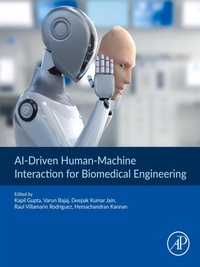
AI-Driven Human-Machine Interaction for Biomedical Engineering
Concepts, Applications, and Methodologies
Published on 22. April 2026
250 pages
978-0-443-44639-9 (ISBN)
Description

AI-Driven Human-Machine Interaction for Biomedical Engineering: Concepts, Applications, and Methodologies offers a comprehensive examination of the intricate relationship between humans and machines, particularly through the transformative lens of artificial intelligence (AI). As AI technologies rapidly evolve, understanding their implications for human-machine interaction (HMI) has become essential across various domains, especially healthcare. Structured into well-defined chapters, the book begins with an introduction to AI-driven HMI, laying the groundwork for understanding its significance in sustainable healthcare and beyond. Subsequent chapters explore critical topics such as machine learning principles, advanced biomedical data classification methods, and the role of AI in telemedicine.Readers will delve into cutting-edge techniques, from deep learning to non-invasive computer vision, while also examining the implications of these technologies across industries. Each chapter equips readers with actionable insights and highlights emerging trends, ethical considerations, and the future of AI in HMI, ensuring a well-rounded perspective on this dynamic field. This is an invaluable resource for researchers, academics, and students in the fields of Biomedical Engineering, Computer Science, Data Science, Artificial Intelligence, and Healthcare Technology.
- Offers practical insights into AI-driven methodologies for enhanced human-machine collaboration in healthcare and beyond
- Provides foundational knowledge of machine learning principles applicable across diverse industries
- Equips readers with cutting-edge techniques for biomedical data classification and analysis
- Addresses ethical considerations and emerging trends in AI applications for informed decision-making
- Facilitates innovation by bridging theoretical concepts with real-world applications in human-machine interaction
More details
Other editions
Additional editions
Kapil Gupta | Varun Bajaj | Deepak Kumar Jain
AI-Driven Human-Machine Interaction for Biomedical Engineering
Concepts, Applications, and Methodologies
Book
approx. 05/2026
Academic Press
€166.50
Not yet published
Content
1. Basics, Constraints, and Future Potential of Machine Learning in HMI2. Human-Computer Interaction for Cardiac Feedback: A Physics-Guided Deep Learning Approach3. Classification of Steady State Visual Evoked Potentials in Brain-Computer Interface systems using Python4. Contactless Vital Sign Monitoring Through Intelligent Human-Machine Interaction (HMI): A Systematic Review of Image- and Video-Based Techniques5. AI-driven Scalable Software Architecture for Enhancing Human-Machine Interaction in Biomedical Data Ecosystems6. AI-Driven Depression Detection Using EEG Signal Determinants and MTO7. EEG-Driven Machine Learning for Recognition of Emergency Numbers for Crisis Readiness: A Translational Study8. Suppression of Artifacts from EEG Signals using Quadratic Relative Error based LMS (QRE-LMS) Algorithm9. Two-Stage Verification for Multi-Instance Feature Selection in Dental Anomaly Detection: A CNN-GRU Approach with Explainable AI and Optimization Techniques10. Performance Evaluation of Vision Transformers for AI-driven Diagnosis of Bleeding Detection in Wireless Endoscopy Bleeding11. Human Machine Interface In Healthcare Imaging And Medical Treatments12. State-of-the-art methods for diagnosis of acute leukemia: A survey13. Optimized Feature Subsets for Characterizing Fetal QRS Complexes in Non-Invasive Abdominal ECG Recordings14. Multimodal AI in Human-Computer Interaction: Transforming Medical Feedback Delivery15. Computer Vision for AI-Driven Human-Machine Interaction and Enhanced Diagnosis16. Human-Machine Interaction in AI-Assisted Medical Diagnosis: Challenges and Future Directions
