

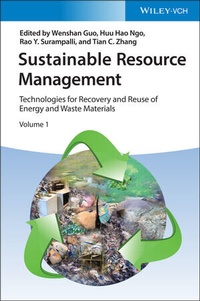
Sustainable Resource Management
Technologies for Recovery and Reuse of Energy and Waste Materials
1st Edition
Published on 8. April 2021
832 pages
978-3-527-82537-0 (ISBN)
Description

Elucidates basic scientific principles and technological advances of current practical technologies for resource recovery from waste generated.
More details
Other editions
Additional editions
Wenshan Guo | Huu Hao Ngo | Rao Y. Surampalli
Sustainable Resource Management
Technologies for Recovery and Reuse of Energy and Waste Materials
Book
04/2021
1st Edition
Wiley-VCH
€379.00
Shipment within 5-7 days
Persons
Dr Wenshan Guo is currently Professor at University of Technology Sydney (UTS). She is also a core member in Centre for Technology in Water and Wastewater (CTWW) at UTS. Her current research is in the areas of green technologies for resource and energy recovery, waste-to-energy, water-waste-energy nexus and climate change mitigation.
Dr Huu Hao Ngo is Professor of Environmental Engineering and serving as Deputy Director of Centre for Technology in Water and Wastewater, Co-Director of Joint Research Centre for Protective Infrastructure Technology and Environmental Green Bioprocess, School of Civil and Environmental Engineering, Faculty of Engineering and Information Technology, University of Technology Sydney. He has been duly elected as Fellow of International Water Association (FIWA) and Fellow and Lead Researcher of the International Bioprocessing Association (FIBA and LRIBA) and serving as IBA Council Member. He has also served as Co-director of Collaborative Membrane Bioreactor Center. Currently, his activities focuses more on the development of specific green bioprocessing technologies: resource recovery, water-waste-bioenergy nexus and greenhouse gas emission control.
Dr. Rao Y. Surampalli is President and Chief Executive Officer of the Global Institute for Energy, Environment and Sustainability. He was with the U.S. Environmental Protection Agency (USEPA) for 29 years and retired as an Engineer Director. He has conducted research on over fifty environmental engineering topics; including on bioconversion of wastes to value added products; occurrence, fate/transport and removal of emerging contaminants in the environment; water and wastewater treatment; resource recovery and reuse; solid and hazardous waste management; environmental toxicity and risk of nanomaterials; bioremediation of contaminated sites and groundwater; and climate change mitigation and adaptation. He is an Adjunct Professor in seven universities and distinguished/honorary visiting professor in five universities.
Dr. Tian C. Zhang is Professor in the department of Civil Engineering at the University of Nebraska-Lincoln (UNL), USA. His research involves fundamentals and applications of nanotechnology and conventional technology for water, wastewater, and storm water treatment and management, remediation of contaminated environments, and detection/control of emerging contaminants in the environment.
Dr Huu Hao Ngo is Professor of Environmental Engineering and serving as Deputy Director of Centre for Technology in Water and Wastewater, Co-Director of Joint Research Centre for Protective Infrastructure Technology and Environmental Green Bioprocess, School of Civil and Environmental Engineering, Faculty of Engineering and Information Technology, University of Technology Sydney. He has been duly elected as Fellow of International Water Association (FIWA) and Fellow and Lead Researcher of the International Bioprocessing Association (FIBA and LRIBA) and serving as IBA Council Member. He has also served as Co-director of Collaborative Membrane Bioreactor Center. Currently, his activities focuses more on the development of specific green bioprocessing technologies: resource recovery, water-waste-bioenergy nexus and greenhouse gas emission control.
Dr. Rao Y. Surampalli is President and Chief Executive Officer of the Global Institute for Energy, Environment and Sustainability. He was with the U.S. Environmental Protection Agency (USEPA) for 29 years and retired as an Engineer Director. He has conducted research on over fifty environmental engineering topics; including on bioconversion of wastes to value added products; occurrence, fate/transport and removal of emerging contaminants in the environment; water and wastewater treatment; resource recovery and reuse; solid and hazardous waste management; environmental toxicity and risk of nanomaterials; bioremediation of contaminated sites and groundwater; and climate change mitigation and adaptation. He is an Adjunct Professor in seven universities and distinguished/honorary visiting professor in five universities.
Dr. Tian C. Zhang is Professor in the department of Civil Engineering at the University of Nebraska-Lincoln (UNL), USA. His research involves fundamentals and applications of nanotechnology and conventional technology for water, wastewater, and storm water treatment and management, remediation of contaminated environments, and detection/control of emerging contaminants in the environment.
Content
Volume 1:
1. Resource Recovery and Reuse for Sustainable Future: Introduction and Overview
2. Hydrothermal Liquefaction of Food Waste: A Potential Resource Recovery Strategy
3. Coping with Change: (Re)-evolution of Waste Management in Local Authorities in England
4. Hydrothermal Liquefaction of Lignocellulosic Biomass for Bio-energy Production
5.Resource Recovery Oriented Sanitation and Sustainable Human Excreta Management
6. Resource Recovery and Recycling from Livestock Manure: Current Statue, Challenges and Future Prospects for Sustainable Management
7. Utilization of Microalgae and Thraustochytrids for the Production of Biofuel and Nutraceutical Products
8. Pertinent Issues of Algal Energy and Bio-product Development: A Biorefinery
9. Resource Utilization of Sludge and Its Potentially Environmental Application for Wastewater Treatment
10. Thermal-chemical Treatment of Sewage Sludge Towards Enhanced Energy and Resource Recovery
11. Improving Bioenergy Recovery from Anaerobic Digestion of Sewage Sludge
12. Recovery of Phosphorus from Wastewater and Sludge
13. Magnetic Iron-Based Oxide Materials for Selective Removal and Recovery of Phosphorus
Volume 2:
14. Forward Osmosis for Nutrients Recovery from Wastewater
15. Removal and Recovery of Nutrients using Low-cost Adsorbents from Single-component and Multi-component Adsorption Systems
16. Use and Development of Biochar-Based Materials for Effective Capture and Reuse of Phosphorus
17. Recovery of Gold and Other Precious Metals by Biosorption
18. Bioelectrochemical System in Wastewater Treatment: Resource Recovery from Municipal and Industrial Wastewaters
19. Trends in Using Electron Beam for Treating Textile and Dyeing Wastewater
20. Approaches towards Resource Recovery from Breeding Wastewater
21. Resources Recovery and Reuse from Liquid and Solid Wastes Generated from Electrolytic Manganese Production
22. Recovery of Thermal Energy from Wastewater by Heat Pump Technology
23. Hydrocyclone-Separation Technologies for Resource Recovery and Reuse
24. Methane Recovery from Landfills
25. Resource Recovery from Electronic Waste
1. Resource Recovery and Reuse for Sustainable Future: Introduction and Overview
2. Hydrothermal Liquefaction of Food Waste: A Potential Resource Recovery Strategy
3. Coping with Change: (Re)-evolution of Waste Management in Local Authorities in England
4. Hydrothermal Liquefaction of Lignocellulosic Biomass for Bio-energy Production
5.Resource Recovery Oriented Sanitation and Sustainable Human Excreta Management
6. Resource Recovery and Recycling from Livestock Manure: Current Statue, Challenges and Future Prospects for Sustainable Management
7. Utilization of Microalgae and Thraustochytrids for the Production of Biofuel and Nutraceutical Products
8. Pertinent Issues of Algal Energy and Bio-product Development: A Biorefinery
9. Resource Utilization of Sludge and Its Potentially Environmental Application for Wastewater Treatment
10. Thermal-chemical Treatment of Sewage Sludge Towards Enhanced Energy and Resource Recovery
11. Improving Bioenergy Recovery from Anaerobic Digestion of Sewage Sludge
12. Recovery of Phosphorus from Wastewater and Sludge
13. Magnetic Iron-Based Oxide Materials for Selective Removal and Recovery of Phosphorus
Volume 2:
14. Forward Osmosis for Nutrients Recovery from Wastewater
15. Removal and Recovery of Nutrients using Low-cost Adsorbents from Single-component and Multi-component Adsorption Systems
16. Use and Development of Biochar-Based Materials for Effective Capture and Reuse of Phosphorus
17. Recovery of Gold and Other Precious Metals by Biosorption
18. Bioelectrochemical System in Wastewater Treatment: Resource Recovery from Municipal and Industrial Wastewaters
19. Trends in Using Electron Beam for Treating Textile and Dyeing Wastewater
20. Approaches towards Resource Recovery from Breeding Wastewater
21. Resources Recovery and Reuse from Liquid and Solid Wastes Generated from Electrolytic Manganese Production
22. Recovery of Thermal Energy from Wastewater by Heat Pump Technology
23. Hydrocyclone-Separation Technologies for Resource Recovery and Reuse
24. Methane Recovery from Landfills
25. Resource Recovery from Electronic Waste
