

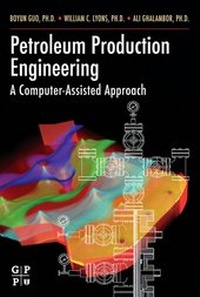
Petroleum Production Engineering, A Computer-Assisted Approach
1st Edition
Published on 1. April 2011
312 pages
978-0-08-047995-8 (ISBN)
Description

Petroleum Production Engineering, A Computer-Assisted Approach provides handy guidelines to designing, analyzing and optimizing petroleum production systems. Broken into four parts, this book covers the full scope of petroleum production engineering, featuring stepwise calculations and computer-based spreadsheet programs. Part one contains discussions of petroleum production engineering fundamentals, empirical models for production decline analysis, and the performance of oil and natural gas wells. Part two presents principles of designing and selecting the main components of petroleum production systems including: well tubing, separation and dehydration systems, liquid pumps, gas compressors, and pipelines for oil and gas transportation. Part three introduces artificial lift methods, including sucker rod pumping systems, gas lift technology, electrical submersible pumps and other artificial lift systems. Part four is comprised of production enhancement techniques including, identifying well problems, designing acidizing jobs, guidelines to hydraulic fracturing and job evaluation techniques, and production optimization techniques.
- Provides complete coverage of the latest techniques used for designing and analyzing petroleum production systems
- Increases efficiency and addresses common problems by utilizing the computer-based solutions discussed within the book
- Presents principles of designing and selecting the main components of petroleum production systems
All prices
More details
Other editions
Additional editions
Book
04/2007
Gulf Publishing
€109.12
Article exhausted; check for reprint
Boyun Guo Phd | William C. Lyons Ph D P E | Ali Ghalambor Phd
Petroleum Production Engineering, a Computer-Assisted Approach
Book
03/2007
Gulf Professional Publishing
€117.50
Article exhausted; check different version
Person
Boyun Guo is a Professor at the University of Louisiana at Lafayette in the Petroleum Engineering Department and Director of the Center for Optimization of Petroleum Systems (COPS) of the Energy Institute of Louisiana (EIL). He has 40 years of work experience in the oil and gas industry and academia. He is the principal author of 11 books and author/coauthor of over 150 research papers. He holds a BS degree in Engineering Science from Daqing Petroleum Institute in China, MS degree in Petroleum Engineering from Montana College of Mineral Science and Technology, and a PhD degree in Petroleum Engineering from New Mexico Institute of Mining and Technology.
Content
PrefaceList of SymbolsList of TablesList of FiguresPart I: Petroleum Production Engineering Fundamentals:Chapter 1: Petroleum Production SystemChapter 2: Properties of Oil and Natural Gas Chapter 3: Reservoir Deliverability Chapter 4: Wellbore Performance Chapter 5: Choke Performance Chapter 6: Well Deliverability Chapter 7: Forecast of Well Production Chapter 8: Production Decline Analysis Part II: Equipment Design and SelectionChapter 9: Well Tubing Chapter 10: Separation Systems Chapter 11: Transportation SystemsPart III: Artificial Lift MethodsChapter 12: Sucker Rod Pumping Chapter 13: Gas Lift Chapter 14: Other Artificial Lift Methods Part IV: Production EnhancementChapter 15: Well Problem Identification Chapter 16: Matrix Acidizing Chapter 17: Hydraulic Fracturing Chapter 18: Production Optimization Appendix A: Unit Conversion FactorsAppendix B: The Minimum Performance Properties of API Tubing
List of Figures
Figure 1.1: A sketch of a petroleum production system. Figure 1.2: A typical hydrocarbon phase diagram. Figure 1.3: A sketch of a water-drive reservoir. Figure 1.4: A sketch of a gas-cap drive reservoir. Figure 1.5: A sketch of a dissolved-gas drive reservoir. Figure 1.6: A sketch of a typical flowing oil well. Figure 1.7: A sketch of a wellhead. Figure 1.8: A sketch of a casing head. Figure 1.9: A sketch of a tubing head. Figure 1.10: A sketch of a "Christmas tree." Figure 1.11: Sketch of a surface valve. Figure 1.12: A sketch of a wellhead choke. Figure 1.13: Conventional horizontal separator. Figure 1.14: Double action piston pump. Figure 1.15: Elements of a typical reciprocating compressor. Figure 1.16: Uses of offshore pipelines. Figure 1.17: Safety device symbols. Figure 1.18: Safety system designs for surface wellhead flowlines. Figure 1.19: Safety system designs for underwater wellhead flowlines. Figure 1.20: Safety system design for pressure vessel. Figure 1.21: Safety system design for pipeline pumps. Figure 1.22: Safety system design for other pumps. Figure 3.1: A sketch of a radial flow reservoir model: (a) lateral view, (b) top view. Figure 3.2: A sketch of a reservoir with a constant-pressure boundary. Figure 3.3: A sketch of a reservoir with no-flow boundaries. Figure 3.4: (a) Shape factors for various closed drainage areas with low-aspect ratios.(b) Shape factors for closed drainage areas with high-aspect ratios. Figure 3.5: A typical IPR curve for an oil well. Figure 3.6: Transient IPR curve for Example Problem3.1. Figure 3.7: Steady-state IPR curve for Example Problem 3.1. Figure 3.8: Pseudo-steady-state IPR curve for Example Problem 3.1. Figure 3.9: IPR curve for Example Problem 3.2. Figure 3.10: Generalized Vogel IPR model for partial two-phase reservoirs. Figure 3.11: IPR curve for Example Problem 3.3. Figure 3.12: IPR curves for Example Problem 3.4, Well A. Figure 3.13: IPR curves for Example Problem 3.4, Well B Figure 3.14: IPR curves for Example Problem 3.5. Figure 3.15: IPR curves of individual layers. Figure 3.16: Composite IPR curve for all the layers open to flow. Figure 3.17: Composite IPR curve for Group 2 (LayersB4, C1, and C2). Figure 3.18: Composite IPR curve for Group 3 (LayersB1, A4, and A5). Figure 3.19: IPR curves for Example Problem 3.6. Figure 3.20: IPR curves for Example Problem 3.7. Figure 4.1: Flow along a tubing string. Figure 4.2: Darcy-Wiesbach friction factor diagram. Figure 4.3: Flow regimes in gas-liquid flow. Figure 4.4: Pressure traverse given by Hagedorn BrownCorreltion.xls for Example. Figure 4.5: Calculated tubing pressure profile for Example Problem 4.5. Figure 5.1: A typical choke performance curve. Figure 5.2: Choke flow coefficient for nozzle-type chokes. Figure 5.3: Choke flow coefficient for orifice-type chokes. Figure 6.1: Nodal analysis for Example Problem 6.1. Figure 6.2: Nodal analysis for Example Problem 6.4. Figure 6.3: Nodal analysis for Example Problem 6.5. Figure 6.4: Nodal analysis for Example Problem 6.6. Figure 6.5: Nodal analysis for Example Problem 6.8. Figure 6.6: Schematic of a multilateral well trajectory. Figure 6.7: Nomenclature of a multilateral well. Figure 7.1: Nodal analysis plot for Example Problem 7.1. Figure 7.2: Production forecast for Example Problem 7.2. Figure 7.3: Nodal analysis plot for Example Problem 7.2. Figure 7.4: Production forecast for Example Problem 7.2 Figure 7.3: Production forecast for Example Problem 7.3. Figure 7.4: Result of production forecast for Example Problem 7.4. Figure 8.1: A semilog plot of q versus t indicating an exponential decline. Figure 8.2: A plot of Np versus q indicating an exponential decline. Figure 8.3: A plot of log(q) versus log(t) indicating a harmonic decline. Figure 8.4: A plot of Np versus log(q) indicating a harmonic decline. Figure 8.5: A plot of relative decline rate versus production rate. Figure 8.6: Procedure for determining a- and b-values. Figure 8.7: A plot of log(q) versus t showing an exponential decline. Figure 8.8: Relative decline rate plot showing exponential decline. Figure 8.9: Projected production rate by an exponential decline model. Figure 8.10: Relative decline rate plot showing harmonic decline. Figure 8.11: Projected production rate by a harmonic decline model. Figure 8.12: Relative decline rate plot showing hyperbolic decline. Figure 8.13: Relative decline rate plot showing hyperbolic decline. Figure 8.14: Projected production rate by a hyperbolic decline model. Figure 9.1: A simple uniaxial test of a metal specimen. Figure 9.2: Effect of tension stress on tangential stress. Figure 9.3: Tubing-packer relation. Figure 9.4: Ballooning and buckling effects. Figure 10.1: A typical vertical separator. Figure 10.2: A typical horizontal separator. Figure 10.3: A typical horizontal double-tube separator. Figure 10.4: A typical horizontal three-phase separator. Figure 10.5: A typical spherical low-pressure separator. Figure 10.6: Water content of natural gases. Figure 10.7: Flow diagram of a typical solid desiccant dehydration plant. Figure 10.8: Flow diagram of a typical glycol dehydrator. Figure 10.9: Gas capacity of vertical inlet scrubbers based on 0.7-specific gravity at 100 °F. Figure 10.10: Gas capacity for trayed glycol contactors based on 0.7-specific gravity at 100 °F. Figure 10.11: Gas capacity for packed glycol contactors based on 0.7-specific gravity...
