

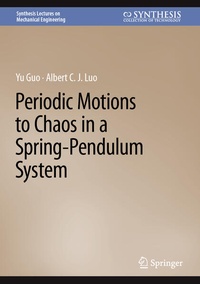
Periodic Motions to Chaos in a Spring-Pendulum System
Description

This book builds on the fundamental understandings, learned in undergraduate engineering and physics in principles of dynamics and control of mechanical systems. The design of real-world mechanical systems and devices becomes far more complex than the spring-pendulum system to which most engineers have been exposed. The authors provide one of the simplest models of nonlinear dynamical systems for learning complex nonlinear dynamical systems.
The book addresses the complex challenges of the necessary modeling for the design of machines. The book addresses the methods to create a mechanical system with stable and unstable motions in environments influenced by an array of motion complexity including varied excitation frequencies ranging from periodic motions to chaos.
Periodic motions to chaos, in a periodically forced nonlinear spring pendulum system, are presented through the discrete mapping method, and the corresponding stability and bifurcations of periodic motions on the bifurcation trees are presented. Developed semi-analytical solutions of periodical motions to chaos help the reader to understand complex nonlinear dynamical behaviors in nonlinear dynamical systems. Especially, one can use unstable motions rather than stable motions only.More details
Other editions
Additional editions
Persons
Dr. Yu Guo worked at Midwestern State University Texas as an Associate Professor. He previously worked at Caterpillar Inc. as an engine structural and dynamics engineer. Dr. Guo conducts research focusing on nonlinear vibration and impact dynamics. He has published 18 peer-reviewed journal papers, more than 20 conference articles, 4 book chapters, and 2 monographs. He has also conducted many professional presentations or invited lectures all over the world.
Professor Albert C.J. Luo has worked at Southern Illinois University Edwardsville. For over 30 years, Dr. Luo's contributions to nonlinear dynamical systems and mechanics lie in (i) the local singularity theory for discontinuous dynamical systems; (ii) dynamical systems synchronization; (iii) analytical solutions of periodic and chaotic motions in nonlinear dynamical systems; (iv) the theory for stochastic and resonant layer in nonlinear Hamiltonian systems; and (v) the full nonlinear theory for a deformablebody. Such contributions have been scattered into 28 monographs and over 350 peer-reviewed journal and conference papers. Dr. Luo served as an editor for the Journal of Communications in Nonlinear Science and Numerical Simulation, and book series on Nonlinear Physical Science (HEP and Springer) and Nonlinear Systems and Complexity (Springer). Dr. Luo was an editorial member for IMeCh E Part K Journal of Multibody Dynamics and Journal of Vibration and Control and has also organized over 30 international symposiums and conferences on dynamics and control.
