

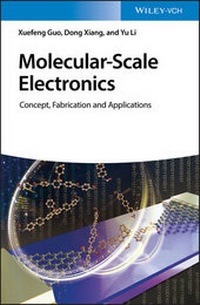
Molecular-Scale Electronics
Description

This comprehensive book covers the major advances with the most general applicability in the field of molecular electronic devices. It emphasizes new insights into the development of efficient platform methodologies for building such reliable devices with desired functionalities through the combination of programmed bottom-up self-assembly and sophisticated top-down device fabrication. It also helps to develop an understanding of the device fabrication processes and the characteristics of the resulting electrode-molecule interface.
Beginning with an introduction to the subject, Molecular-Scale Electronics: Concept, Fabrication and Applications offers full chapter coverage on topics such as: Metal Electrodes for Molecular Electronics; Carbon Electrodes for Molecular Electronics; Other Electrodes for Molecular Electronics; Novel Phenomena in Single-Molecule Junctions; and Supramolecular Interactions in Single-Molecule Junctions. Other chapters discuss Theoretical Aspects for Electron Transport through Molecular Junctions; Characterization Techniques for Molecular Electronics; and Integrating Molecular Functionalities into Electrical Circuits. The book finishes with a summary of the primary challenges facing the field and offers an outlook at its future.
* Summarizes a number of different approaches for forming molecular-scale junctions and discusses various experimental techniques for examining these nanoscale circuits in detail
* Gives overview of characterization techniques and theoretical simulations for molecular electronics
* Highlights the major contributions and new concepts of integrating molecular functionalities into electrical circuits
* Provides a critical discussion of limitations and main challenges that still exist for the development of molecular electronics
* Suited for readers studying or doing research in the broad fields of Nano/molecular electronics and other device-related fields
Molecular-Scale Electronics is an excellent book for materials scientists, electrochemists, electronics engineers, physical chemists, polymer chemists, and solid-state chemists. It will also benefit physicists, semiconductor physicists, engineering scientists, and surface chemists.
More details
Other editions
Additional editions
Persons
Yu Li is a research scientist in the College of Chemistry and Molecular Engineering at Peking University. She graduated from Tokyo Institute of Technology with degree of doctor of science in chemistry in 2017. In the period of Ph.D., Ms. Yu focused on the chemical reactions in the single molecular junction. With great enthusiasm and diligence in research, her work has been published in prestigious international physical chemistry journals like J. Phys. Chem. C, Phys. Chem. Chem. Phys.
Content
2. Metal Electrodes for Molecular
2.1 Electronics2.1 Single-Molecule Junctions
2.2 Ensemble Molecular Junctions
3. Carbon Electrodes for Molecular Electronics
3.1 Carbon Nanotube-based Electrodes
3.2 Graphene-based Electrodes
3.3 Other Carbon-Based Electrodes
4. Other Electrodes for Molecular Electronics
4.1 Silicon-based Electrodes
4.2 Polymer-based Electrodes
5. Novel Phenomena in Single-Molecule Junctions
5.1 Quantum Interference
5.2 Coulomb Blockade and Kondo Resonance
5.3 Thermoelectricity
5.4 Electronic-Plasmonic Conversion
6. Supramolecular Interactions in Single-Molecule Junctions
6.1 Hydrogen Bonds
6.2 p-p Stacking Interactions
6.3 Host-Guest Interactions
6.4 Charge-Transfer Interactions
7. Characterization Techniques for Molecular Electronics
7.1 Inelastic Electron Tunneling Spectroscopy
7.2 Temperature-Length-Variable Transport Measurement
7.3 Noise Spectroscopy
7.4 Optical and Optoelectronic Spectroscopy
7.5 Data Characterization Approaches
8. Theoretical Aspects for Electron Transport through Molecular Junctions
8.1 Theoretical Description of the Tunneling Process
8.2 Electron Transport Mechanism
8.3 First-Principles Modeling
9. Integrating Molecular Functionalities into Electrical Circuits
9.1 Wiring towards Nanocircuits
9.2 Rectification towards Diodes
9.3 Negative differential conductance toward oscillators
9.4 Gating towards Molecular Transistors
9.5 Switching toward Memory Devices
9.6 Molecular Computing
9.7 Transduction towards Molecular Sensors
9.8 High-Frequency Molecular Devices
9.9 Molecular Machines
10. Summary and Perspectives
10.1 Primary Challenges
10.2 Open Questions
10.3 Outlook
1
Introduction
What does the future hold for electronic devices? To what extent can their dimensions be reduced in the future? Forty years ago, the gate length of a transistor was approximately 10 µm; however, over the past few decades, traditional transistors have shrunk dramatically and now reach dimensions of about 3 nm in research devices [1, 2]. The further miniaturization of electronic devices remains extremely challenging, which is primarily due to either technique limitations or lack of fundamental understanding of transport mechanisms [3]. In this sense, it is remarkable that chemically identical molecules, with sizes on the order of 1 nm, can be synthesized in bulk while accomplishing a variety of electronic tasks, including conducting wire, rectification, memory, and switching; thus, they might have the potential to partly replace traditional solid-state device counterparts in the future. Comprehensive experimental findings in electron transport through individual molecules introduce the idea that beyond traditional complementary metal oxide semiconductor (CMOS) technologies, the ultimate goal for shrinking electrical circuits is the realization of molecular-scale/single-molecule electronics because single molecules constitute the smallest stable structures imaginable [4-7]. Molecular-scale electronics, which is the concept of creating functional electrical circuits based on properties inherent in individual or ensemble molecules, have several unparalleled advantages in comparison with silicon-based electronic devices. Firstly, the extremely reduced size of the molecules in order of 1 nm may enable heightened capacities and faster performances. Moreover, such small size of the molecule provides the ability to surpass the limit of conventional silicon circuit integration. Secondly, the abundant diversity in the molecular structures, which can be changed via flexible chemical designs, may lead to a direct observation of novel effects as well as the fundamental discovery of physical phenomena that are not accessible by using traditional materials or approaches. Thirdly, another attractive feature of this approach is the universal availability of molecules due to the ease of bulk synthesis, thus potentially leading to low-cost manufacturing.
In fact, molecular-scale electronics is currently a research area of focus because it not only meets the increasing technical demands of the miniaturization of traditional silicon-based electronic devices but also provides an ideal window of exploring the intrinsic properties of materials at the molecular level. Generally, molecular-scale electronics refers to the use of single molecules or nanoscale collections of single molecules as electronic components [2, 8-10]. The primary theme in this field is the construction, measurement, and understanding of the current-voltage responses of electrical circuits, in which molecular systems play an important role as pivotal elements [11]. Indeed, over the past decade, we observed significant developments achieved in both experiments and theory to reveal the electronic and photonic responses of these conceptually simple molecular junctions [5-12].
The history of molecular-scale electronics is surging forward with great momentum, and outstanding scientists have provided significant contributions to the development of molecular-sale electronics. Briefly, several pioneering studies were performed in the 1970s at the laboratory of Hans Kuhn along with Mann and coworkers [10, 13-15]. They developed the first effective self-assembly techniques (via molecular bond formation) to prepare molecular structures in which organic molecules adhered to solid substrate surfaces without using simple dispersion forces. Additionally, these groups reported a few of the earliest reproducible electrical transport measurements through molecules. After Mann and Kuhn's study, there were a number of important follow-up experiments and measurements [10]. During the same period, a visionary concept of exploiting the intrinsic functionalities of molecules for electronics (i.e. a single molecule could function as a rectifier) was sketched out by Aviram and Ratner [16]. Then, the desire of using molecules as functional units in electronic circuits motivated many researchers over the next few decades. A significant development occurred in 1982 with the development of a scanning probe microscopy (SPM) [17]. The SPM is a powerful technique regarded as a milestone in the history of molecular electronics, by which both the surface topography and its transport information can be addressed [18]. By using the SPM, Weiss and his colleagues performed the first experiment resembling transport through single molecules, thus launching a promising approach to realizing the goal [19]. Nonetheless, the SPM technique is limited to lab experiments and cannot be directly applied to realistic device fabrication. In addition to the development of the SPM, various techniques based on either metal or carbon nanoelectrodes have been introduced for single-molecule studies in the following years, including mechanically controllable break junctions, electromigration breakdowns, electrical chemical depositions, and surface diffusion mediated depositions [20-23].
The success of these techniques led to an explosion interest in using individual molecules in molecular-scale electronics and significantly promoted the development of the field. With improved measurement capability, a number of new effects beyond electronic transport, including electron-mechanics, thermoelectricity, optoelectronics, quantum interferences, and spin transports, were discovered at the single-molecule level [624-27]. In contrast to metal electrodes, non-metal materials, such as conducting polymers and carbon-based materials, can be regarded as molecules themselves, and they possess a natural compatibility with the traditional silicon-based technique and excellent mechanical flexibility [28, 29]. Hence, the past decade was an exciting developmental period for non-metal-based molecular electronics. For example, nanotubes and graphene have been used as point contacts for creating robust single-molecule junctions with desired functions, thus paving the way for practical applications [30, 31].
The theory developed for interpreting the current-voltage characteristics in molecular junctions began to appear in the 1990s. The early approach was to use the Landauer formulation to explain the electron transport behavior [32, 33]. In this simple picture, the charge transport through the molecular junctions was interpreted in terms of elastic scattering with a key parameter, known as the "transmission coefficient," which describes how effective a molecule was in scattering the incoming electron from the right lead into the left lead. Additionally, more powerful formulations, including the non-equilibrium Green's function (NEGF) approach, Breit-Wigner formula and Simmons model, have been used to interpret the electron transport behaviors through a molecule [34-37]. In particular, the NEGF approach demonstrated the capability of combining both the elastic and inelastic effects with the metal-electrode coupling and gating effects [38]. However, practical molecular junctions are really complex, and the development of advanced theories that consider all of the factors, including real molecules, electrodes, molecule-electrode interfaces, electron-phonon interactions, spin-orbit interactions, and electron-solvent couplings, is of significant importance to the comprehensive advancement in the field [34]. The motivation for the theory development is far from saturated, and significant efforts are needed to reduce the gap between the theoretical calculations and the experimental data.
Nonetheless, numerous challenges need to be addressed before single-molecule devices can be used as commercial products. The basic challenge involves determining the structure-function relationships for the electronic transport (intra- or intermolecular) through a junction containing one or a few molecules. It is a complicated engineer since the behaviors of the molecular devices are strongly dependent on the electrode fabrication process, selection of electrode materials, contact chemistry, and number of molecules to be tested. Unlike traditional semiconductors that use a standard product line, there are no standard processes for molecular device fabrication thus far. A small variation in each process may result in a large change in molecular devices. The resulting challenge is the reproducibility. Generally, the passing current detected is small (~nA) when the target unit scales down to the single-molecule scale, and thus the current is sensitive to the environmental changes, e.g. contamination, radiation, humidity, temperature variation, and other external vibrations. Furthermore, molecular aging is another factor that leads to reproducibility problems. Another primary challenge involves developing a technology for the mass production of single-molecule devices at low cost. Although the molecules can be synthesized in large quantities, most widely used techniques, such as electron beam lithography (EBL) for nanoelectrode fabrication, are expensive for mass production. Decreasing the unit size and increasing the integration...
