

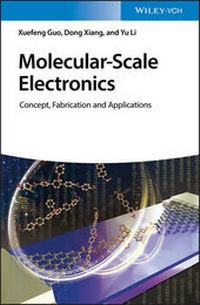
Molecular-Scale Electronics
Concept, Fabrication and Applications
1st Edition
Published on 2. July 2020
VIII, 400 pages
978-3-527-81888-4 (ISBN)
Description

Provides in-depth knowledge on molecular electronics and emphasizes the techniques for designing molecular junctions with controlled functionalities
This comprehensive book covers the major advances with the most general applicability in the field of molecular electronic devices. It emphasizes new insights into the development of efficient platform methodologies for building such reliable devices with desired functionalities through the combination of programmed bottom-up self-assembly and sophisticated top-down device fabrication. It also helps to develop an understanding of the device fabrication processes and the characteristics of the resulting electrode-molecule interface.
Beginning with an introduction to the subject, Molecular-Scale Electronics: Concept, Fabrication and Applications offers full chapter coverage on topics such as: Metal Electrodes for Molecular Electronics; Carbon Electrodes for Molecular Electronics; Other Electrodes for Molecular Electronics; Novel Phenomena in Single-Molecule Junctions; and Supramolecular Interactions in Single-Molecule Junctions. Other chapters discuss Theoretical Aspects for Electron Transport through Molecular Junctions; Characterization Techniques for Molecular Electronics; and Integrating Molecular Functionalities into Electrical Circuits. The book finishes with a summary of the primary challenges facing the field and offers an outlook at its future.
* Summarizes a number of different approaches for forming molecular-scale junctions and discusses various experimental techniques for examining these nanoscale circuits in detail
* Gives overview of characterization techniques and theoretical simulations for molecular electronics
* Highlights the major contributions and new concepts of integrating molecular functionalities into electrical circuits
* Provides a critical discussion of limitations and main challenges that still exist for the development of molecular electronics
* Suited for readers studying or doing research in the broad fields of Nano/molecular electronics and other device-related fields
Molecular-Scale Electronics is an excellent book for materials scientists, electrochemists, electronics engineers, physical chemists, polymer chemists, and solid-state chemists. It will also benefit physicists, semiconductor physicists, engineering scientists, and surface chemists.
This comprehensive book covers the major advances with the most general applicability in the field of molecular electronic devices. It emphasizes new insights into the development of efficient platform methodologies for building such reliable devices with desired functionalities through the combination of programmed bottom-up self-assembly and sophisticated top-down device fabrication. It also helps to develop an understanding of the device fabrication processes and the characteristics of the resulting electrode-molecule interface.
Beginning with an introduction to the subject, Molecular-Scale Electronics: Concept, Fabrication and Applications offers full chapter coverage on topics such as: Metal Electrodes for Molecular Electronics; Carbon Electrodes for Molecular Electronics; Other Electrodes for Molecular Electronics; Novel Phenomena in Single-Molecule Junctions; and Supramolecular Interactions in Single-Molecule Junctions. Other chapters discuss Theoretical Aspects for Electron Transport through Molecular Junctions; Characterization Techniques for Molecular Electronics; and Integrating Molecular Functionalities into Electrical Circuits. The book finishes with a summary of the primary challenges facing the field and offers an outlook at its future.
* Summarizes a number of different approaches for forming molecular-scale junctions and discusses various experimental techniques for examining these nanoscale circuits in detail
* Gives overview of characterization techniques and theoretical simulations for molecular electronics
* Highlights the major contributions and new concepts of integrating molecular functionalities into electrical circuits
* Provides a critical discussion of limitations and main challenges that still exist for the development of molecular electronics
* Suited for readers studying or doing research in the broad fields of Nano/molecular electronics and other device-related fields
Molecular-Scale Electronics is an excellent book for materials scientists, electrochemists, electronics engineers, physical chemists, polymer chemists, and solid-state chemists. It will also benefit physicists, semiconductor physicists, engineering scientists, and surface chemists.
More details
Other editions
Additional editions
Book
08/2020
1st Edition
Wiley-VCH
€165.00
Shipment within 5-7 days
Persons
Xuefeng Guo received his Ph.D. from the Institute of Chemistry, Chinese Academy of Sciences, Beijing in 2004. From 2004 to 2007, he was a postdoctoral research scientist at the Columbia University Nanocenter. He joined the faculty as a professor under "Peking 100-Talent" Program at Peking University in 2008. In 2012, he won the National Science Funds for Distinguished Young Scholars of China. His current research is focused on functional nanometer/molecular devices. Professor Guo has authored over 130 scientific publications and has received numerous scientific awards, including the First Prize of Ministry of Education Natural Science Award.Dong Xiang is a Professor in the College of Electronic Information and Optical Engineering, Nankai University. He received his M.S. degree in 2006 from Huazhong University of Science & Technology, China and received his Ph.D degree from RWTH Aachen University, Germany in 2011. From 2012 to 2014, he was a postdoctoral research scientist at the Department of Physics and Astronomy, Seoul National University, Korea. His current research interests focus on single molecule studies and optoelectronic molecular devices.
Yu Li is a research scientist in the College of Chemistry and Molecular Engineering at Peking University. She graduated from Tokyo Institute of Technology with degree of doctor of science in chemistry in 2017. In the period of Ph.D., Ms. Yu focused on the chemical reactions in the single molecular junction. With great enthusiasm and diligence in research, her work has been published in prestigious international physical chemistry journals like J. Phys. Chem. C, Phys. Chem. Chem. Phys.
Yu Li is a research scientist in the College of Chemistry and Molecular Engineering at Peking University. She graduated from Tokyo Institute of Technology with degree of doctor of science in chemistry in 2017. In the period of Ph.D., Ms. Yu focused on the chemical reactions in the single molecular junction. With great enthusiasm and diligence in research, her work has been published in prestigious international physical chemistry journals like J. Phys. Chem. C, Phys. Chem. Chem. Phys.
Content
1. Introduction
2. Metal Electrodes for Molecular
2.1 Electronics2.1 Single-Molecule Junctions
2.2 Ensemble Molecular Junctions
3. Carbon Electrodes for Molecular Electronics
3.1 Carbon Nanotube-based Electrodes
3.2 Graphene-based Electrodes
3.3 Other Carbon-Based Electrodes
4. Other Electrodes for Molecular Electronics
4.1 Silicon-based Electrodes
4.2 Polymer-based Electrodes
5. Novel Phenomena in Single-Molecule Junctions
5.1 Quantum Interference
5.2 Coulomb Blockade and Kondo Resonance
5.3 Thermoelectricity
5.4 Electronic-Plasmonic Conversion
6. Supramolecular Interactions in Single-Molecule Junctions
6.1 Hydrogen Bonds
6.2 p-p Stacking Interactions
6.3 Host-Guest Interactions
6.4 Charge-Transfer Interactions
7. Characterization Techniques for Molecular Electronics
7.1 Inelastic Electron Tunneling Spectroscopy
7.2 Temperature-Length-Variable Transport Measurement
7.3 Noise Spectroscopy
7.4 Optical and Optoelectronic Spectroscopy
7.5 Data Characterization Approaches
8. Theoretical Aspects for Electron Transport through Molecular Junctions
8.1 Theoretical Description of the Tunneling Process
8.2 Electron Transport Mechanism
8.3 First-Principles Modeling
9. Integrating Molecular Functionalities into Electrical Circuits
9.1 Wiring towards Nanocircuits
9.2 Rectification towards Diodes
9.3 Negative differential conductance toward oscillators
9.4 Gating towards Molecular Transistors
9.5 Switching toward Memory Devices
9.6 Molecular Computing
9.7 Transduction towards Molecular Sensors
9.8 High-Frequency Molecular Devices
9.9 Molecular Machines
10. Summary and Perspectives
10.1 Primary Challenges
10.2 Open Questions
10.3 Outlook
2. Metal Electrodes for Molecular
2.1 Electronics2.1 Single-Molecule Junctions
2.2 Ensemble Molecular Junctions
3. Carbon Electrodes for Molecular Electronics
3.1 Carbon Nanotube-based Electrodes
3.2 Graphene-based Electrodes
3.3 Other Carbon-Based Electrodes
4. Other Electrodes for Molecular Electronics
4.1 Silicon-based Electrodes
4.2 Polymer-based Electrodes
5. Novel Phenomena in Single-Molecule Junctions
5.1 Quantum Interference
5.2 Coulomb Blockade and Kondo Resonance
5.3 Thermoelectricity
5.4 Electronic-Plasmonic Conversion
6. Supramolecular Interactions in Single-Molecule Junctions
6.1 Hydrogen Bonds
6.2 p-p Stacking Interactions
6.3 Host-Guest Interactions
6.4 Charge-Transfer Interactions
7. Characterization Techniques for Molecular Electronics
7.1 Inelastic Electron Tunneling Spectroscopy
7.2 Temperature-Length-Variable Transport Measurement
7.3 Noise Spectroscopy
7.4 Optical and Optoelectronic Spectroscopy
7.5 Data Characterization Approaches
8. Theoretical Aspects for Electron Transport through Molecular Junctions
8.1 Theoretical Description of the Tunneling Process
8.2 Electron Transport Mechanism
8.3 First-Principles Modeling
9. Integrating Molecular Functionalities into Electrical Circuits
9.1 Wiring towards Nanocircuits
9.2 Rectification towards Diodes
9.3 Negative differential conductance toward oscillators
9.4 Gating towards Molecular Transistors
9.5 Switching toward Memory Devices
9.6 Molecular Computing
9.7 Transduction towards Molecular Sensors
9.8 High-Frequency Molecular Devices
9.9 Molecular Machines
10. Summary and Perspectives
10.1 Primary Challenges
10.2 Open Questions
10.3 Outlook
