

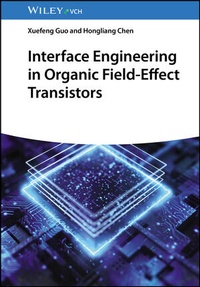
Interface Engineering in Organic Field-Effect Transistors
1st Edition
Published on 5. July 2023
272 pages
978-3-527-84046-5 (ISBN)
Description

a systematic summary of advances in developing effective methodologies of interface engineering in organic field-effect transistors, from fundamental models to experimental techniques.
More details
Other editions
Additional editions
Xuefeng Guo | Hongliang Chen
Interface Engineering in Organic Field-Effect Transistors
Software
09/2023
Wiley-VCH
€190.32
Article exhausted; check different version
Xuefeng Guo | Hongliang Chen
Interface Engineering in Organic Field-Effect Transistors
Book
08/2023
1st Edition
Wiley-VCH
€135.00
Shipment within 5-7 days
Persons
Xuefeng Guo received his Ph.D. in 2004 from the Institute of Chemistry, Chinese Academy of Sciences, Beijing. From 2004 to 2007, he was a postdoctoral research scientist at the Columbia University Nanocenter. He joined the faculty as a professor under ?Peking 100-Talent? Program at Peking University in 2008. In 2012, he won the National Science Funds for Distinguished Young Scholars of China. His current research is focused on functional nanometer/molecular devices. Professor Xuefeng Guo has authored over 195 scientific publications and has received numerous scientific awards, including the First Award of First prize of Ministry of Education Natural Science Award and the XPLORER PRIZE.
Hongliang Chen received his Ph.D. in 2016 from the College of Chemistry and Molecular Engineering, Peking University, under the guidance of Professor Xuefeng Guo. From 2016 to 2018, he worked as a research scientist at Core R&D department in Dow Chemical Company. Then he moved to Northwestern University in United States and worked as a postdoctoral research fellow in Professor Sir Fraser Stoddart?s group from 2018 to 2021. He joined Zhejiang University as an assistant professor since June 2021. His research interest is focused on organic functional devices and molecular electronics.
Hongliang Chen received his Ph.D. in 2016 from the College of Chemistry and Molecular Engineering, Peking University, under the guidance of Professor Xuefeng Guo. From 2016 to 2018, he worked as a research scientist at Core R&D department in Dow Chemical Company. Then he moved to Northwestern University in United States and worked as a postdoctoral research fellow in Professor Sir Fraser Stoddart?s group from 2018 to 2021. He joined Zhejiang University as an assistant professor since June 2021. His research interest is focused on organic functional devices and molecular electronics.
Content
1. INTRODUCTION
1.1. Different Interfaces in OFETs
1.2. Brief Historic Overview of Interface Engineering in OFETs
1.3. Scope of the Book
2. INTERFACIAL MODIFICATION METHODS
2.1. Noncovalent Modification Methods
2.2. Covalent Modification Methods
2.3. Efforts in Developing New Methods
3. SEMICONDUCTOR/SEMICONDUCTOR INTERFACE
3.1. Influence of additives on a material?s nucleation and morphology
3.2. Enhancing the performance through semiconductor heterojunctions
3.3. Integrating molecular functionalities into electrical circuits
4. SEMICONDUCTOR/ELECTRODE INTERFACE
4.1. Work function tuning for better contact
4.2. Installing switching effects at semiconductor/electrode interface
5. SEMICONDUCTOR/DIELECTRIC INTERFACE
5.1. Dielectric modification to tune semiconductor morphology
5.2. Eliminating interfacial traps
5.3. Integrating new functionalities
6. SEMICONDUCTOR/ENVIRONMENT INTERFACE
6.1. Device optimization to improve sensing performance
6.2. OCET-based and EGOFET-based sensors
7. INTERFACING ORGANIC ELECTRONICS WITH BIOLOGY
7.1. Integration of OFETs/OECTs with nonelectrogenic cells
7.2. Integration of flexible bioelectronics with electrogenic cells
7.3. Light/cell/device interfaces
8. CONCLUDING REMARKS AND OUTLOOK
8.1. New challenges in molecular design
8.2. High-quality OSC films: Self-assembly control
8.3. High-performance scalable flexible optoelectronics
8.4. Exploration of novel structures: Organic/2D heterostructures and vertical structures
8.5. Instability: Stability in aqueous media and thermal stability in hygienic applications
8.6. Multifunctional Sensor Systems
1.1. Different Interfaces in OFETs
1.2. Brief Historic Overview of Interface Engineering in OFETs
1.3. Scope of the Book
2. INTERFACIAL MODIFICATION METHODS
2.1. Noncovalent Modification Methods
2.2. Covalent Modification Methods
2.3. Efforts in Developing New Methods
3. SEMICONDUCTOR/SEMICONDUCTOR INTERFACE
3.1. Influence of additives on a material?s nucleation and morphology
3.2. Enhancing the performance through semiconductor heterojunctions
3.3. Integrating molecular functionalities into electrical circuits
4. SEMICONDUCTOR/ELECTRODE INTERFACE
4.1. Work function tuning for better contact
4.2. Installing switching effects at semiconductor/electrode interface
5. SEMICONDUCTOR/DIELECTRIC INTERFACE
5.1. Dielectric modification to tune semiconductor morphology
5.2. Eliminating interfacial traps
5.3. Integrating new functionalities
6. SEMICONDUCTOR/ENVIRONMENT INTERFACE
6.1. Device optimization to improve sensing performance
6.2. OCET-based and EGOFET-based sensors
7. INTERFACING ORGANIC ELECTRONICS WITH BIOLOGY
7.1. Integration of OFETs/OECTs with nonelectrogenic cells
7.2. Integration of flexible bioelectronics with electrogenic cells
7.3. Light/cell/device interfaces
8. CONCLUDING REMARKS AND OUTLOOK
8.1. New challenges in molecular design
8.2. High-quality OSC films: Self-assembly control
8.3. High-performance scalable flexible optoelectronics
8.4. Exploration of novel structures: Organic/2D heterostructures and vertical structures
8.5. Instability: Stability in aqueous media and thermal stability in hygienic applications
8.6. Multifunctional Sensor Systems
