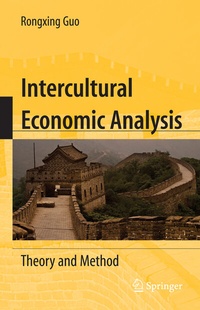
Intercultural Economic Analysis
Description

Since the end of the Cold War, the study of intercultural relations has become one of the most popular topics in the field of global politics and economics. This book presents a methodological framework for the analysis of intercultural issues frequently misinterpreted by existing theories. The book uses a challenge-and-response theory of cultural development to examine the relationship between different natural disasters and threats and the developments of ancient civilizations. The spatial interaction of ancient civilizations is assessed and some theoretical patterns of intercultural influences are presented with a focus on the Chinese, Egyptian, Indus, and Mesopotamian civilizations. Using the development of China as a case study, and on the basis of a simplified spatial model, the optimal spatial structure and size of culture areas are mathematically solved, and the political economy implications to the interactions between cultures differing in size are illustrated.
The book also examines various aspects of intercultural economic influences, such as those of culture on international trade. The empirical results suggest that high-income trade partners are less sensitive than low-income trade partners to the measures of cultural dissimilarity which block international trade. The existing literature relating to the determinants of economic growth treats explanatory variables such as income inequality and cultural diversity separately. This book investigates whether there are any conditions under which income inequality and cultural diversity could encourage economic growth and provides evidence from a broad panel of nations, which reveals that economic growth is quite independent from the variables of inequality and cultural (linguistic and religious) diversity. Finally, this book provides suggestions for how cultural influences can benefit developing economies both large and small.
More details
Other editions
Additional editions