

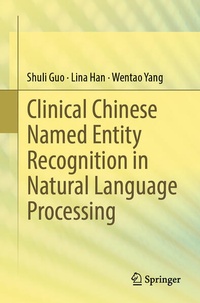
Clinical Chinese Named Entity Recognition in Natural Language Processing
Description

This book introduces how to enhance the context capture ability of the model, improve the position information perception ability of the pretrained models, and identify and denoise the unlabeled entities. The Chinese medical named entity recognition is an important branch of the intelligent medicine, which is beneficial to mine the information hidden in medical texts and provide the medical entity information for clinical medical decision-making and medical classification. Researchers, engineers and post-graduate students in the fields of medicine management and software engineering.
More details
Other editions
Additional editions
Persons
Dr. Shuli Guo is a full professor of the Beijing Institute of Technology, Beijing, China.
Prof. Shuli Guo was born in 1973 in Inner Mongolia, P.R. China. He received his Bachelor Degree (1995), Master Degree (1998) from Inner Mongolia Normal University, and his Ph.D. Degree from Peking University (2001). Dr. Guo worked as a postdoctoral researcher from January 2002 to April 2004 at Tsinghua University, as a researcher fellow from January 2008 to September 2008 at Akita Prefectural University, and as a postdoctoral researcher from September 2008 to September 2009 at Oxford University. Prof. Guo's research interests include classical control theory and application, medical image processing, medical data analysis, typical chronic disease analysis, and remote medical monitoring. Recently, he has published nearly 70 impactful paper, 3 monographs, 34 authorized Chinese patents, and 15 authorized software copyrights. He has published 3 Chinese national standardsand handed in 9 Chinese national standards/industrial standards for approval. He obtained one third prize for military medical achievements, one third prize for science and technology of the Chinese Medical Association, and one third prize for Beijing Medical Science and Technology. And he is the member of Chinese national technical committee for professional standardization (2021-2026), the head of China geriatric disease standardized diagnosis and treatment society of CAGG(2018-2023), and the chief expert of Chinese national key research and development program (2017-2021).
Prof. Lina Han was born in 1973 in Jilin Province, P.R. China. She received her Med. Bachelor Degree (1995), Med. Master Degree (2000), and Ph.D. Degree (2003) from Jilin University. Dr. Han worked as a postdoctoral researcher from July 2003 to April 2005 at Chinese PLA General Hospital and as a research fellow from August 2008 to September 2009 at Kyoto University. And now, she works as a research fellow in Department of Cardiovascular Internal Medicine, National Clinical Research Center for Geriatric Diseases, The 2nd Medicine Centre of Chinese PLA General Hospital and Chinese PLA Medical School. Her research interests focus on many 3D modeling problems on cardiovascular systems and their medical solutions.
Mr. Wentao Yang was born in 1990 in Hebei Province, P.R. China. He received his Bachelor Degree (2019) from Tianjin Institute of Technology and Master Degree (2022) from Beijing Institute of Technology. His main research interests are the area of wireless sensor networks and software engineering.
Content
Introduction.- Theoretical Basis.- Related Existed Models.- Medical Named Entity Recognition Models with the Attention Distraction Mechanism.- Transformer Entity Automatic Extraction Models in Multi-Layer Soft Location Matching Format.- Medical Named Entity Recognition Modelling based on Remote Monitoring and Denoising.
