

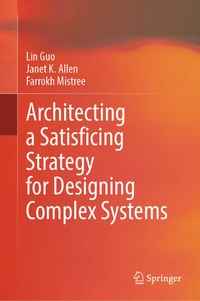
Architecting a Satisficing Strategy for Designing Complex Systems
Description

In this book, the authors describe how designers evolve their designs through the Design Evolution Cycle. It identifies challenges associated with designing complex systems, such as dealing with multiple conflicting goals, evolving design preferences, nonlinear and nonconvex constraints and goals, continuous and discrete variables, coupled decisions, sub-models with different levels of fidelity, and emergent properties.
The book empowers designers to make robust, informed, and iteratively improved decisions in designing complex systems
More details
Other editions
Additional editions
Persons
Janet K. Allen came to the School of Industrial and Systems Engineering at the University of Oklahoma from Georgia Tech in 2009. At the University of Oklahoma, Janet holds the John and Mary Moore Chair of Engineering. Janet graduated with an S.B. from the Massachusetts Institute of Technology and a Ph.D. from the University of California, Berkeley. At the University of Oklahoma, Janet Allen has built on her background in engineering design to think about the various types of product and process networks including the integrated design of materials, products, and other engineering systems. Her research focus is on managing the uncertainty which is inherent in simulation-based design. Her group was among the first to recognize that there are four types of uncertainty inherent in simulation-based design and to suggest that this uncertainty could be managed with robust design.
Lin Guo is Assistant Professor of the Department of Industrial Engineering at South Dakota School of Mines and Technology. She got her Ph.D. in industrial and systems engineering in 2021 from University of Oklahoma, M.S. in management science and engineering in 2011 from Shanghai Jiao Tong University, and B.S. in management information systems in 2007 from Zhongnan University of Economics and Law. Lin Guo's research interests include exploring satisficing strategies for engineering design; data science and analytics in manufacturing and health care; and hazardous products end-of-life management. She devotes herself to merging machine learning (ML) techniques and operation research (OR) to deliver useful, effective, and efficient methods and approaches for supporting human decision-making in the design of complex engineered systems. She has co-authored 9 journal papers and 4 conference papers in engineering design and data analytics.
Farrokh Mistree holds L. A. Comp Chair in the School of Aerospace and Mechanical Engineering at the University of Oklahoma in Norman, Oklahoma. Farrokh received his B.Tech. (Hons) degree in Naval Architecture in 1967 from the Indian Institute of Technology, Kharagpur, and his Ph.D. in engineering from the University of California, Berkeley, in 1974. He has co-authored two textbooks, two monographs, and more than 400 technical papers dealing with the integrated realization of materials; products and associated manufacturing processes; the design of mechanical, thermal, and structural systems; ships and aircraft; and supply networks. His design experience spans the areas of mechanical, aeronautical, structural, and industrial engineering. He has taught courses in engineering design, naval architecture, solid mechanics, operations research, and computer science. He has supervised 34 doctoral students and 60 master's students, all of whom are well-placed around the world.
Content
DESIGNING COMPLEX SYSTEMS USING SATISFICING STRATEGY.- RESEARCH QUESTIONS: HOW CAN WE REALIZE MODEL EVOLUTION.- PROPOSED METHODS THE DESIGN EVOLUTION LOOP.- Types I and II Robust Design Through Formulation Exploration Framework.- TYPE I, II, AND III ROBUST DESIGN THROUGH IMPROVING APPROXIMATION.- TYPE I, III, AND IV ROBUST DESIGN THROUGH UNSUPERVISED LEARNING.- TYPE I, II, AND IV ROBUST DESIGN THROUGH EMERGENT PROPERTIES IDENTIFICATION AND INTERPRETATIONS.- VALIDATION OF THE HYPOTHESES IN REALIZING
DESIGN EVOLUTION.- CLOSING REMARKS - ADVANCING DESIGN EVOLUTION IN OTHER DISCIPLINES.
