

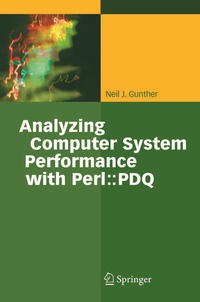
Analyzing Computer System Performance with Perl::PDQ
Description

Analyzing computer system performance is often regarded by most system administrators, IT professionals and software engineers as a black art that is too time consuming to learn and apply. Finally, this book by acclaimed performance analyst Dr. Neil Gunther makes this subject understandable and applicable through programmatic examples. The means to this end is the open-source performance analyzer Pretty Damn Quick (PDQ) written in Perl and available for download from the author's Website: www.perfdynamics.com.
As the epigraph in this book points out, Common sense is the pitfall of performance analysis. The performance analysis framework that replaces common sense is revealed in the first few chapters of Part I. The important queueing concepts embedded in PDQ are explained in a very simple style that does not require any knowledge of formal probability theory. Part II begins with a full specification of how to set up and use PDQ replete with examples written in Perl. Subsequent chapters present applications of PDQ to the performance analysis of multicomputer architectures, benchmark results, client/server scalability, and Web-based applications. The examples are not mere academic toys but are based on the author's experience analyzing the performance of large-scale systems over the past 20 years. By following his lead, you will quickly be able to set up your own Perl scripts for collecting data and exploring performance-by-design alternatives without inflating your manager's schedule.
Reviews / Votes
From the reviews:
"The literature of computer performance analysis is generally composed of two groups: heavy theoretical treatises and performance cookbooks. . Surprisingly, this book is exceptionally well balanced between theory and practice . . I strongly recommend this book, both for the novice practitioner and for the experienced performance analyst. Both can extract a vast array of benefits, ranging from understanding the theoretical concepts of performance modeling, to building for themselves a powerful modeling tool . ." (Jair Merlo, Computing Reviews, May, 2005)
More details
Other editions
New editions
Additional editions
Person
Neil Gunther, M.Sc., Ph.D. is a leading industry computer performance consultant who founded Performance Dynamics Company (www.perfdynamics.com) in 1994. Prior to that, Dr. Gunther held research and management positions at San Jose State University, JPL/NASA (Voyager and Galileo spacecraft), Xerox PARC research center and Pyramid/Siemens Technology. His performance and capacity planning classes have been presented at such organizations as Boeing, Fedex, Motorola, Stanford University, and Sun Microsystems.
Dr. Gunther is the author of over a hundred papers on computer performance topics, including "HIT-AND-RUN TACTICS ENABLE GUERRILLA CAPACITY PLANNING," published recently in IEEE IT Professional magazine. He has also written the book THE PRACTICAL PERFORMANCE ANALYST (iUniverse.com 2000). In 1996 he was awarded Best Technical Paper at CMG, and in 1997 was nominated for the A.A. Michelson Award. Dr. Gunther is a member of the AMS, ACM, CMG, IEEE, SAGE-AU, SIGMETRICS and USENIX.
