


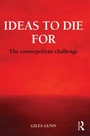
Ideas to Die For
The Cosmopolitan Challenge
1st Edition
Published on 12. April 2013
200 pages
978-1-135-91565-0 (ISBN)
Description

Cosmopolitanism and Its Discontents seeks to address the kinds of challenges that cosmopolitan perspectives and practices face in a world organized increasingly in relation to a proliferating series of global absolutisms - religious, political, social, and economic. While these challenges are often used to support the claim that cosmopolitanism is impotent to resist such totalizing ideologies because it is either a Western conceit or a globalist fiction, Gunn argues that cosmopolitanism is neither.
Situating his discussion in an emphatically global context, Gunn shows how cosmopolitanism has been effective in resisting such essentialisms and authoritarianisms precisely because it is more pragmatic than prescriptive, more self-critical than self-interested and finds several of its foremost recent expressions in the work of an Indian philosopher, a Palestinian writer, and South African story-tellers. This kind of cosmopolitanism offers a genuine ethical alternative to the politics of dogmatism and extremism because it is grounded on a new delineation of the human and opens toward a new, indeed, an "other," humanism.
Situating his discussion in an emphatically global context, Gunn shows how cosmopolitanism has been effective in resisting such essentialisms and authoritarianisms precisely because it is more pragmatic than prescriptive, more self-critical than self-interested and finds several of its foremost recent expressions in the work of an Indian philosopher, a Palestinian writer, and South African story-tellers. This kind of cosmopolitanism offers a genuine ethical alternative to the politics of dogmatism and extremism because it is grounded on a new delineation of the human and opens toward a new, indeed, an "other," humanism.
Reviews / Votes
In Giles Gunn you have a distinguished senior scholar at the height of his powers, building upon his last several books to create a far-reaching articulation and vindication of what he calls "pragmatic cosmopolitanism." Any readers of his earlier works on "solidarity" and "pragmatism" will be prepared for the humane, learned, and forthright style of this new book, but readers who have never read a word of Gunn's before will find this an accessible, self-contained work. Ideas to Die For: The Cosmopolitan Challenge is an earnest, sober, and deeply appealing essay on some of the most vexing issues of our time.David A. Hollinger, Preston Hotchkis Professor of History, University of California Berkeley, USA.
The brilliance of this book lies in its author's uncanny ability to subject the long tradition of academic reflections on cosmopolitanism to cutting-edge insights drawn from the emerging transdisciplinary field of global studies. Insisting that various forms of cosmopolitanisms are best understood when associated with the concrete social problems they are grappling with, Giles Gunn relies on a good dose of Deweyan pragmatism to sketch the social, literary, historical, and religious dimensions of a sensible cosmopolitanism opposed to globalized absolutisms of any kind.
Manfred B. Steger, Professor of Global Politics, University of Hawai'i-Manoa, USA and author of The Rise of the Global Imaginary.
More details
Series
Language
English
Place of publication
London
United Kingdom
Publishing group
Taylor & Francis Ltd
Target group
College/higher education
File size
2,88 MB
ISBN-13
978-1-135-91565-0 (9781135915650)
Copyright in bibliographic data and cover images is held by Nielsen Book Services Limited or by the publishers or by their respective licensors: all rights reserved.
Schweitzer Classification
Other editions
Additional editions

Book
03/2013
1st Edition
Routledge
€215.41
Shipment within 15-20 days
Book
03/2013
1st Edition
Routledge
€76.94
Shipment within 15-20 days
Person
Giles Gunn is Professor of Global & International Studies and of English at the University of California, Santa Barbara, writes on the cultural and ethical study of globalization and is author or editor, most recently, of Beyond Solidarity and America and the Misshaping of a New World Order.
Content
Preface 1. Introduction: Mapping and Remapping the Global 2.Cosmopolitanism and Being Other-wise 3. Pragmatist Alternatives and Absolutist Options 4. Culture and the Misshaping of World Order 5. America's Gods Then and Now 6. War Narratives and American Exceptionalism 7. The Trans-civilizational, the Inter-civilizational, and the Human 8. Globalizing the Humanities and an "Other" Humanism Bibliography
