

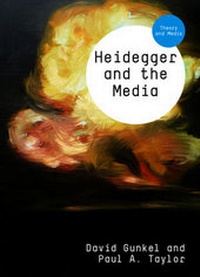
Heidegger and the Media
Description

More details
Other editions
Additional editions
Persons
Paul A. Taylor is associate professor in the Institute ofCommunication Studies at the University of Leeds.His previouspublications include Zizek and the Media (Polity, 2011). Heis the General Editor of the 'International Journal of ZizekStudies' and Editorial Board Member of the 'International Journalof Baudrillard Studies', 'Fast Capitalism' and the 'InternationalJournal of Badiou Studies'.
Content
1 We Need to Talk About Media
2 Mediated Truth
3 In Media Res
4 The Dasign of Media Apps: The Questions Concerning New Technologies
Conclusion
INTRODUCTION
Guns don’t kill people. People kill people.
Unofficial slogan of the National Rifle Association
The essence of technology is by no means anything technological.
QCT: 4
In the absence of precise statistics, we strongly suspect that the majority of self-styled liberal academics would vehemently disagree with the above NRA-associated sentiment. This is because those in favour of gun control (or at least some level of regulation) tend to readily embrace the seemingly logical notion that guns play a technologically determining role in violence. The presence of military assault rifles in urban settings, for example, is likely to lead to more fatalities compared to the presence of non-automatic weapons or no guns at all. Interestingly, however, amongst similar academics in the fields of Media and Communications Studies one frequently encounters a largely unquestioned belief in the essential neutrality of technology. This belief repeatedly manifests itself in variations on the basic mantra: ‘it’s not the technology you use, but how you choose to use it that is important’ – a view that Langdon Winner (1977: 27) termed the ‘myth of neutrality’ and dismissed as ‘a truism striving to be a bromide’. Despite being seldom acknowledged by media scholars (or if acknowledged, only cursorily), Heidegger’s philosophical approach to technology raises a profound challenge to those who selectively endorse and critique technological determinism, an issue that, with the advent of ubiquitous computing (ubicomp) and such new forms of subtly unobtrusive technological mediation as Google’s new Glass interface, has never been more pertinent.
Although seemingly paradoxical, Heidegger’s pronouncement that the essence of technology lies beyond the particular characteristics of any specific technological contrivance encapsulates the manner in which his work encourages us to consider the determining qualities of technological environments rather than individual artefacts. The homespun saying ‘when you have a hammer, everything looks like a nail’ expresses this determinist quality, this alteration in our mindset that occurs when we start using a simple tool. The change introduced when the artefact at hand is a complex piece of technology is exponentially greater, and then greater still when considering the use of technologies that rely upon an integrated system of mutually referential technologies such as the digital matrices that surround us today. What makes Heidegger uniquely important for the study of media technology is the manner in which his seemingly unfashionable notion of technology helps us to reflect upon the general nature of the technocratic mind-set. We argue that this is ultimately much more significant than the specific peculiarities of individual artefacts whether they be hammers, iPads or the internet.
THE ONTOLOGY OF DASEIN
Dasein is an entity which does not just occur among other entities. Rather it is ontically distinguished by the fact that, in its very Being, that Being is an issue for it. But in that case, this is a constitutive state of Dasein’s Being, and this implies that Dasein, in its Being, has a relationship towards that Being – a relationship which itself is one of Being. And this means further that there is some way in which Dasein understands itself in its Being, and that to some degree it does so explicitly. It is peculiar to this entity that with and through its Being, this Being is disclosed to it. Understanding of Being is itself a definite characteristic of Dasein’s Being. Dasein is ontically distinctive in that it is ontological.
BT: 32
Since it is the use of untranslated terms like Dasein that is a likely contributor to Heidegger’s reputation for incomprehensibility, it is worth tackling this term’s significance straight away. In standard German, the word Dasein means ‘existence’. Heidegger, however, uses the word in its more literal sense of ‘there being’ as an expression of the kind of being that is characteristic of human existence. Obviously, German was the language of Heidegger’s original texts, but the fact that the term remains untranslated in standard translations of his writings is an indication of the special work it is designed to carry out. Dasein conveys something about the unique nature of being human that is not adequately articulated by the available vocabulary, like ‘human nature’, ‘human being’ or ‘human existence’. A key feature of the term that we will repeatedly return to throughout this book is its positionality, its being-in-the-world – something that is, for better or worse, not expressible with a single English word (or any other word in any other language, for that matter). Additionally, Heidegger’s use of the term Dasein immediately introduces us to the significance of the philosophical distinction between the ontic and the ontological. The ontic indicates that which exists, whilst ontological refers to the being of beings, or how the existence of those things is supported or structured. Much more than just an esoteric philosophical distinction, recognizing the difference between the ontic and the ontological is particularly important for understanding the nature of mediated Being.
For Heidegger, Dasein only makes sense in terms of a particular comportment towards Being. Being, however, is not, as Heidegger points out, able to be experienced as such; it does not exist alongside and come to be encountered as just another entity. For this reason, Being is that which we most take for granted and routinely fail to reflect upon. For example, we are so familiar with the conjoined (and upon reflection partially redundant) term human beings, that we tend to assume automatically the natural relationship between the two words rather than recognize the precise way in which together they express the inseparability of what we understand as ‘human’ and ‘being’. The curious obtrusiveness of the word Dasein (an obtrusiveness that is also evident in the German text and not just in translation) is deliberately used by Heidegger to call attention to this problem and cause us to think reflectively about something that often goes by without a second thought. Although the above quotation from Heidegger might initially appear more confusing than helpful, given the complexity of what Heidegger is trying to articulate about Dasein, it actually constitutes a direct statement of the term’s centrality to his insistently ontological approach. Namely, that an ‘understanding of Being is itself a definite characteristic of Dasein’s Being’. In other words, Dasein is not just one entity existing among other entities. What distinguishes Dasein is that it is the one entity that in its very being is concerned with Being. Or as Heidegger succinctly summarizes it, ‘Dasein is ontically distinctive in that it is ontological.’
But what does all this philosophizing possibly have to do with media? Our answer is that Dasein – both the obtrusive materiality of the word itself and the ontological concept to which it refers – raises a series of fundamental questions about the nature of being mediated and mediated being that have been largely ignored by media scholars due to, at best, indifferent neglect and, at worst, intellectually defensive and short-sighted claims that Heidegger is obscurantist and muddle-headed. Rejecting this characterization outright, we propose that Heidegger’s ontology enables us to understand the fundamental basis, the primum mobile, of the act of mediation. This understanding then sheds light on its subsequent embodiment in a whole range of media manifestations that culminate in today’s ‘ubicomp’ environment. Each with their own particular focus, the following four chapters all examine different aspects of Heidegger’s thought to show how we live in a mediated environment in which the distinction between being and Being or the ontic and the ontological has become increasingly indistinguishable. Although we risk being accused of taking the reader away from a direct focus upon media technology, this book takes Heidegger at his word when he says that ‘the essence of technology is by no means anything technological’. We therefore unapologetically focus on the essential aspects of media that, somewhat paradoxically, are better understood when one moves away from specific media examples and instead concentrates upon the broader implications for a society pervaded by mediated objects and techniques of objectification. In this way, Heidegger’s thought provides access to a core aspect of mediated life that more overtly media-focused approaches are actually ill-equipped to consider.
CHAPTER SUMMARIES
1 We Need to Talk About Media
The first chapter deals with the originating act of mediation, that is, language. It explores Heidegger’s innovative thesis that we not only speak language, but language also speaks us – a formulation that paved the way for subsequent explorations of this theme by influential post-structuralist thinkers like Jacques Lacan, Julia Kristeva, Jean Baudrillard and Jacques Derrida. Following the twists...
