

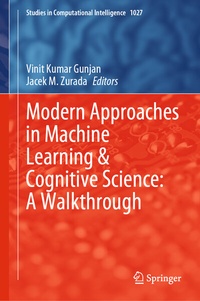
Modern Approaches in Machine Learning & Cognitive Science: A Walkthrough
Description

This book provides a systematic and comprehensive overview of AI and machine learning which have got the ability to identify patterns in large and complex data sets. A remarkable success has been experienced in the last decade by emulating the brain computer interface. It presents the cognitive science methods and technologies that have played an important role at the core of practical solutions for a wide scope of tasks between handheld apps, industrial process control, autonomous vehicles, environmental policies, life sciences, playing computer games, computational theory, and engineering development. The chapters in this book focuses on audiences interested in machine learning, cognitive and neuro-inspired computational systems, their theories, mechanisms, and architecture, which underline human and animal behaviour, and their application to conscious and intelligent systems. In the current version, it focuses on the successful implementation and step-by-step explanation of practical applications of the domain. It also offers a wide range of inspiring and interesting cutting-edge contributions on applications of machine learning and cognitive science such as healthcare products, medical electronics, and gaming.
More details
Other editions
Additional editions
Persons
Jacek M. Zurada is Professor of Electrical and Computer Engineering and Director of the Computational Intelligence Laboratory at the University of Louisville, Kentucky, USA, where he served as Department Chair and Distinguished University Scholar. He received his M.S. and Ph.D. degrees (with distinction) in electrical engineering from the Technical University of Gdansk, Poland. He has published over 420 journal and conference papers in neural networks, deep learning, computational intelligence, data mining, image processing, and VLSI circuits. He has authored or co-authored three books, including the pioneering text Introduction to artificial neural systems, co-edited the volumes computational intelligence: imitating life, knowledge-based neurocomputing, and co-edited twenty volumes in Springer Lecture Notes on Computer Science. In addition to his pioneering neural networks textbook, his most recognized achievements include an extension of complex-valued neurons to associative memories and perception networks; sensitivity concepts applied to multilayer neural networks; application of networks to clustering, biomedical image classification, and drug dosing; blind sources separation; and rule extraction as a tool for prediction of protein secondary structure.
