

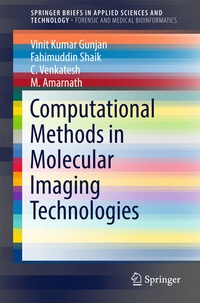
Computational Methods in Molecular Imaging Technologies
Description

This book highlights the experimental investigations that have been carried out on magnetic resonance imaging and computed tomography (MRI & CT) images using state-of-the-art Computational Image processing techniques, and tabulates the statistical values wherever necessary. In a very simple and straightforward way, it explains how image processing methods are used to improve the quality of medical images and facilitate analysis. It offers a valuable resource for researchers, engineers, medical doctors and bioinformatics experts alike.
More details
Other editions
Additional editions
Persons
Vinit Kumar Gunjan is an Associate Professor at Annamacharya Institute of Technology and Sciences (AITS), India. He is the Principal Investigator for a project funded by the Science and Engineering Research Board, Department of Science & Technology, Government of India. He also serves as the Chairman of the IEEE Young Professionals and has served as the Secretary of the IEEE Computer Society, Hyderabad Chapter. He worked with Tata Consultancy Services and the School of Engineering and Technology (SET), Sharda University, Noida before joining the AITS. Vinit is a member of several IEEE Societies, the ACM, ACCS and others, and has several national and international publications to his credit.
Fahimuddin Shaik holds a PhD in Electronics and Communication Engineering and currently serves as an Associate Professor at Annamacharya Institute of Technology & Sciences (AITS) (an Autonomous Institute), India. His research interests include Signal Processing, Time Series Analysisand Biomedical Image Processing. He is the Co-Principal Investigator for a project funded by the Science Engineering Research Board, Department of Science & Technology, Government of India. He has authored the books "Medical Imaging in Diabetes" and "Image Processing in Diabetic Related Causes" and is a member of professional bodies like the IEEE, BMESI, ISTE, IACSIT, IAENG etc.
C. Venkatesh is with Annamacharya Institute of Technology & Sciences (AITS), India, where he currently serves as an Assistant Professor. He received his B.Tech in Electronics & Communication Engineering and M.Tech (Embedded Systems) from Jawaharlal Nehru Technological University. He is a member of professional bodies like the IEEE, IE, ISTE, IACSIT, IAENG etc. His research interests include Biomedical Image Processing, Embedded Systems and Signal Processing.
Amarnath M. is a Technology Consultant with Hewlett Packard Globalsoft Pvt. Ltd. Australia. He is currently on deputation with Singtel Optus Pty Ltd. He is an ITIL Foundation in IT Service Management certified practitioner focused on comprehensive IT service management and continuous service improvement. He holds a Bachelor of Technology from Sri Venkateswara University, Tirupati, India and has extensive expertise as a Software Engineer, Solution Designer, Technical Architect and Application Support Engineer.
