

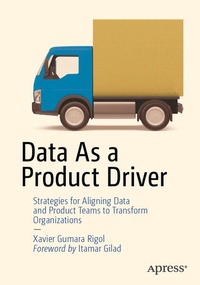
Data As a Product Driver
Description

Is your company struggling to get real value from data? Problem solved. This book is your guide to transforming an organization from one that treats data as an afterthought or merely a support function into one that makes data a key driver of product development and business innovation. In doing so, you will be able to measure outcomes that matter, rather than just tracking features shipped.
In a world where products are increasingly driven by data and AI, traditional approaches to product development and data management have become barriers to growth rather than enablers of success. At its core, this book establishes two fundamental principles for success: autonomous, outcome/data-driven product teams and the need for data assets to be managed as products. These principles are then expanded into practical frameworks, step-by-step implementation guides, and maturity models that cross-functional teams in any industry can incorporate in their decision-making.
Whether you are a product manager wanting to become more data-fluent, a data professional aiming to increase your product impact, or a leader trying to break down silos in your organization, Data as a Product Driver provides practical steps to transform how your company uses data.
What You Will Learn
- Reorganize your teams around business problems instead of technical disciplines.
- Manage the transition from centralized data teams to domain-driven decentralized data ownership.
- Build effective data platform teams that enable product teams while maintaining consistent standards across your data ecosystem.
- Create data assets that provide lasting value across your organization.
- Implement the right operating model for your company's size and maturity level.
Who This Book Is For
Product and data leads driving organizational transformation, product managers, team accountable leads, and data practitioners such as data engineers, data analysts, data scientists, and ML engineers who are willing to evolve their team's operating model to maximize value from data.
More details
Other editions
Additional editions
Person
Xavier Gumara Rigol has spent more than a decade at the intersection of product development and data, leading cross-functional teams focused on Business Intelligence, Data Engineering, Experimentation, and Product Information Management. His career spans from implementing data architectures for small businesses during his consulting days to participating in data transformation initiatives at companies like Schibsted, Adevinta, Oda, and Manychat. Having witnessed firsthand the evolution from treating data as a support function to embracing it as a core product driver, Xavier brings a unique perspective that makes him an authoritative voice on the convergence of data and product development.
Content
Part I: Understanding the Transformation.- 1. The Convergence of Data and Product.- 2. Building The Data-Driven Product Organization.- Part II: The First Pillar: Outcome-Driven Product Teams.- 3. Establishing Outcome-Oriented Measurement.- 4. Adopting a Problem-Centric Operating Model.- 5. Distributing Data Teams and Capabilities.- 6. Forming Cross-Functional Teams.- 7. Operating Empowered Product Teams.- Part III: The Second Pillar: Data Assets as Products.- 8. Scaling Data Infrastructure Through Platform Teams.- 9. Thinking in Data Products.- 10. Validating Data Product Ideas.- 11. Managing the Data Product Lifecycle.- 12. Architecting Datasets as Products.- 13. Building ML and AI Products.- Part IV: The Future Convergence.- 14. The Convergence of GenAI into Product.
