

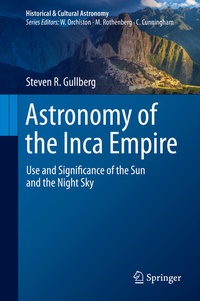
Astronomy of the Inca Empire
Use and Significance of the Sun and the Night Sky
1st Edition
Published on 6. August 2020
XVII, 370 pages
978-3-030-48366-1 (ISBN)
Description

Astronomy in the Inca Empire was a robust and fundamental practice. The subsequent Spanish conquest of the Andes region disrupted much of this indigenous culture and resulted in a significant loss of information about its rich history. Through modern archaeoastronomy, this book helps recover and interpret some of these elements of Inca civilization.
Astronomy was intricately woven into the very fabric of Andean existence and daily life. Accordingly, the text takes a holistic approach to its research, considering first and foremost the cultural context of each astronomy-related site. The chapters necessarily start with a history of the Incas from the beginning of their empire through the completion of the conquest by Spain before diving into an astronomical and cultural analysis of many of the huacas found in the heart of the Inca Empire.Over 300 color images-original artwork and many photos captured during the author's extensive field research in Machu Picchu, the SacredValley, Cusco, and elsewhere-are included throughout the book, adding visual insight to a rigorous examination of Inca astronomical sites and history.
Reviews / Votes
"This informative book, clearly a labor of love, animates a subject whose interest remains undimmed. Above the emperor Huayna Capac's former royal estate at Yucay, Gullberg documents two sun pillars whose counterparts in Cusco were destroyed after the Spanish invasion." (Christopher Heaney, Isis, Vol. 112 (4), December, 2021)"The book is astonishingly well illustrated, with a total of 312 figures . . The illustrations include both black-and-white and color photographs of archaeological sites and other items of cultural interest, as well as many original pencil drawings and watercolor paintings of sites and cultural miscellanea by the author's spouse, Jessica Gullberg. In sum, this is a highly informed and informative book. It raises the standard of the study of Inca astronomy and archaeoastronomy to a whole new level." (Gary Urton, Journal for the History of Astronomy, Vol. 52 (3), August, 2021)
More details
Series
Language
English
Place of publication
Cham
Switzerland
Publishing group
Springer International Publishing
Target group
Professional and scholarly
Product notice
Reflowable
Illustrations
XVII, 370 p. 317 illus., 275 illus. in color.
File size
55,36 MB
ISBN-13
978-3-030-48366-1 (9783030483661)
DOI
10.1007/978-3-030-48366-1
Schweitzer Classification
Other editions
Additional editions
Book
08/2020
Springer
€160.49
Shipment within 7-9 days
Person
Steven Gullberg holds a Ph.D. in astronomy from James Cook University (Australia) and is an Associate Professor at the University of Oklahoma, where he is Lead Faculty for the School of Integrative and Cultural Studies. He is the University's Director for Archaeoastronomy and Astronomy in Culture, and he also serves as Chair of the International Astronomical Union's Working Group for Archaeoastronomy and Astronomy in Culture. He has conducted extensive field research on the astronomy of the Incas in the Peruvian Andes and has written many research papers. At the University of Oklahoma, he led the development of a graduate-level archaeoastronomy distance-learning program designed to educate researchers around the world. Dr. Gullberg regularly presents papers at international conferences as he endeavors to globally advance the field of archaeoastronomy.
Content
1 Introduction ................... 2 Evolution of an Empire ................ 2.1 Before the Incas ............... 2.2 The Early Incas ................ 2.3 Rulers of Imperial Expansion ............ 2.4 Spanish Conquest ................ 2.5 Inca Resistance ................. 2.6 The Catholic Purge .............. 2.7 Summary...................
3 Cultural Context .................. 3.1 Religion .................. 3.2 Cosmology ................. 3.3 Sacred Landscape ............... 3.4 Camay ..................... 3.5 Intihuatanas ................... 3.6 Sacred Animals ................ 3.7 Ancestors ................... 3.8 Social Issues ................. 3.9 Organization ................. 3.10 Succession ................. 3.11 Festivals .................. 3.12 Climate ................... 3.13 Agriculture ................... 3.14 Irrigation ................... 3.15 Imperial Expansion ............... 3.16 Pilgrimage ................. 3.17 Building an Empire ............... 3.18 Architecture .................. 3.19 Inca Roads ................. 3.20 Carved Rocks ................ 3.21 Summary ...................
4 Ceques and Huacas .................. 4.1 History ..................... 4.2 Ceques ................... 4.3 Huacas ................... 4.4 Huaca Maintenance and Worship .......... 4.5 Ceque and Huaca Astronomy .......... 4.6 Ceque System Controversy ........... 4.7 Summary ..................
5 Archaeoastronomy ................ 5.1 The Celestial Sphere .............. 5.2 Motions of the Heavens ............ 5.3 Solstices and Equinoxes ............ 5.4 Cardinal Directions .............. 5.5 Zenith and Anti-Zenith Sun ............. 5.6 Horizon Astronomy ................ 5.7 Field Research .................. 5.8 Summary ....................
6 Inca Astronomy and Cosmology ........... 6.1 A Complex Astronomy ............... 6.2 Sun Worship ................. 6.3 Cosmology and Origins .............. 6.4 Principal Festivals and Ceremonies ........ 6.5 Inca Horizon Astronomy ............. 6.6 Architectural Alignments ............ 6.7 Ushnus, Sucancas, Pillars, and Gnomons ........ 6.8 Inca Calendar .................. 6.9 The Moon .................. 6.10 The Milky Way .................. 6.11 Stars .................... 6.12 Ceque System and the Stars ........... 6.13 Cosmology and Atmospheric Phenomena ....... 6.14 Summary ..................
7 Orientations at or near Cusco, Tipon, and Saihute .... 7.1 Kenko Grande ................... 7.2 Kenko Chico .................. 7.3 Mesa Redonda .................. 7.4 Tetecaca ................... 7.5 Patallacta ..................... 7.6 Kusilluchayoc ................. 7.7 Lacco ..................... 7.8 Huaca 44 .................... 7.9 Lanlakuyok ................... 7.10 Puca Pucara .................. 7.11 Tambomachay ................. 7.12 Sacsahuaman ................... 7.13 Mollaguanca ................. 7.14 Sapantiana .................. 7.15 Rumiwasi Bajo ................. 7.16 Rumiwasi Alto ................. 7.17 Kusicallanca .................. 7.18 Tipon .................... 7.19 Saihuite .................... 7.20 Summary ....................
8 Orientations in the Sacred Valley ............. 8.1 Chinchero ................... 8.2 Pisac ..................... 8.3 Q'espiwanka ................... 8.4 Cerro Pumahuachana .............. 8.5 Cerro Unoraqui ................. 8.6 Maras .................... 8.7 Moray ...................... 8.8 Choquequilla ................. 8.9 Ollantaytambo .................. 8.10 Summary ....................
9 Orientations at and near Machu Picchu ........ 9.1 History and Design ................ 9.2 Machu Picchu ................. 9.3 River Intihuatana ................. 9.4 Llactapata .................. 9.5 Summary ...................
10 Discussion, Findings, and Conclusion .......... 10.1 Discussion .................. 10.2 Findings ..................... 10.3 Concluding Remarks ...............
Appendices ...................... A.1 Glossary ................... A.2 Azimuths and Inclinations ............ A.3 GPS Field Data ................. A.4 Magnetic Declination .............. A.5 Solar Horizon Positions ............. A.6 Sperical Trigonometry Formulae ...........
Bibliography .....................
Index .........................
