

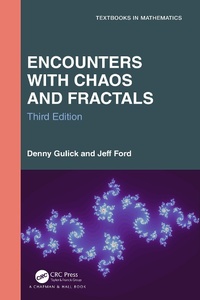
Encounters with Chaos and Fractals
3rd Edition
Published on 10. May 2024
410 pages
978-1-003-83577-6 (ISBN)
Description

Encounters with Chaos and Fractals, Third Edition provides an accessible introduction to chaotic dynamics and fractal geometry. It incorporates important mathematical concepts and backs up the definitions and results with motivation, examples, and applications.
The third edition updates this classic book for a modern audience. New applications on contemporary topics, like data science and mathematical modeling, appear throughout. Coding activities are transitioned to open-source programming languages, including Python.
The text begins with examples of mathematical behavior exhibited by chaotic systems, first in one dimension and then in two and three dimensions. Focusing on fractal geometry, the authors introduce famous, infinitely complicated fractals. How to obtain computer renditions of them is explained. The book concludes with Julia sets and the Mandelbrot set.
The Third Edition includes:
More coding activities incorporated in each section with expanded code to include pseudo-code, with specific examples in MATLAB (R) (or its open-source cousin Octave) and Python
Additional exercises-many updated-from previous editions
Proof-writing exercises for a more theoretical course
Revised sections to include historical context
Short sections added to explain applied problems in developing mathematics
This edition reveals how these ideas are continuing to be applied in the 21st century, while connecting to the long and winding history of dynamical systems. The primary focus is the beauty and diversity of these ideas. Offering more than enough material for a one-semester course, the authors show how these subjects continue to grow within mathematics and in many other disciplines.
The third edition updates this classic book for a modern audience. New applications on contemporary topics, like data science and mathematical modeling, appear throughout. Coding activities are transitioned to open-source programming languages, including Python.
The text begins with examples of mathematical behavior exhibited by chaotic systems, first in one dimension and then in two and three dimensions. Focusing on fractal geometry, the authors introduce famous, infinitely complicated fractals. How to obtain computer renditions of them is explained. The book concludes with Julia sets and the Mandelbrot set.
The Third Edition includes:
More coding activities incorporated in each section with expanded code to include pseudo-code, with specific examples in MATLAB (R) (or its open-source cousin Octave) and Python
Additional exercises-many updated-from previous editions
Proof-writing exercises for a more theoretical course
Revised sections to include historical context
Short sections added to explain applied problems in developing mathematics
This edition reveals how these ideas are continuing to be applied in the 21st century, while connecting to the long and winding history of dynamical systems. The primary focus is the beauty and diversity of these ideas. Offering more than enough material for a one-semester course, the authors show how these subjects continue to grow within mathematics and in many other disciplines.
More details
Series
Edition
3rd edition
Language
English
Place of publication
London
United Kingdom
Publishing group
Taylor & Francis Ebooks
Target group
College/higher education
Illustrations
160 Halftones, black and white; 160 Illustrations, black and white
ISBN-13
978-1-003-83577-6 (9781003835776)
Copyright in bibliographic data and cover images is held by Nielsen Book Services Limited or by the publishers or by their respective licensors: all rights reserved.
Schweitzer Classification
Other editions
Additional editions
Denny Gulick | Jeff Ford
Encounters with Chaos and Fractals
Book
05/2024
3rd Edition
Chapman & Hall/CRC
€122.50
Shipment within 10-20 days
Persons
Denny Gulick is Professor Emeritus in the Department of Mathematics at the University of Maryland. His research interests include operator theory and fractal geometry. He earned a PhD from Yale University.
Jeff Ford is a Visiting Assistant Professor of Mathematics at Gustavus Adolphus College. He earned his Bachelor's degree from Gustavus Adolphus College, his Master's degree in mathematics from Minnesota State University-Mankato, and his Ph.D. in mathematics from Auburn University, studying under Dr. Krystyna Kuperberg. Jeff is interested in the existence of volume-preserving dynamical systems with unique properties. Jeff uses and assesses a variety of active learning techniques in his class including inquiry-based learning and team-based learning. His scholarship in this area centers on understanding how active learning techniques improve confidence and reduce anxiety in undergraduate students.
Jeff Ford is a Visiting Assistant Professor of Mathematics at Gustavus Adolphus College. He earned his Bachelor's degree from Gustavus Adolphus College, his Master's degree in mathematics from Minnesota State University-Mankato, and his Ph.D. in mathematics from Auburn University, studying under Dr. Krystyna Kuperberg. Jeff is interested in the existence of volume-preserving dynamical systems with unique properties. Jeff uses and assesses a variety of active learning techniques in his class including inquiry-based learning and team-based learning. His scholarship in this area centers on understanding how active learning techniques improve confidence and reduce anxiety in undergraduate students.
Content
Chapter 1. Periodic Points. Chapter 2. One-Dimensional Chaos. Chapter 3. Two-Dimensional Chaos. Chapter 4. Systems of Differential Equations. Chapter 5. Introduction to Fractals. Chapter 6. Creating Fractal Sets. Chapter 7. Complex Fractals: Julia Sets and The Mandelbrot.
