

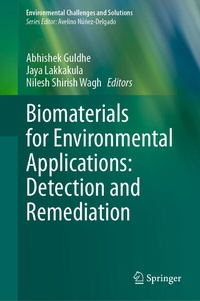
Biomaterials for Environmental Applications: Detection and Remediation
Description

Environmental pollutants are posing a threat to ecological balance, human health and climate. Early detection and efficient remediation of these pollutants is important to prevent further damage. Various natural and synthetic materials have been studied and applied for detection and remediation of environmental pollutants. Biomaterials have gained importance to tackle challenges pertaining to environmental issues owing to advantages like biocompatibility, specificity, ease of manufacturing, biodegradability, economical and environment friendly nature.
This book discusses current techniques based on various biomaterials for detection of environmental pollutants. This includes advancement in various biomolecules used in biosensors for pollutant detection. The book covers basics as well as recent trends in bioremediation using biomolecules such as chitosan, alginate, pectin, peptides, biochar etc. Nanomaterial synthesized using bacterial, fungus, algae and plants are also discussed in the book. Advanced conversion techniques to synthesize biomaterials, application strategies for detection and remediation of pollutants, challenges in application, economic and environmental impact are also discussed in the book.
More details
Other editions
Additional editions
Persons
Dr. Abhishek Guldhe was awarded Ph.D. from Institute for Water and Wastewater Technology at Durban University of Technology, South Africa. He is awarded with prestigious Ramalingaswami Re-entry Fellowship of Department of Biotechnology, Government of India in 2019. He has featured in the list of world's top 2% scientists published by Stanford University, USA. His research focus area is microalgal biotechnology for biofuels, fertilizers, bioactive compounds, and waste beneficiation application. He teaches courses on various subjects of Biotechnology and Environmental Sciences. He has published his research work extensively in prestigious journals, book chapters, books and presented in international conferences. His published research work has garnered interest from researchers across the globe. He is currently working as Associate Professor, Amity institute of Biotechnology, Amity University Maharashtra, Mumbai.
Dr. Jaya Lakkakula
holds a PhD Degree in Chemistry from the University of Johannesburg, South Africa (2014) and a master's degree in Botany (2008). She was awarded UJ-COMMONWEALTH bursary for pursuing Ph.D. at University of Johannesburg (Jan 2011 - Dec 2013). In addition to that she was awarded the UJ Merit bursary award and IBSA (India-Brazil-South Africa) trilateral fellowship at University of Johannesburg. She was a recipient of Sandiswa Imbewu grant at Rhodes University for Postdoctoral Fellowship. She completed her second Postdoctoral fellowship at IIT Bombay, India. Currently, Dr. Jaya Lakkakula is Assistant Professor at Amity Institute of Biotechnology, Amity University Maharashtra, India. Dr Lakkakula's field of expertise lies in nanomaterials, green synthesis, drug delivery etc. She has hands-on experience and expertise in the synthesis of nanomaterials and characterization techniques like UV-Vis, FTIR, SEM, TEM, Zeta sizer etc. She has expertise in designing novel delivery systems for hydrophobic drugs using cyclodextrins and polymer materials. She has guided undergraduate and
postgraduate students for research projects.
Dr. Nilesh Shirish Wagh holds a Doctoral degree in Biotechnology from Swami Ramanand Teerth Marathwada University, Nanded, Maharashtra, India. He was awarded the Department of Science and Technology-INSPIRE Fellowship during the Doctoral program in Biotechnology. Dr. Nilesh Wagh has qualified the National Eligibility Test (Lectureship) conducted by Council of Scientific and Industrial Research, New Delhi, India. Currently, Dr Nilesh Wagh is working as Assistant Professor at Amity Institute of Biotechnology, Amity University Maharashtra, India. Dr. Nilesh Wagh has expertise in molecular biology, plant phytochemicals-isolation, purification, characterization and their bioactivities. He also has experience in deducing the probable interactions between the phytochemicals (ligands) and molecular targets through in silico and in vitro approaches.
Content
Chapter 1. Enzyme Based Biosensors for Detection of Environmental Pollutants.- Chapter 2. Nano-Biomaterials in the Detection of Environmental Pollutants.- Chapter 3. Whole Cell-Based Biosensors for Detection of Environmental Pollutants.- Chapter 4. Lipids: Biomarkers for Detection of Environmental Pollutants.- Chapter 5. Chitosan-an Abundant Biopolymer Used for Water Treatment.- Chapter 6. Alginate Based Biosorbents for Environmental Remediation.- Chapter 7. Use of Pectin for Degradation of Environmental Pollutants.- Chapter 8. Biosurfactant as a Potential Strategy for Remediation.- Chapter 9. Utilization of Biochar for Remediation.- Chapter 10. Effect of Algae-Based Nanoparticles and Implications in Remediation.- Chapter 11. Role of Phytosynthesized Nanoparticles for Remediation of Contaminants.- Chapter 12. Exploring the Potential of Fungus Mediated Synthesis of Nanoparticles and Its Application in Remediation of Contaminated Environment.- Chapter 13. Use of Bacterial Reduced Nanoparticle as a Tool for the Environmental Remediation: An Overview.- Chapter 14. Advanced Nanocomposite Materials for Remediation of Hazardous Pollutants.
