

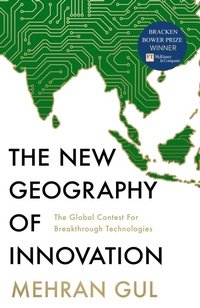
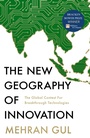
The New Geography of Innovation
The Global Contest for Breakthrough Technologies
Published on 3. July 2025
368 pages
978-0-00-832782-8 (ISBN)
Description

'Sprightly written and anecdote-rich' FINANCIAL TIMES
The US is the source of just about all the technologies that define modern life: personal computers, operating systems, smartphones, e-commerce, web browsers, email, search engines, social networks, electric cars and the rest. And most of the tech companies that created and monetized these technologies are also in the US.
In this book Mehran Gul, the winner of the Financial Times/McKinsey Bracken Bower Prize, asks: is that changing?
Less than a decade ago, the sentiment towards Chinese tech compa-nies was often dismissive and complacent. Now the alarm bells are ringing. But as the commentariat pontificates how the US-China tech battle will play out, an equally interesting question to ask is: are there more Chinas out there? Places no one is taking seriously now that might turn out to be massively competitive sooner than we think.
Samsung, a South Korean conglomerate, competes with Apple to be the world's largest manufacturer of smartphones. Arm, founded in the UK, develops chip designs that are used in more than 90 per cent of all mobile devices. Spotify, based in Sweden, is the most popular music streaming service in the world.
That's not all. The world's most important semiconductor company, TSMC, is in Taiwan. The other most important company in the semiconductor industry, ASML, is in the Netherlands. Some of the world's best-known games like Minecraft, Candy Crush and Angry Birds came from gaming studios in the Nordics. Nearly all the major electric battery manufacturers like CATL, LG, and SK On are in Asia.
This is a story about technology and the places where it finds its way into the world. Silicon Valley has for half a century been unrivalled in spinning out technologies and fast-growing, high-value, billion-dollar-plus tech companies, the Apples, Facebooks, Googles of the world, that made it the centre for the most rapid creation of wealth in human history. Its secrets are spreading to more places.
The geography of innovation is shifting. The world has a lot more high-value tech companies than ever before, growing a lot faster than ever before, in a lot more places than ever before. This is a book about these places.
The US is the source of just about all the technologies that define modern life: personal computers, operating systems, smartphones, e-commerce, web browsers, email, search engines, social networks, electric cars and the rest. And most of the tech companies that created and monetized these technologies are also in the US.
In this book Mehran Gul, the winner of the Financial Times/McKinsey Bracken Bower Prize, asks: is that changing?
Less than a decade ago, the sentiment towards Chinese tech compa-nies was often dismissive and complacent. Now the alarm bells are ringing. But as the commentariat pontificates how the US-China tech battle will play out, an equally interesting question to ask is: are there more Chinas out there? Places no one is taking seriously now that might turn out to be massively competitive sooner than we think.
Samsung, a South Korean conglomerate, competes with Apple to be the world's largest manufacturer of smartphones. Arm, founded in the UK, develops chip designs that are used in more than 90 per cent of all mobile devices. Spotify, based in Sweden, is the most popular music streaming service in the world.
That's not all. The world's most important semiconductor company, TSMC, is in Taiwan. The other most important company in the semiconductor industry, ASML, is in the Netherlands. Some of the world's best-known games like Minecraft, Candy Crush and Angry Birds came from gaming studios in the Nordics. Nearly all the major electric battery manufacturers like CATL, LG, and SK On are in Asia.
This is a story about technology and the places where it finds its way into the world. Silicon Valley has for half a century been unrivalled in spinning out technologies and fast-growing, high-value, billion-dollar-plus tech companies, the Apples, Facebooks, Googles of the world, that made it the centre for the most rapid creation of wealth in human history. Its secrets are spreading to more places.
The geography of innovation is shifting. The world has a lot more high-value tech companies than ever before, growing a lot faster than ever before, in a lot more places than ever before. This is a book about these places.
Reviews / Votes
'Sprightly written and anecdote-rich' Financial Times'Gul is undoubtedly right that we need to measure innovation against a lot of different metrics, not just market capitalization' Bloomberg
'A must-read for anyone curious about the future of innovation and how it touches lives in places we might not expect' Harper's Bazaar Arabia
'For anyone fascinated by questions about technological innovation, why it happens, what makes it happen ... This book has some wonderful case studies' Business Standard
'Gul's assessment of a dynamic landscape offers an early glimpse of a revolution poised to change everything' Asian Review of Books
'Fascinating' Monocle
More details
Language
English
Place of publication
London
United Kingdom
Publishing group
HarperCollins Publishers
Product notice
Reflowable
File size
2,26 MB
ISBN-13
978-0-00-832782-8 (9780008327828)
Copyright in bibliographic data and cover images is held by Nielsen Book Services Limited or by the publishers or by their respective licensors: all rights reserved.
Schweitzer Classification
Other editions
Additional editions
Book
approx. 07/2026
William Collins
€14.00
Not yet published
Book
07/2025
William Collins
€27.50
Shipment within 15-20 days
Book
07/2025
William Collins
€21.50
Available immediately
Book
07/2025
HarperCollins
€21.50
No shipping information available
Person
Mehran Gul thinks and writes about technology and business. He is a winner of the Financial Times/McKinsey Bracken Bower Prize. He attended Yale where he was a Fulbright Scholar, Fox International Fellow, and Teaching Fellow. He has been a Lead for the Digital Transformation of Industries at the World Economic Forum and an expert on Higher Education, Entrepreneurship, and Industrial Policy at the United Nations Industrial Development Organisation.
Before Yale, he studied at the Lahore University of Management Sciences. He has been a visiting scholar at the Jawaharlal Nehru University in New Delhi and a Fellow with the Acumen Fund. He lives in Switzerland and The New Geography of Innovation is his first book.
mehrangul.com
mehrang.substack.com
Before Yale, he studied at the Lahore University of Management Sciences. He has been a visiting scholar at the Jawaharlal Nehru University in New Delhi and a Fellow with the Acumen Fund. He lives in Switzerland and The New Geography of Innovation is his first book.
mehrangul.com
mehrang.substack.com
