

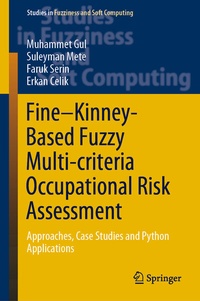
Fine-Kinney-Based Fuzzy Multi-criteria Occupational Risk Assessment
Description

This book presents a number of approaches to Fine-Kinney-based multi-criteria occupational risk-assessment. For each proposed approach, it provides case studies demonstrating their applicability, as well as Python coding, which will enable readers to implement them into their own risk assessment process.
The book begins by giving a review of Fine-Kinney occupational risk-assessment methods and their extension by fuzzy sets. It then progresses in a logical fashion, dedicating a chapter to each approach, including the fuzzy best and worst method, interval-valued Pythagorean fuzzy VIKOR and interval type-2 fuzzy QUALIFLEX.
This book will be of interest to professionals and researchers working in the field of occupational risk management, as well as postgraduate and undergraduate students studying applications of fuzzy systems.More details
Other editions
Additional editions
Persons
Dr
Muhammet Gul
is an associate professor in the Department of Industrial Engineering at Munzur university. He gained his MSc and PhD in 2011 and 2016 respectively, both from Yıldız Technical University. He has authored or co-authored around 75 journal and conference papers, and has acted as a reviewer for multiple journals and books. His research interests include risk assessment and management, operations research and fuzzy sets and systems.
Dr
Suleyman Mete
graduated with his PhD from Gaziantep University in 2017. He had gained his MSc from the same university in 2013. He currently works as an assistant professor at Gaziantep University, in the Department of Industrial Engineering. He has published over 30 journal and proceedings papers, mainly focused on assembly/disassembly line balancing, optimization and mathematical modelling.
Dr
Faruk Serin
currently works as an assistant professor in the Department of Computer Engineering at Munzur University. He gained his MSc and PhD from Inonu University in 2013 and 2017 respectively. Prior to becoming an assistant professor, he worked as a research assistant at Inonu University. His research interests include machine learning, computer aided diagnosis and multi-attribute decision-making.
Dr
Erkan Celik
has been associate professor at Munzur University since 2018. He graduated with his MSc in industrial engineering in 2011 from Selcuk University, and gained his PhD in 2015 from Yıldız Technical University. He has authored or co-authored over 60 journal papers and proceedings papers. He has reviewed papers for numerous journals.
Content
Fine-Kinney Occupational Risk Assessment Method and its Extensions by Fuzzy Sets: A State of the Art Review.- Fine-Kinney Based Occupational Risk Assessment Using Fuzzy Quality Function Deployment.- Fine-Kinney Based Occupational Risk Assessment Using Interval Type-2 Fuzzy TOPSIS.- Fine-Kinney Based Occupational Risk Assessment Using Interval Valued Pythagorean Fuzzy VIKOR.- Fine-Kinney Based Occupational Risk Assessment Using Intuitionistic Fuzzy TODIM.- Fine-Kinney Based Occupational Risk Assessment Using Hesitant Fuzzy MULTIMOORA.- Fine-Kinney Based Occupational Risk Assessment Using Single Valued Neutrosophic TOPSIS.- Fine-Kinney Based Occupational Risk Assessment Using Interval Type-2 Fuzzy QUALIFLEX.- Fine-Kinney Based Occupational Risk Assessment Using Interval Type-2 Fuzzy VIKOR.
