

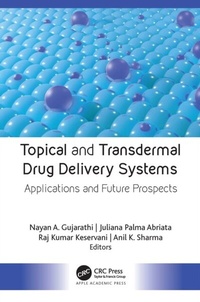
Topical and Transdermal Drug Delivery Systems
Applications and Future Prospects
1st Edition
Published on 6. February 2023
352 pages
978-1-000-57764-8 (ISBN)
Description

Topical and transdermal drug delivery systems (TDDs) have several advantages over traditional drug delivery methods, as they can be less invasive, more sanitary, more cost-effective, and may result in better patient compliance. TDDs play a significant role in therapeutics with a variety of preparations and approaches designed by expert formulation scientists. This volume integrates a wide variety of case studies, research, and theories to reveal their diversity and capture the novel approaches of transdermal and topical drug delivery employed by developers and content experts in the field. It provides an abundance of important information and state-of-the-art research on topical and transdermal drug delivery systems and addresses the basics of drug delivery systems, strategies to enhance permeation across membranes, and formulation and evaluation of diverse dosage forms.
The volume presents an evaluation of the pros and cons of conventional drug delivery systems against TDDs and discusses the nuances of micro- and nano-systems in TDDs. The extraordinary packages of nano systems (vesicular systems, polymeric nanoparticles, nanoemulsion and dendrimers) are broadly discussed, and their applications are reviewed through a transdermal route.
The book looks at TDDs and the main nanoparticles used in skin diseases and lesions of the aging, such as psoriasis, vitiligo, cancer, lesions of the aging and others. Chapters also discuss polymeric micelles in topical and transdermal delivery; microneedles; emulsion, nanoemulsion and microemulsion; TDDs in pulmonary drug delivery systems; nanoencapsulated nasal drug delivery systems; skin sensitivity and irritation testing for transposing transdermal drug delivery systems; and regulatory aspects of drug development for dermal products.
Topical and Transdermal Drug Delivery Systems: Applications and Prospects will be a valuable resource for pharmaceutical scientists and researchers, industry professionals, and academicians and students of the pharmaceutical and biomedical sciences.
The volume presents an evaluation of the pros and cons of conventional drug delivery systems against TDDs and discusses the nuances of micro- and nano-systems in TDDs. The extraordinary packages of nano systems (vesicular systems, polymeric nanoparticles, nanoemulsion and dendrimers) are broadly discussed, and their applications are reviewed through a transdermal route.
The book looks at TDDs and the main nanoparticles used in skin diseases and lesions of the aging, such as psoriasis, vitiligo, cancer, lesions of the aging and others. Chapters also discuss polymeric micelles in topical and transdermal delivery; microneedles; emulsion, nanoemulsion and microemulsion; TDDs in pulmonary drug delivery systems; nanoencapsulated nasal drug delivery systems; skin sensitivity and irritation testing for transposing transdermal drug delivery systems; and regulatory aspects of drug development for dermal products.
Topical and Transdermal Drug Delivery Systems: Applications and Prospects will be a valuable resource for pharmaceutical scientists and researchers, industry professionals, and academicians and students of the pharmaceutical and biomedical sciences.
More details
Edition
1. Auflage
Language
English
Place of publication
London
United Kingdom
Publishing group
Taylor & Francis Ltd
Target group
Professional and scholarly
Illustrations
7 Line drawings, color; 15 Line drawings, black and white; 7 Illustrations, color; 15 Illustrations, black and white
ISBN-13
978-1-000-57764-8 (9781000577648)
Copyright in bibliographic data and cover images is held by Nielsen Book Services Limited or by the publishers or by their respective licensors: all rights reserved.
Schweitzer Classification
Other editions
Additional editions
Nayan A. Gujarathi | Juliana Palma Abriata | Raj Kumar Keservani
Topical and Transdermal Drug Delivery Systems
Applications and Future Prospects
Book
02/2023
1st Edition
Apple Academic Press Inc.
€161.50
Shipment within 3-4 weeks
Persons
Nayan A. Gujarathi, PhD, MPharm, is Assistant Professor at the Department of Pharmaceutics, Shri Vile Parle Kelavani Mandal's Institute of Pharmacy, Dhule, India. He has 13 years of academic experience in pharmaceutical science. He has published over 30 peer-reviewed papers in the field of pharmaceutical sciences in national and international journals as well as several book chapters. He has presented his research work at an international conference organized by the Controlled Release Society and delivered several expert talks on outcome-based education for the accreditation process. His research interest encompasses novel drug delivery systems, polymer science, nanotechnology, and nutraceuticals.
Juliana Palma Abriata, PhD, is at the School of Pharmaceutical Sciences of Ribeirao Preto, Sao Paulo, Brazil, where she earned her master's degree as well as developed her doctoral research. She worked with the development and characterization of drug delivery systems for Chagas disease and ovarian cancer treatment. She was a guest PhD student at the College of Pharmacy, Ohio State University, USA, under the supervision of Dr. Robert Lee. She has published in the drug delivery field.
Raj Kumar Keservani, MPharm, is a Faculty of B. Pharmacy, CSM Group of Institutions, Allahabad, India. He has more than 12 years of academic (teaching) experience at various institutes of India in pharmaceutical education. He has published 30 peer-reviewed papers in the field of pharmaceutical sciences in national and international journals, 15 book chapters, three co-authored books, and 12 edited books. He is also active as a reviewer for several international scientific journals. His research interests include nutraceutical and functional foods, novel drug delivery systems (NDDS), transdermal drug delivery/drug delivery, health science, cancer biology, and neurobiology.
Anil Kumar Sharma, PhD, MPharm, is an expert in the area of pharmaceutics with a background in drug delivery. He has taught these subjects for nearly 10 years at universities such as the Delhi Institute of Pharmaceutical Sciences and Research, University of Delhi, and School of Medical and Allied Sciences, G D Goenka University, India. Prior to taking up his current role in 2018, Dr. Sharma served in academic positions such as Lecturer (Pharmaceutics), Delhi Institute of Pharmaceutical Sciences and Research, University of Delhi, India. He has published over 28 peer-reviewed papers in the field of pharmaceutical sciences in both national and international journals as well many book chapters and several edited books.
Juliana Palma Abriata, PhD, is at the School of Pharmaceutical Sciences of Ribeirao Preto, Sao Paulo, Brazil, where she earned her master's degree as well as developed her doctoral research. She worked with the development and characterization of drug delivery systems for Chagas disease and ovarian cancer treatment. She was a guest PhD student at the College of Pharmacy, Ohio State University, USA, under the supervision of Dr. Robert Lee. She has published in the drug delivery field.
Raj Kumar Keservani, MPharm, is a Faculty of B. Pharmacy, CSM Group of Institutions, Allahabad, India. He has more than 12 years of academic (teaching) experience at various institutes of India in pharmaceutical education. He has published 30 peer-reviewed papers in the field of pharmaceutical sciences in national and international journals, 15 book chapters, three co-authored books, and 12 edited books. He is also active as a reviewer for several international scientific journals. His research interests include nutraceutical and functional foods, novel drug delivery systems (NDDS), transdermal drug delivery/drug delivery, health science, cancer biology, and neurobiology.
Anil Kumar Sharma, PhD, MPharm, is an expert in the area of pharmaceutics with a background in drug delivery. He has taught these subjects for nearly 10 years at universities such as the Delhi Institute of Pharmaceutical Sciences and Research, University of Delhi, and School of Medical and Allied Sciences, G D Goenka University, India. Prior to taking up his current role in 2018, Dr. Sharma served in academic positions such as Lecturer (Pharmaceutics), Delhi Institute of Pharmaceutical Sciences and Research, University of Delhi, India. He has published over 28 peer-reviewed papers in the field of pharmaceutical sciences in both national and international journals as well many book chapters and several edited books.
Content
PART I: BASICS OF TRANSDERMAL DRUG DELIVERY SYSTEMS 1. Concepts and Applications in Topical and Transdermal Drug Delivery 2. Micro- and Nano-Systems in Transdermal Drug Delivery System 3. Advanced Topical and Transdermal Drug Delivery (TTDS) Used in Skin Diseases and Lesions of the Aging PART II: DIVERSE TRANSDERMAL DRUG DELIVERY SYSTEMS 4. Polymeric Micelles in Topical and Transdermal Delivery 5. Microneedles: An Innovative Strategy for Skin Drug Delivery, Diagnostic, and Cosmetologic Approaches 6. Emulsion, Nanoemulsion, and Microemulsion in Tdds 7. Pulmonary Drug Delivery Systems 8. Nanoencapsulated Nasal Drug Delivery System PART III: MISCELLANEOUS 9. Skin Sensitivity and Irritation Testing for Transposing Transdermal Drug Delivery System 10. Regulatory Aspects of Drug Development for Dermal Products
