

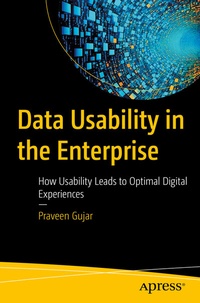
Data Usability in the Enterprise
Description

Ensuring data usability is paramount to unlocking a company's full potential and driving informed decision-making. Part of author Saurav Bhattacharya's trilogy that covers the essential pillars of digital ecosystems-security, reliability, and usability-this book offers a comprehensive exploration of the fundamental concepts, principles, and practices essential for enhancing data accessibility and effectiveness.
You'll study the core aspects of data design, standardization, and interoperability, gaining the knowledge needed to create and maintain high-quality data environments. By examining the tools and technologies that improve data usability, along with best practices for data visualization and user-centric strategies, this book serves as an invaluable resource for professionals seeking to leverage data more effectively.
The book also addresses crucial governance issues, ensuring data quality, integrity, and security are maintained. Through a detailed analysis of data governance frameworks and privacy concerns, you'll see how to manage data responsibly. Additionally, the book includes compelling case studies that highlight successful data usability implementations, future trends, and the challenges faced in achieving optimal data usability. By fostering a culture of data literacy and usability, this book will help you and your organization navigate the evolving data landscape and harness the power of data for innovation and growth.
What You Will Learn
- Understand the fundamental concepts and importance of data usability, including effective data design, enhancing data accessibility, and ensuring data standardization and interoperability.
- Review the latest tools and technologies that enhance data usability, best practices for data visualization, and strategies for implementing user-centric data approaches.
- Ensure data quality and integrity, while navigating data privacy and security concerns.
- Implement robust data governance frameworks to manage data responsibly and effectively.
Who This Book Is For
Cybersecurity and IT professionals
More details
Other editions
Additional editions
Person
Praveen Gujar stands at the forefront of product innovation, boasting an illustrious career close to two decades and marked by the successful launch of cutting-edge Enterprise Data products in Digital Advertising. A stalwart in the tech industry, Praveen has left his mark on tech giants like LinkedIn, Amazon, and Twitter, spearheading initiatives that have catapulted these companies into multi-billion dollar echelons.
A globally recognized thought leader, Praveen shares insights at prominent industry and academic conferences, expert panels, and publications in popular platforms such as Forbes and IEEE, shaping industry trends and guiding senior executives in AI, digital transformation, and product innovation. He holds fellowships with esteemed organizations such as Engineering and Technology (IET) IET and The Institution of Electronics and Telecommunication Engineers (IETE)IETE and serves as Marketing Chair for IEEE Technology and Engineering Management Society (TEMS)TEMS, further cementing his influence in the tech community. Praveen's work continues to inspire innovation and strategic growth across the tech landscape.
Content
Part 1; Introduction to Data Usability.- Chapter 1: Concepts and Importance.- Chapter 2: Principles of Effective Data Design.- Chapter 3: Enhancing Data Accessibility for Use Cases.- Chapter 4: Data Standardization and Interoperability.- Part 2: Tools & Experience.- Chapter 5: Tools and Technologies for Improved Data Usability.- Chapter 6: Data Visualization: Techniques and Best Practices.- Chapter 7: User-Centric Data Strategies.- Part 3: Governance.- Chapter 8: Ensuring Data Quality and Integrity.- Chapter 9: Data Governance and Usability Frameworks.- Chapter 10: Navigating Data Privacy and Security Concerns.- Part 4: Industry Perspective.- Chapter 11: Case Studies: Success Stories in Data Usability.- Chapter 12: Future Trends in Data Usability and Innovation.- Chapter 13: Building a Culture of Data Literacy and Usability.- Chapter 14: Challenges in Achieving Data Usability.- Part 5: Future Trends.- Chapter 15: The Road Ahead for Data Usability.- Part 6: Conclusion.- Chapter 16: Conclusion.
