

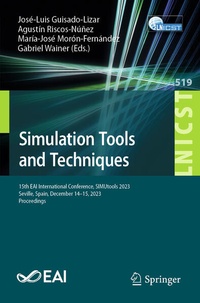
Simulation Tools and Techniques
Description

The 23 revised full papers were carefully selected from 58 submissions. The papers focus on various areas such as Simulation Tools and Methods; Artificial Intelligence and Simulation; Transportation and Logistics; Medical Sciences; and Network Simulations.
More details
Other editions
Additional editions
Content
.- Simulation Tools and Methods .
.- A DEVS-based methodology for simulation and model-driven development of IoT.
.- Performance Evaluation of a Legacy Real-Time System: An Improved RAST Approach.
.- KNXsim: Simulator tool for KNX home automation training by means of group addresses.
.- Development of a 3D visualization interface for virtualized UAVs.
.- Test-Driven Simulation of Robots Controlled by Enzymatic Numerical P Systems Models.
.- PySPN: An Extendable Python Library for Modeling & Simulation of Stochastic Petri Nets.
.- Replacing Sugarscape: A Comprehensive, Expansive, and Transparent Reimplementation.
.- Artificial Intelligence and Simulation.
.- Generative AI with Modeling and Simulation of Activity and Flow-based Diagrams.
.- Wildfire Risk Mapping based on Mutlti-Source Data and Machine Learning.
.- An Intelligent Ranking Evaluation Method of Simulation Models Based on Graph Neural Network.
.- Simulation of drinking water infrastructures through artificial intelligence-based modelling for
sustainability improvement.
.- Transportation and Logistics.
.- Spatio-temporal Speed Metrics for Traffic State Estimation on complex Urban Roads.
.- Integrating Efficient Routes with Station Monitoring for Electric Vehicles in Urban Environments: Simulation and Analysis.
.- Comparing the Efficiency of Traffic Simulations using Cellular Automata.
.- Multi-Agent Simulation for Scheduling and Path Planning of Autonomous Intelligent Vehicles.
.- Medical Sciences.
.- ECG pre-processing and feature extraction tool for intelligent simulation systems.
.- OTOVIRT: An image-guided workflow for individualized surgical planning and multiphysics simulation in cochlear implant patients.
.- Network Simulations.
.- Adaptive sharing of IoT resources through SDN-based microsegmentation of services using Mininet.
.- UAV-Assisted Wireless Communications: An Experimental Analysis of A2G and G2A Channels.
.- Trajectory-Aware Rate Adaptation for Flying Networks.- Rate Adaptation Aware Positioning for Flying Gateways using Reinforcement Learning.
.- RateRL: A Framework for Developing RL-Based Rate Adaptation Algorithms in ns-3.
.- On the Analysis of Computational Delays in Reinforcement Learning-based Rate Adaptation Algorithms.
