

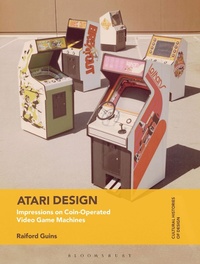
Atari Design
Impressions on Coin-Operated Video Game Machines
1st Edition
Published on 12. November 2020
280 pages
978-1-4742-8452-3 (ISBN)
Description

Drawing from deep archival research and extensive interviews, Atari Design is a rich, historical study of how Atari's industrial and graphic designers contributed to the development of the video game machine.
Innovative game design played a key role in the growth of Atari - from Pong to Asteroids and beyond - but fun, challenging and exciting game play was not unique to the famous Silicon Valley company. What set it apart from its competitors was innovation in the coin-op machine's cabinet. Atari did not just make games, it designed products for environments.
With "tasteful packaging", Atari exceeded traditional locations like bars, amusement parks and arcades, developing the look and feel of their game cabinets for new locations such as fast food restaurants, department stores, country clubs, university unions, and airports, making game-play a ubiquitous social and cultural experience. By actively shaping the interaction between user and machine, overcoming styling limitations and generating a distinct corporate identity, Atari designed products that impacted the everyday visual and material culture of the late 20th century.
Design was never an afterthought at Atari.
Innovative game design played a key role in the growth of Atari - from Pong to Asteroids and beyond - but fun, challenging and exciting game play was not unique to the famous Silicon Valley company. What set it apart from its competitors was innovation in the coin-op machine's cabinet. Atari did not just make games, it designed products for environments.
With "tasteful packaging", Atari exceeded traditional locations like bars, amusement parks and arcades, developing the look and feel of their game cabinets for new locations such as fast food restaurants, department stores, country clubs, university unions, and airports, making game-play a ubiquitous social and cultural experience. By actively shaping the interaction between user and machine, overcoming styling limitations and generating a distinct corporate identity, Atari designed products that impacted the everyday visual and material culture of the late 20th century.
Design was never an afterthought at Atari.
More details
Series
Edition
1. Auflage
Language
English
Place of publication
London
United Kingdom
Publishing group
Bloomsbury Publishing PLC
Illustrations
120 bw illus with 16 page colour plate section
ISBN-13
978-1-4742-8452-3 (9781474284523)
Copyright in bibliographic data and cover images is held by Nielsen Book Services Limited or by the publishers or by their respective licensors: all rights reserved.
Schweitzer Classification
Other editions
Additional editions
Book
11/2020
Bloomsbury Visual Arts
€31.50
Shipment within 15-20 days
Book
11/2020
Bloomsbury Visual Arts
€112.85
Article exhausted; check different version
Person
Raiford Guins is Professor of Cinema and Media Studies in the Media School and Adjunct Professor of Informatics at Indiana University, USA. He has authored Game After: A Cultural Study of Video Game Afterlife (2014) and Edited Clean Version: Technology and the Culture of Control (2009) and co-edited several collections including The Object Reader with Fiona Candlin (2009) and Debugging Game History: A Critical Lexicon with Henry Lowood (2016). Guins serves as co-editor of MIT Press's Game Histories book series with Lowood and is a founding editor of ROMchip: A Journal of Game Histories also with Lowood and Laine Nooney. His writings on game history appear in the following journals and magazines: American Journal of Play, The Atlantic, Cabinet, Design and Culture, Design Issues, Digital Culture & Education, Game Studies, Journal of Design History, Journal of Visual Culture, and Reconstruction: Studies in Contemporary Culture.
Content
List of Images
List of Plates
Prologue: Not on Display
Acknowledgements
Ignition: Advanced Electronics and Styling
Zero to 60 in 25¢
Design History of Video Games
1. Game Design is Inadequate
2. Platform Studies Doesn't Scratch These Surfaces
3. Coin-op Video Games Machines are Complex Artifacts
4. Cabinet Design is Design
Taking Anonymous History for a Spin
Chapter I: Start With a Clean Piece of Paper
Man, that thing needs some help
BEAUTIFUL SPACE-AGE CABINET: A Plasticine Moment
Low Key Cabinet, Suitable for Sophisticated Locations: The Veneer of Game History
Never Leave Well Enough Alone...
Chapter II: Come and Play Me
Far Out
More Than a Box
Independent Functionality, or Designing "Atari Style"
2 Game Module, or On the Importance of Not Shitting in the Punchbowl
Project Development, or Everything You Wanted to Know About Video Pinball (But Never Thought to Ask an Industrial Designer)
Chapter III: Happy Stuff
Uncabinet
Good Design is Good for (the Coin-Op) Business
Cabinets as Graphically Design Products
Chapter IV: A Kinesthetic World of Shapes and Color
Bold Impact
As you get Excited you Start to Hug the Game
Environmental Communication
Communicative Environments
Chapter V: Shifting Gears
Parking Brake: Look Beyond Finished Form
List of Plates
Prologue: Not on Display
Acknowledgements
Ignition: Advanced Electronics and Styling
Zero to 60 in 25¢
Design History of Video Games
1. Game Design is Inadequate
2. Platform Studies Doesn't Scratch These Surfaces
3. Coin-op Video Games Machines are Complex Artifacts
4. Cabinet Design is Design
Taking Anonymous History for a Spin
Chapter I: Start With a Clean Piece of Paper
Man, that thing needs some help
BEAUTIFUL SPACE-AGE CABINET: A Plasticine Moment
Low Key Cabinet, Suitable for Sophisticated Locations: The Veneer of Game History
Never Leave Well Enough Alone...
Chapter II: Come and Play Me
Far Out
More Than a Box
Independent Functionality, or Designing "Atari Style"
2 Game Module, or On the Importance of Not Shitting in the Punchbowl
Project Development, or Everything You Wanted to Know About Video Pinball (But Never Thought to Ask an Industrial Designer)
Chapter III: Happy Stuff
Uncabinet
Good Design is Good for (the Coin-Op) Business
Cabinets as Graphically Design Products
Chapter IV: A Kinesthetic World of Shapes and Color
Bold Impact
As you get Excited you Start to Hug the Game
Environmental Communication
Communicative Environments
Chapter V: Shifting Gears
Parking Brake: Look Beyond Finished Form
