

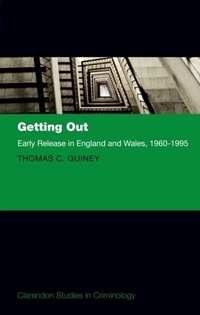
Getting Out
Early Release in England and Wales, 1960 - 1995
1st Edition
Published on 12. July 2018
304 pages
978-0-19-252556-7 (ISBN)
Description

Getting Out offers the first systematic account of the evolution of early release as a public policy concern in England and Wales between 1960 and 1995.
At a time when public discourse on crime has focused, to a significant degree, upon the powers of the police and the sentence of the court this book seeks to turn current debate on its head and examine the circumstances in which policy makers have found it desirable to reduce the custodial element of a prison sentence and return prisoners to the community.
Drawing upon an extensive period of archival research, and interviews with key decision-makers, this book considers three defining periods of reform that illuminate the complex ideas, trade-offs, and moments of political controversy that have shaped this secretive and little understood area of penal policy.
The book argues that early release is inherently bound up with prevailing societal justifications for punishment and the appropriate use of imprisonment within our liberal democratic system. It draws attention to the uneasy constitutional balance of power between the judiciary and the executive, and reflects upon the administrative task of governing large captive populations where the hopes and expectations of inmates do not always align with the interests of prison authorities or the community at large.
In so doing, Getting Out challenges widespread assumptions about penal change and shows how government policy has been shaped by the legacy of past political choices, the organisation of central government departments and the fluid balance of power within Whitehall.
More details
Other editions
Additional editions
Book
08/2018
Oxford University Press
€99.40
Shipment within 15-20 days
Person
Dr Thomas Guiney is a Visiting Fellow at the Mannheim Centre for Criminology. He completed his PhD at the London School of Economics and was awarded the Titmuss Award for Best Overall Thesis in 2016 for the quality and originality of his research. He has written widely on penal policy and his work has featured on national print media, TV and radio.
Content
- Cover
- Series
- Getting Out
- Copyright
- Table of Contents
- List of Figures
- List of Tables
- Part I Introduction
- 1. Early Release in Comparative Historical Perspective
- Introduction
- When to Release: Justice, Fairness, and the Limits of the Liberal Democratic State
- Situating Early Release: Criminal Justice as a Public Policy Concern
- Case Studies: Three Defining Moments of Reform
- Conclusion
- 2. Conceptualizing Policy Change
- Beyond Structure and Agency: The Mediating Role of Political Institutions
- Historical Institutionalism: Organizational Factors in Political Life
- The Criminologist as Historian
- Conclusion
- Part II Penal Optimism, 1960-?1968
- 3. An Idea Whose Time Had Come: Parole, Indeterminacy, and the Personalization of Punishment
- A Brief History of Early Release in England and Wales
- Criminal Justice in an Age of Optimism
- A Recognizable Peak: The Coupling of Parole and Indeterminacy
- A System of Parole Takes Shape: The Adult Offender White Paper
- 4. A Very British Compromise: The Criminal Justice Act 1967
- A Change at the Top
- Managing the Crisis: A Home Office on the Back Foot
- The Criminal Justice Act 1967
- Cautious First Steps for the Parole System in England and Wales
- Conclusion: A Victory for Principle or Pragmatism?
- Part III An Age of Uncertainty, 1975-?1983
- 5. Squaring the Circle: Early Release and Short Sentence Prisoners
- The Long Shadow of Disinvestment
- The 'Jenkins Initiative'
- Policy Innovation: The Partly Suspended Sentence
- New Government, New Direction
- 6. The Politics of Inertia: The Criminal Justice Act 1982
- On the Horns of a Dilemma: The Question of Short-?Term Prisoners
- The Home Office Review of Parole in England and Wales
- 'Whitelaw Mark 1 and Whitelaw Mark 2'
- The Criminal Justice Act 1982
- Conclusion: Administrative Realpolitik
- Part IV Breakdown and Renewal, 1987-?1995
- 7. Truth in Sentencing: The Carlisle Committee Review of Parole in England and Wales
- A Restricted Operating Space
- The Introduction of 50 Per Cent Remission
- The Carlisle Committee Review of Parole in England and Wales
- Managing the Fallout
- 8. A New System Takes Shape: The Criminal Justice Act 1991
- The 1987 General Election: From Penal Pragmatism to a Strategic Approach
- A Fragile Consensus: The Green Paper and Ditchley Park
- The Criminal Justice Act 1991
- The Backlash Begins
- Conclusion: Penal Policy at a Crossroads
- Part V Discussion
- 9. Organizational Factors in Early Release Policy and Practice
- Inside the Home Office: From Plurality to Action
- The Mediations of Political Power
- Law's Empire
- Conclusion: Criminal Justice as Statecraft
- 10. Temporal Factors in Early Release Policy and Practice
- Policy-?Making in Real-?World Settings
- Path Dependence
- Continuity and Change
- Conclusion: The Merits of Comparative Historical Study
- Postscript
- Context
- 1997-?2003
- 2004-?2009
- 2010-?2017
- Appendix 1: Early Release Key Event Timeline, 1960-?1995
- Appendix 2: Biography of Key Actors
- Appendix 3: Carlisle Review Committee Membership and Terms of Reference
- Bibliography
- Copyright Acknowledgements
- Index
