

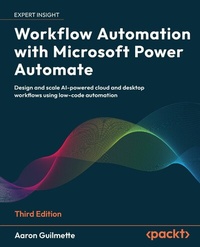
Workflow Automation with Microsoft Power Automate
Description

- Learn to create robust cloud and desktop automations through real-world examples
- Implement best practices for security, governance, and monitoring
Book DescriptionWhether you're automating a daily task or implementing automation at scale, this third edition gives you everything you need to succeed. This practical guide makes automation accessible, helping you streamline operations using low-code cloud flows, desktop RPA, and AI tools built into Microsoft Power Automate. You'll begin by building foundational skills through easy-to-follow tutorials that show how to automate actions across Outlook, Teams, SharePoint, Slack, and more. From there, you'll level up to integrating approvals, databases, and Forms, handle complex scenarios such as sequential and parallel approvals, and manage shared flows. The book explores Power Automate's robotic process automation capabilities, teaching you how to automate legacy applications, web interfaces, and Access databases. With expanded coverage of AI Builder, sentiment analysis, Copilot, and document summarization using generative AI, you'll gain hands-on experience creating intelligent, responsive workflows that drive efficiency. Written by a Microsoft 365 expert, this third edition adds 8 new chapters along with guidance on governance, compliance, and enterprise deployment, making it a complete guide for anyone looking to get started or scale automation with Power Automate. *Email sign-up and proof of purchase requiredWhat you will learn - Build cloud flows using triggers, connectors, and actions
- Use Copilot and generative AI to create and edit flows
- Automate desktop tasks with Power Automate for Desktop
- Create approval processes for Teams, Slack, and email
- Connect Power Automate to Dataverse, Forms, and SQL
- Implement error handling, monitoring, and troubleshooting
- Govern and scale automations using best practices
Who this book is forThis book is ideal for information workers, citizen developers, and Power users looking to automate workflows across Microsoft 365, Teams, Outlook, and third-party platforms. Basic familiarity with Microsoft 365 is recommended.
All prices
More details
Other editions
New editions
Content
Preface
There was a time when "automation" meant writing a script that only worked on your laptop, broke every Friday, and required you to fix it before anyone noticed. Thankfully, those days are (mostly) over. Microsoft Power Automate has continued to evolve over the past few years since the last edition of this book. It's moved from just being the duct tape of digital productivity (except smarter, cleaner, and slightly less sticky) to something that can be used to streamline both your business and your daily tasks.
This third edition of Workflow Automation with Microsoft Power Automate takes things further. Robotic process automation lets you automate the previously unautomatable-the old apps that refuse to retire and the screens that pretend it's still 2003. Copilot now helps you build flows by simply explaining what you want in plain English, which means you can finally stop arguing with your syntax (again, mostly). And with access to AI tools and models built into the platform, your automations can analyze, predict, and respond faster than you can get ChatGPT to spit out a rap about oatmeal.
You'll still find the familiar foundations from the previous edition: how to connect cloud and on-premises systems, streamline repetitive work, and reclaim the hours you've been donating to manual tasks. But this time, we'll do it with a little more intelligence-and a little more personality. Hopefully, you'll pick up some ideas along the way on how low-code automation and AI can make everything just a little easier.
Who this book is for
This book is for anyone who's ever thought, "There has to be a better way to do this." If you're new to Microsoft Power Platform-whether that means Power Automate, Power Apps, or Power BI-you're in the right place. You don't need to know how to code, architect enterprise systems, or speak fluent tech jargon. You just need a healthy curiosity and maybe a mild frustration with repetitive work to inspire you to find a new way.
We'll start with the basics: simple, practical tasks that teach you how the pieces of the platform work. From there, you can move right into learning more complex skills, maybe even getting some ideas on how to begin solving problems you have right now. Along the way, you'll build real workflows-things you can export, use, and brag about to your dog.
By the end, you'll see how the Power Platform can turn routine work into something smarter, faster, and (dare we say?) kind of fun.
What this book covers
Chapter 1, Introducing Microsoft Power Automate, introduces the basic concepts of workflows and automation.
Chapter 2, Getting Started with Power Automate, dives into the Power Automate interface and application components.
Chapter 3, Working with Email, explains how to configure Power Automate to process and interact with emails and attachments.
Chapter 4, Copying Files, explores how to use Power Automate to copy files between cloud-based services.
Chapter 5, Creating Button Flows, demonstrates how to use button flows (also called manual or instant flows) and shows how they can be executed from mobile devices.
Chapter 6, Generating Push Notifications, explains how to configure flows with push notifications to mobile devices.
Chapter 7, Working with Shared Flows, covers how to share and co-manage flows with your peers.
Chapter 8, Working with Conditions, explains how to enable multiple outcomes for flows based on criteria evaluation.
Chapter 9, Understanding Expressions and Functions, describes the concepts of more complex components such as functions and expressions.
Chapter 10, Getting Started with Approvals, discusses how to use approval workflows for documents.
Chapter 11, Working with Multiple Approvals, builds on the knowledge gained in the previous chapter and expands it using conditions, branching, and sequential approvals.
Chapter 12, Posting Approvals to Teams, demonstrates how to integrate approval workflows into Microsoft Teams.
Chapter 13, Using Databases, covers connecting to a database and using it to store or retrieve information as part of a flow.
Chapter 14, Working with Microsoft Forms, demonstrates how to use Power Automate to process response data from Microsoft Forms.
Chapter 15, Posting to Slack, covers using Power Automate to connect Slack and Teams.
Chapter 16, Accepting User Input, explores configuring a button flow to accept a variety of user input types.
Chapter 17, Automating Entra ID, introduces connectors for working with Microsoft Graph and Entra ID.
Chapter 18, Introducing Robotic Process Automation, talks about capturing screen, keyboard, and mouse data.
Chapter 19, Contributing to an Access Database with RPA, explains how to use Power Automate Desktop to perform data entry in Microsoft Access.
Chapter 20, Automating Web Pages with RPA, demonstrates concepts for automating web pages through screen scraping and screen capture.
Chapter 21, Introducing AI Models and Generative AI, introduces the AI Builder components in the Power Platform as well as generative AI capabilities.
Chapter 22, Creating a Sentiment Analysis Flow, explores using the Sentiment Analysis AI Builder model for evaluating text as either positive, neutral, or negative sentiment and then taking action on it.
Chapter 23, Using Copilot to Create and Manage Flows, covers some of the new Copilot capabilities.
Chapter 24, Using Generative AI to Summarize Documents, walks through using OpenAI tools to work with documents and generate document summaries based on an uploaded file.
Chapter 25, Exporting, Importing, and Distributing Flows, shows how to move flows in and out of environments.
Chapter 26, Monitoring and Troubleshooting Flows, contains troubleshooting tips for when things go wrong.
Chapter 27, Governance in the Power Platform, introduces some of the security and governance controls using the Center of Excellence and data loss prevention.
To get the most out of this book
To get the most out of this book, you should have a Microsoft 365 subscription with access to a premium Power Automate plan to enable access to premium connectors, AI models, and Robotic Process Automation (RPA).
You should also have an internet-connected computer with a modern browser such as Microsoft Edge or Google Chrome. You can obtain a free Microsoft 365 subscription from https://www.microsoft.com/en-us/microsoft-365/try.
Download the example code files
The code bundle for the book is hosted on GitHub at https://github.com/PacktPublishing/Workflow-Automation-with-Microsoft-Power-Automate-Third-Edition. We also have other code bundles from our rich catalog of books and videos available at https://github.com/PacktPublishing. Check them out!
Download the color images
We also provide a PDF file that has color images of the screenshots/diagrams used in this book. You can download it here: https://packt.link/gbp/9781836649632.
Conventions used
There are a number of text conventions used throughout this book.
CodeInText: Indicates code words in text, database table names, folder names, filenames, file extensions, pathnames, dummy URLs, user input, and X/Twitter handles. For example: "In the Search connectors and actions box, type SharePoint Create new folder and select the Create new folder SharePoint action."
A block of code is set as follows:
if [condition equals true], then [do action]; else [do other action] Bold: Indicates a new term, an important word, or words that you see on the screen. For instance, words in menus or dialog boxes appear in the text like this. For example: "In the Add an action flyout, select the Send me a mobile notification action."
Warnings or important notes appear like this.
Tips and tricks appear like this.
Get in touch
Feedback from our readers is always welcome.
General feedback: If you have questions about any aspect of this book or have any general feedback, please email us at customercare@packt.com and mention the book's title in the subject of your message.
Errata: Although we have taken every care to ensure the accuracy of our content, mistakes do happen. If you have found a mistake in this book, we would be grateful if you reported this to us. Please visit http://www.packt.com/submit-errata, click Submit...
