

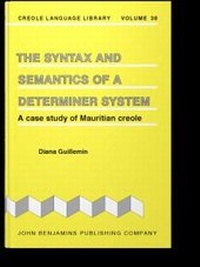
The Syntax and Semantics of a Determiner System
A case study of Mauritian creole
1st Edition
Published on 16. November 2011
XVIII, 310 pages
978-90-272-8470-9 (ISBN)
Description

Within the framework of Chomsky's Minimalism and Formal Semantics, this work documents the development of the Mauritian Creole (MC) determiner system from the mid 18th century to the present. Guillemin proposes that the loss of the French quantificational determiners, which agglutinated to nouns, resulted in the occurrence of bare nouns in argument positions. This triggered a shift in noun denotation, from predicative in French to argumental in MC, and accounts for the very different determiner systems of the creole and its lexifier. MC nouns are lexically stored as Kind denoting terms, that share some of the distributional properties of English bare plurals. New MC determiners are analyzed as 'type shifting operators' that shift Kinds into predicates, and serve to establish the referential properties of noun phrases. The analysis provides evidence for the universality of semantic features like Definiteness and Specificity, and the mapping of their form and function.
More details
Other editions
Additional editions
Book
11/2011
John Benjamins Publishing Co
€111.30
Shipment within 10-15 days
Person
Content
- The Syntax and Semantics of a Determiner System
- Editorial page
- Title page
- LCC data
- Dedication page
- Table of contents
- Acknowledgements
- 1. Sources of Mauritian Creole
- 1. Origins
- 2. Language situation in Mauritius
- 3. A corpus-based approach to the study of MC determiners
- 4. Outline of this work
- 2. Introduction
- 1. Why the determiner system?
- 1.1 A quantificational approach
- 2. Early changes from French to MC
- 3. The new MC determiner system
- 4. Syntactic framework
- 4.1 A rationale for Minimalism
- 4.2 The Determiner Phrase
- 5. Semantics of determiners
- 5.1 Definitions
- 5.2 Formal Semantics
- 5.3 Noun categories and layers in the DP
- 6. The feature argumental [ARG]
- 7. Contribution to linguistic theory
- 3. Syntactic framework
- 1. Assumptions of the Minimalist Program
- 1.1 X-bar theory
- 1.1.1 Bare phrase structure
- 1.2 Contain and c-command
- 1.3 Economy principles
- 1.4 The principle of Full Interpretation
- 1.5 Derivation by phase
- 1.6 Case and agreement
- 2. Logical form
- 2.1 Quantifier raising
- 2.2 Scope
- 2.3 Legitimate LF elements
- 3. The architecture of the MC clause
- 3.1 The Split Inflectional Hypothesis
- 4. Predication
- 4.1 The predicate phrase
- 5. DPs and NPs
- 5.1 Weak and strong determiners
- 6. Bare nouns and the feature Argument [ARG]
- 7. The architecture of the MC noun phrase
- 7.1 Phases within the DP
- 7.1.1 Licensing empty categories
- 4 . Semantics
- 1. Introduction
- 2. Part I: Definitions
- 2.1 Definiteness
- 2.1.1 The 'Familiarity' theory of definiteness
- 2.1.2 Incomplete definite descriptions
- 2.1.3 Singular and plural definite descriptions
- 2.1.4 Referential and attributive uses of definite descriptions
- 2.1.5 Stages of Familiarity
- 2.1.6 Anaphoric uses of definite descriptions
- 2.1.7 Immediate situational uses of definite descriptions
- 2.1.8 Larger situational uses of definite descriptions
- 2.1.9 Unfamiliarity uses of definite descriptions
- 2.2 Specificity
- 2.2.1 The indefinite article
- 2.2.2 Indefinite 'this'
- 2.2.3 Are all definites specific?
- 2.3 Deixis
- 2.3.1 Exophoric functions of demonstratives
- 2.3.2 ndophoric functions of demonstratives
- 3. Part II: The function of determiners and the denotation of nouns
- 3.1 Weak and strong determiners
- 3.2 DPs and NPs
- 3.3 Denotation
- 3.4 Kinds
- 4. The count vs. mass distinction
- 4.1 Parts and boundaries
- 4.1.1 The function PL(ural)
- 4.1.2 The ELT (Element of) function
- 4.1.3 The function Definiteness
- 4.2 The atomic structure of nouns
- 5. Part III: Formal Semantics
- 5.1 Categories of noun phrases
- 5.2 Partee's 'Noun interpretation and Type-shifting principles'
- 5.3 Chierchia's 'Derived Kind Predication'
- 5.4 Zamparelli's 'Multi-Layer DP Hypothesis'
- 6. The semantics of Predication
- 6.1 Aristotle's definition of Predication
- 6.2 Bowers' (1993) Semantics of Predication
- 6.3 Type-shifting: General principles and particular rules
- 5. Early changes
- 1. Introduction
- 2. Reanalysis and loss of the French determiners
- 2.1 From French DP to MC N
- 2.2 Bantu influence?
- 2.3 Ambiguous interpretations of bare nouns
- 2.4 Early evidence of article incorporation
- 2.4.1 Ambiguous interpretations of MC nouns in early MC
- 3. A new determiner system
- 3.1 The demonstrative 'sa'
- 3.2 The indefinite singular 'enn'
- 3.3 The post nominal Specificity marker 'la'
- 3.4 The plural marker 'bann'
- 3.5 The definite determiner 'so'
- 3.6 Bare nouns
- 3.7 A phonologically null definite determiner
- 4. The loss of an overt copula
- 4.1 The copula 'ete'
- 4.2 Predicative constructions in early MC
- 4.3 The resumptive pronoun 'li'
- 4.4 'Li' a predicate marker?
- 4.5 'De-marking'
- 5. The loss of the French functional prepositions 'à' and 'de'
- 5.1 The lexical prepositions
- 5.1.1 The prepositon 'à'
- 5.1.2 The prepositon 'de'
- 5.2 Genitive constructions
- 5.2.1 Two genitive constructions in modern MC
- 6. Conclusion
- 6. The emergence of a new determiner system
- 1. Introduction
- 2. The discourse markers
- 2.1 Marking Topic: The demonstratives 'ça . là' - 1750 to 1820
- 2.2 'a' without 'là' - 1820 onwards
- 2.2.1 No proximate vs. distal deictic contrast in MC
- 2.3 The Specificity marker 'là' - 1820 onwards
- 2.4 Recalling a Topic - 'là' marks old information
- 2.5 A number feature in 'ça' and 'là'?
- 2.6 Indefinite 'ça . là'
- 2.7 Summary
- 3. Bare mass nouns
- 3.1 Bare mass nouns as subject
- 3.2 Bare mass nouns as direct object
- 3.3 Bare mass nouns as object of preposition
- 3.3.1 The demonstrative 'ça .là' with mass nouns - 1850 onwards
- 3.4 Summary
- 4. Bare nouns
- 4.1 Bare count nouns as subject
- 4.2 Bare count nouns as direct object
- 4.3 Bare count nouns as object of preposition
- 4.4 Bare count nouns in the scope of negation
- 5. The quantificational determiners
- 5.1 The indefinite singular article 'enn' - 1820 onwards
- 5.1.1 Nominal predicates
- 5.1.2 Existential constructions
- 5.1.3 Indefinite singular direct object
- 5.1.4 Indefinite singular subject
- 5.2 The definite determiner 'so' - 1835 onwards
- 5.2.1 From possessive pronoun to determiner
- 5.2.2 'So' marks Focus
- 5.2.3 'So' as an emphatic determiner
- 5.3 The universal quantifier 'tout/tous' - 1820 onwards
- 5.4 The proportional quantifier 'bon morceau' - 1820 onwards
- 5.5 The proportional quantifier 'enne bande' - 1850 onwards
- 5.6 The plural marker 'bann' - 1885 onwards
- 5.7 The mass noun quantifier 'morceau' - 1820 onwards
- 5.8 '(Bon) morceau' with unique and abstract nouns
- 6. Summary
- 7. The modern MC determiner system
- 1. Introduction
- 2. Bare count nouns
- 2.1 Bare count nouns in existential constructions
- 2.2 Bare count nouns as subject of stage level predicates
- 2.3 Bare count nouns as subject of individual level predicates
- 2.4 Bare count nouns ascomplement of opacity inducing predicates
- 2.5 Bare nouns as complement of stage level predicates
- 2.6 Bare count nouns as object of preposition
- 2.6.1 Object of preposition in generic contexts
- 2.7 Unique nouns
- 3. Bare mass nouns
- 3.1 Bare mass nouns in existential constructions
- 3.2 Bare mass nouns as subject of stage level predicates
- 3.3 Bare mass nouns as subject of individual level predicates
- 3.4 Bare mass nouns as complement of opacity inducing predicates
- 3.5 Bare mass nouns as object of preposition
- 4. The discourse markers
- 4.1 The Specificity marker 'la'
- 4.1.1 'La' is not a suffix
- 4.1.2 'La' with singular count nouns
- 4.1.3 'La' with plural count nouns
- 4.1.4 'La' with mass nouns
- 4.2 The demonstratives 'sa .la'
- 4.2.1 Indefintie 'sa . la'
- 4.3 'Sa' without 'la'
- 5. The quantificational determiners
- 5.1 The indefinite singular 'enn'
- 5.1.1 'Enn' in existential constructions
- 5.1.2 Singular indefinites as subject of stage level predicates
- 5.1.3 Singular indefinites as subject of individual level predicates
- 5.1.4 Singular indefinites in direct object position
- 5.1.5 Singular indefinites as object of preposition
- 5.2 The proportional quantifier 'ennbann'
- 5.3 The plural marker 'bann'
- 5.3.1 The plural marker in existential sentences
- 5.3.2 The plural marker in subject position
- 5.3.3 The plural marker in direct object position
- 5.3.4 The plural marker in prepositional object position
- 5.3.5 A definition of 'bann'
- 5.3.6 Why does MC need a plural marker?
- 5.4 The emphatic determiner 'so'
- 6. Summary
- 8. Noun denotation and function of determiners
- 1. Introduction
- 2. Noun denotation
- 2.1 Kinds and properties
- 2.2 Categories of nouns and type shifting principles
- 2.3 The count vs. mass distinction
- 2.4 Kinds, predicates and GQs
- 3. DPs and NPs
- 3.1 English bare plurals
- 4. Comparing MC bare nouns and English bare plurals
- 4.1 Similarities between MC bare nouns with English bare plurals
- 4.1.1 In the scope of negation
- 4.1.2 With opacity inducing predicates
- 4.1.3 In the scope of sentence final time adverbs
- 4.1.4 Anaphora
- 4.1.5 Bare plurals and mass nouns
- 4.2 Differences between MC bare nouns and English bare plurals
- 4.2.1 Count nouns with stage level predicates
- 4.2.2 Count nouns with individual level predicates
- 4.2.3 Mass nouns with stage level predicates
- 4.2.4 Mass nouns with individual level predicates
- 5. A shift in noun denotation from French to Creole
- 5.1 From predicative nouns in French to argumental nouns in MC
- 5.2 The feature Argumental [ARG]
- 5.3 Deriving instances of kinds
- 5.4 The functions PL(ural) and ELT (Element of) in English
- 5.5 Marking plural in MC: The function of bann
- 5.6 Marking singular in MC: The function of enn
- 5.7 Marking definiteness
- 6. Type shifting principles
- 6.1 How type shifting operators apply in MC
- 6.1.1 The function lift
- 6.1.2 The function nom
- 6.1.3 The function pred
- 6.1.4 The function THE
- 6.1.5 The function BE
- 6.1.6 The function A
- 9. The syntax of the MC Noun Phrase
- 1. Introduction
- 2. Kinds, predicates and GQs
- 2.1 Layers in the DP
- 2.2 Count and mass nouns in predicative constructions
- 2.3 Kinds as arguments
- 2.3.1 Generic contexts
- 2.3.2 Opaque contexts
- 3. The Number Phrase
- 3.1 The [+count] feature
- 3.2 The indefinite singular 'enn'
- 3.3 The Plural marker'bann'
- 4. The Definiteness Phrase
- 4.1 Definite mass nouns
- 4.2 Abstract nouns
- 4.3 Definite count nouns
- 4.3.1 Unique nouns and proper nouns
- 4.4 Licensing null d
- 4.5 Definite plural subjects
- 4.6 The emphatic definite determiner 'so'
- 5. The Specificity Phrase
- 5.1 Specific indefinites
- 5.1.1 Specific [-definite] mass nouns
- 5.1.2 Specific [-definite] count nouns
- 5.2 Specific definites
- 5.2.1 Specific [+ definite] mass nouns
- 5.2.2 Specific [+ definite] singulars
- 5.2.3 Specific [+ definite] plurals
- 5.3 Denoting and referring expressions
- 5.4 A 'Derivation by Phase' (DbP) analysis
- 5.4.1 DP and CP parallel
- 5.4.2 DefP and SpP phases
- 6. The Demonstrative Phrase
- 6.1 'Sa' without 'la'
- 6.2 Indefinite Specific 'sa . la'
- 6.3 Definite and Specific 'sa . la'
- 7. The position of adjectives
- 8. The Quantifiers
- 8.1 The universal quantifiers
- 8.2 The proportional quantifiers
- 9. The Possessive Phrase
- 9.1 The Possessive adjectives
- 9.2 Two types of genitive constructions
- 9.2.1 The postposed genitive and Semitic Construct State
- 9.2.2 The preposed genitive
- 9.2.3 'Portrait' genitives
- 10. A Topic - Possessive construction
- 11. Summary
- 10. Conclusion
- 1. A new determiner system
- 1.1 A change in noun denotation
- 1.2 Bare nouns
- 1.3 The indefinite singular article 'enn'
- 1.4 The plural marker 'bann'
- 1.5 The null definite determiner d
- 1.6 The Specificity marker 'la'
- 1.7 The demonstrative 'sa'
- 2. Contribution to linguistic theory
- 2.1 Contribution to the creole genesis debate
- 2.2 Syntax and semantics
- 2.2.1 Definitenesss
- 2.2.2 Specificity
- 2.2.3 Economy principles and 'empty categories'
- 2.2.4 The definite article is a type-shifting operator
- Abbreviations and symbols
- Abbreviations
- Symbols
- Texts (sources of examples)
- References
- Index
