

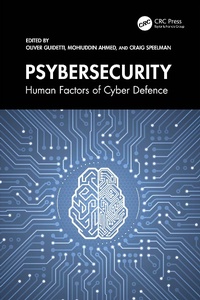
Psybersecurity
Human Factors of Cyber Defence
1st Edition
Published on 9. September 2024
254 pages
978-1-040-11195-6 (ISBN)
Description

Psybersecurity: Human Factors of Cyber Defence is a clarion call to action in the face of a stark reality: over 90% of cyberattacks exploit human vulnerabilities, as highlighted by the 2022 Global Risks Report from the World Economic Forum. This gap between the rapid advancement of cyber security technologies and the slower pace of development in human-centric defences poses a formidable challenge to national security and personal safety. Amidst the dazzling progress of AI technologies like ChatGPT and Microsoft Security Co-Pilot, the human element of cyber security remains critically underdeveloped.
Set against the backdrop of the Australian government's ambitious goal to become the world's most cybersecure nation by 2030, this book embarks on a mission to address the overlooked human factors in cyber defence. It advocates for a balanced approach that not only relies on technological advancements but also significantly enhances the human aspects of cyber security.
Through an interdisciplinary exploration, Psybersecurity delves into how cyberthreats exploit human vulnerabilities and offers innovative solutions for building resilience against these vulnerabilities. It examines the necessity for cyber security strategies that encompass psychological insights, systemic resilience, and the mitigation of human errors, particularly within critical infrastructures and cyber-physical systems (CPS).
Furthermore, this work critiques existing cyber security education frameworks, proposing a comprehensive curriculum that equips individuals with technical skills and the behavioural competencies needed to navigate the cyber landscape ethically and effectively. It also addresses AI's ethical dilemmas and psychological impacts, offering a forward-looking perspective on combating AI-driven harassment and endorsing a new field of study: "Psybersecurity."
Psybersecurity: Human Factors of Cyber Defence aims to bridge the gap between cyber security and human sciences, ignite a transformation in understanding, and fortify our digital world. It is an essential read for academics, professionals, and anyone committed to building a safer, more resilient cyber future in alignment with Australia's 2030 vision.
Set against the backdrop of the Australian government's ambitious goal to become the world's most cybersecure nation by 2030, this book embarks on a mission to address the overlooked human factors in cyber defence. It advocates for a balanced approach that not only relies on technological advancements but also significantly enhances the human aspects of cyber security.
Through an interdisciplinary exploration, Psybersecurity delves into how cyberthreats exploit human vulnerabilities and offers innovative solutions for building resilience against these vulnerabilities. It examines the necessity for cyber security strategies that encompass psychological insights, systemic resilience, and the mitigation of human errors, particularly within critical infrastructures and cyber-physical systems (CPS).
Furthermore, this work critiques existing cyber security education frameworks, proposing a comprehensive curriculum that equips individuals with technical skills and the behavioural competencies needed to navigate the cyber landscape ethically and effectively. It also addresses AI's ethical dilemmas and psychological impacts, offering a forward-looking perspective on combating AI-driven harassment and endorsing a new field of study: "Psybersecurity."
Psybersecurity: Human Factors of Cyber Defence aims to bridge the gap between cyber security and human sciences, ignite a transformation in understanding, and fortify our digital world. It is an essential read for academics, professionals, and anyone committed to building a safer, more resilient cyber future in alignment with Australia's 2030 vision.
More details
Edition
1. Auflage
Language
English
Place of publication
London
United Kingdom
Publishing group
Taylor & Francis Ltd
Target group
College/higher education
Professional and scholarly
Illustrations
6 Tables, black and white; 14 Line drawings, black and white; 14 Illustrations, black and white
ISBN-13
978-1-040-11195-6 (9781040111956)
Copyright in bibliographic data and cover images is held by Nielsen Book Services Limited or by the publishers or by their respective licensors: all rights reserved.
Schweitzer Classification
Other editions
Additional editions
Book
05/2026
1st Edition
CRC Press
€64.50
Shipment within 10-20 days
Book
09/2024
1st Edition
CRC Press
€231.80
Shipment within 10-20 days
Persons
Oliver Guidetti is a postdoctoral researcher specialising in the human factors of cyber security. He has an extensive background working on applied socio-technical projects that examine the interplay between the human brain and technology. His PhD research focused on measuring and mitigating vigilance decrement in cyber network defence tasks. Guidetti has published numerous research papers on topics such as cyber vigilance tasks, the neuropsychology of network defence operators, human resource policy in relation to neurotechnology, and the effects of cognitive load on the performance of cyber first responders. Through his work, he hopes to contribute to our increasingly digital world's socio-technical security and resilience.
Mohiuddin Ahmed is a Senior Lecturer of Computing and Security Discipline at the School of Science, Edith Cowan University, Australia. He earned his PhD in computer science from the University of New South Wales in 2016. He is a member of the Association for Computing Machinery (ACM), the Australian Information Security Association (AISA), a senior member of the Institute of Electrical and Electronics Engineers (IEEE), a Certified Professional of the Australian Computer Society (ACS), and a Fellow of the Higher Education Academy, UK. He is also an ACM Distinguished Speaker and delivered several keynotes and invited talks on cyber security. He has been educating the next generation of cyber leaders and researching to disrupt the cybercrime ecosystem. His research is focused on ensuring national security and safeguarding critical infrastructures from cyber terrorists. He secured several external and internal grants worth more than AU$1.7 million and has been collaborating with academia and industry.
Craig Speelman has been Professor in the School of Psychology and Social Science, Edith Cowan University, since 2008. He was Head of the School between 2002-2011. Speelman conducts research in the general area of cognitive psychology, but much of his research has focused on the topic of skill acquisition and transfer. He is the author of Beyond the Learning Curve: The Construction of Mind and several book chapters. He has edited three research volumes and also authored papers published in highly ranked journals, including the Journal of Experimental Psychology: LMC, Nature Scientific Reports, Frontiers in Psychology, The American Journal of Geriatric Psychiatry, and PLOS ONE. He has received funding from the Australian Research Council, Health Workforce Australia, and the Association of Independent Schools (AISWA). He has served on editorial boards of journals and was the editor-in-chief of the GSTF Journal of Psychology. He has served on the organising committees for national and international psychology conferences. Speelman has applied this expertise to developing a training program for acquiring skin cancer detection skills, the development of basic arithmetic skills, where he produced the commercial app Numbeat, and psychological aspects of cyber security.
Mohiuddin Ahmed is a Senior Lecturer of Computing and Security Discipline at the School of Science, Edith Cowan University, Australia. He earned his PhD in computer science from the University of New South Wales in 2016. He is a member of the Association for Computing Machinery (ACM), the Australian Information Security Association (AISA), a senior member of the Institute of Electrical and Electronics Engineers (IEEE), a Certified Professional of the Australian Computer Society (ACS), and a Fellow of the Higher Education Academy, UK. He is also an ACM Distinguished Speaker and delivered several keynotes and invited talks on cyber security. He has been educating the next generation of cyber leaders and researching to disrupt the cybercrime ecosystem. His research is focused on ensuring national security and safeguarding critical infrastructures from cyber terrorists. He secured several external and internal grants worth more than AU$1.7 million and has been collaborating with academia and industry.
Craig Speelman has been Professor in the School of Psychology and Social Science, Edith Cowan University, since 2008. He was Head of the School between 2002-2011. Speelman conducts research in the general area of cognitive psychology, but much of his research has focused on the topic of skill acquisition and transfer. He is the author of Beyond the Learning Curve: The Construction of Mind and several book chapters. He has edited three research volumes and also authored papers published in highly ranked journals, including the Journal of Experimental Psychology: LMC, Nature Scientific Reports, Frontiers in Psychology, The American Journal of Geriatric Psychiatry, and PLOS ONE. He has received funding from the Australian Research Council, Health Workforce Australia, and the Association of Independent Schools (AISWA). He has served on editorial boards of journals and was the editor-in-chief of the GSTF Journal of Psychology. He has served on the organising committees for national and international psychology conferences. Speelman has applied this expertise to developing a training program for acquiring skin cancer detection skills, the development of basic arithmetic skills, where he produced the commercial app Numbeat, and psychological aspects of cyber security.
Content
List of Figures, Tables, and Equations. Preface. About the Editors. List of Contributors. Chapter 1: Integrating Human Factors and Systemic Resilience: An Interdisciplinary Approach to Cyber Security in Critical Infrastructures and Utilities. Chapter 2: Analysing Cyber Physical Attacks: The Human Operator Challenge in Mining. Chapter 3: Building Cognitive Resilience for Enhanced Cyber Governance. Chapter 4: Cyber Security in Australian Higher Education Curricula: The SFIA Framework. Chapter 5: Dark Echoes: The Exploitative Potential of Generative AI in Online Harassment. Chapter 6: Trust and Risk: Psybersecurity in the AI Era. Chapter 7: Security Through Influence Over Mandate. Chapter 8: Human Skills and Socio-Cultural Impacts of K-12 Cyber Security Education. Chapter 9: Incident Response Drills On Cyber Ranges: Enhancing Cyber-Defence Education. Index
