

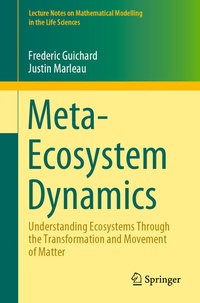
Meta-Ecosystem Dynamics
Description

This book presents current meta-ecosystem models and their derivation from classical ecosystem and metapopulation theories. Specifically, it reviews recent modelling efforts that have emphasized the role of nonlinear dynamics on spatial and food web networks, and which have cast their implications within the context of spatial synchrony and ecological stoichiometry. It suggests that these recent advances naturally lead to a generalization of meta-ecosystem theories to spatial fluxes of matter that have both a trophic and non-trophic impact on species.
Ecosystem dynamics refers to the cycling of matter and energy across ecological compartments through processes such as consumption and recycling. Spatial dynamics established its ecological roots with metapopulation theories and focuses on scaling up local ecological processes through the limited movement of individuals and matter. Over the last 15 years, theories integrating ecosystem and spatial dynamics have quickly coalesced into meta-ecosystem theories, the focus of this book.The book will be of interest to graduate students and researchers who wish to learn more about the synthesis of ecosystem and spatial dynamics, which form the foundation of the theory of meta-ecosystems.
More details
Other editions
Additional editions
Persons
Justin Marleau is a research associate in the Department of Biology at McGill University. While earning his PhD in mathematical and theoretical ecology at McGill in 2014, he became deeply interested in pedagogy, eventually becoming a biology college professor at Champlain Regional College in Saint-Lambert, Quebec from 2013-2016. After a brief sojourn in science policy with the Canadian federal government from 2016-2017, Dr. Marleau returned to full-time research at McGill, initially as a post-doctoral fellow. He specializes in the development of theory and models to advance our ability to predict and understand ecological systems.
