

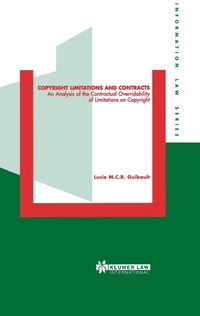
Copyright Limitations and Contracts
An Analysis of the Contractual Overridability of Limitations on Copyright
Published on 1. February 2002
394 pages
978-90-411-8065-0 (ISBN)
Description

Traditional copyright law strikes a delicate balance between an author's control of original material and society's interest in the free flow of ideas, information, and commerce. In today's digitally networked environment, this balance has shifted dramatically to one side, as powerful right holders contractually impose terms and conditions of use far beyond the bounds set by copyright law. This vitally significant book explores this conflict from its gestation through its current manifestations to its future lineaments and potential consequences.
Focusing on statutory copyright limitations that enshrine constitutional rights such as freedom of expression and privacy, foster dissemination of knowledge, safeguard competition, and protect authors from market failure, Copyright limitations and Contracts clearly explains the rationale for these limitations and questions the legality of overriding them by contractual means. The author hands a complex array of factors clouding the emergence of coherent rules in the matter, among them the nature of the contract (e.g., fully negotiated vs. "shrink wrap"), the respective interest of the parties involved, and the legislated policy of particular regimes. She points out that the United States' new Uniform Computer Information Transactions Act (UCITA), which is likely to be adopted by many U.S. States and influence similar legislation in many other countries, leaves this crucial issue essentially unresolved.
Among the author's many startling insights is that, contrary to the commonly held notion that the Internet is a bastion of free speech, in fact it is now possible (via encryption technology) for the first time in human history to exercise absolute control over copyrighted material, even under circumstances of global mass distribution. As we become more and more aware that the intersection of copyright and contract reveals one of the deepest and most far-reaching contradictions of our time, this illuminating analysis will be of extraordinary value to jurists in every area of public and private law.
Focusing on statutory copyright limitations that enshrine constitutional rights such as freedom of expression and privacy, foster dissemination of knowledge, safeguard competition, and protect authors from market failure, Copyright limitations and Contracts clearly explains the rationale for these limitations and questions the legality of overriding them by contractual means. The author hands a complex array of factors clouding the emergence of coherent rules in the matter, among them the nature of the contract (e.g., fully negotiated vs. "shrink wrap"), the respective interest of the parties involved, and the legislated policy of particular regimes. She points out that the United States' new Uniform Computer Information Transactions Act (UCITA), which is likely to be adopted by many U.S. States and influence similar legislation in many other countries, leaves this crucial issue essentially unresolved.
Among the author's many startling insights is that, contrary to the commonly held notion that the Internet is a bastion of free speech, in fact it is now possible (via encryption technology) for the first time in human history to exercise absolute control over copyrighted material, even under circumstances of global mass distribution. As we become more and more aware that the intersection of copyright and contract reveals one of the deepest and most far-reaching contradictions of our time, this illuminating analysis will be of extraordinary value to jurists in every area of public and private law.
More details
Other editions
Additional editions
Lucie Guibault
Copyright Limitations and Contracts:An Analysis of the Contractual Overridability of Limitations on Copyright
An Analysis of the Contractual Overridability of Limitations on Copyright
Book
02/2002
1st Edition
Kluwer Law International
€117.70
Shipment within 10-20 days
Content
- Cover
- Half Title Page
- Editorial Board
- Title Page
- Copyright Page
- Dedication
- Foreword
- Table of Contens
- List of abbreviations
- Chapter 1. Introduction
- 1.1 Current trends in the information trade
- 1.2 Definition of the problem
- 1.3 Structure of the Book
- Chapter 2. Copyright rules and limitations
- 2.1 General structure of the copyright system
- 2.1.1 OBJECTIVES OF THE COPYRIGHT SYSTEM
- 2.1.1.1 Natural Rights Argument
- 2.1.1.2 Utilitarian argument
- 2.1.1.3 Economic argument
- 2.1.2 LIMITATIONS INSIDE THE COPYRIGHT SYSTEM
- 2.1.2.1 Open or closed system of limitations
- 2.1.2.2 Forms of limitations
- 2.1.2.2.1 Exemptions
- 2.1.2.2.2 Statutory licences
- 2.1.2.2.3 Compulsory licences
- 2.1.2.2.4 Mandatory collective administration of author's rights
- 2.2 Justifications behind the limitations
- 2.2.1 PROTECTION OF CONSTITUTIONAL RIGHTS
- 2.2.1.1 Freedom of expression
- 2.2.1.2 Right to privacy
- 2.2.2 REGULATION OF INDUSTRY PRACTICE AND COMPETITION
- 2.2.2.1 Press reviews
- 2.2.2.2 Reproductions of computer programs
- 2.2.3 DISSEMINATION OF KNOWLEDGE
- 2.2.3.1 Educational institutions
- 2.2.3.2 Public libraries and archives
- 2.2.4 MARKET FAILURE CONSIDERATIONS
- 2.2.4.1 Transaction costs
- 2.2.4.2 Non-rivalry
- 2.2.4.3 Market failure and digital technology
- 2.2.5 CONCLUSION
- 2.3 Legal nature of the limitations
- 2.3.1 SUBJECTIVE RIGHT
- 2.3.2 OBJECTIVE RIGHT OR PRIVILEGE
- 2.3.3 INFLUENCE OF THE FORM ON THE LIMITATION'S NATURE
- 2.3.4 INFLUENCE OF THE JUSTIFICATION ON THE LIMITATION'S NATURE
- 2.3.5 CONCLUSION
- Chapter 3. Freedom of contract
- 3.1 Principle of freedom of contract
- 3.1.1 CLASSIC CONTRACT MODEL
- 3.1.2 STANDARD FORM CONTRACT MODEL
- 3.1.3 CONCLUSION
- 3.2 Limits on freedom of contract
- 3.2.1 NORMS OF PUBLIC ORDER
- 3.2.1.1 Economic public order
- 3.2.1.2 Protective public order
- 3.2.2 CONSTITUTIONAL RIGHTS
- 3.2.2.1 'Horizontal working' of fundamental rights
- 3.2.2.2 Constitutional limits to fundamental rights
- 3.2.2.3 Waiver of fundamental rights
- 3.2.2.4 'Horizontal working' in contractual relationships
- 3.2.3 ABUSE OR MISUSE OF RIGHTS
- 3.2.4 CONCLUSION
- Chapter 4. Intersection between copyright rules and freedom of contract
- 4.1 Contracts for the use of copyrighted material
- 4.1.1 CLASSIC CONTRACT MODEL
- 4.1.2 STANDARD FORM CONTRACT MODEL
- 4.2 Limits on freedom of contract
- 4.2.1 LIMITS SET BY COPYRIGHT LAW
- 4.2.1.1 Europe
- 4.2.1.2 United States
- 4.2.2 GENERAL LIMITS ON FREEDOM OF CONTRACT
- 4.2.2.1 Economic public order
- 4.2.2.2 Protective public order
- 4.2.2.3 Constitutional rights
- 4.2.2.4 Abuse or misuse of rights
- Chapter 5. Conclusion
- 5.1 Summary
- 5.2 Concluding remarks
- SAMENVATTING
- SOMMAIRE
- Bibliography
- Index
- About the author
- Back Cover
