

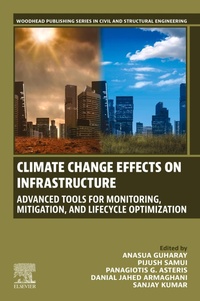
Climate Change Effects on Infrastructure
Advanced Tools for Monitoring, Mitigation, and Lifecycle Optimization
Published on 30. March 2026
650 pages
978-0-443-33686-7 (ISBN)
Description

The design of structures and infrastructure facilities has typically assumed a future climate that is much the same as today's. However, a changing climate and the resulting more extreme weather events mean those climate bands are becoming outdated, leaving infrastructure operating outside or at the limit of its tolerance levels.With its evaluation of a host of assets in the built environment, Climate Change Effects on Infrastructure: Advanced Tools for Monitoring, Mitigation, and Lifecycle Optimization instructs readers how to assess and predict structural vulnerabilities resulting from climate change as well as ensuing hazard patterns using mathematical tools and data-driven models. The carefully compiled contributions also comprehensively survey the latest technological developments and the most useful approaches to counteract and/or prevent damage and connected socio-economic risks.The volume proves to be an even more invaluable resource thanks to its real-world application examples that spotlight the urgency of further investigations into the implementation of cost-effective and sustainable adaptive measures that can enhance or extend the reliable performance, durability, and efficiency of structures and infrastructure systems throughout their entire lifecycle.
- Reviews advanced computational models, simulations, and data analytics techniques for determining the effects of climate change on infrastructure.
- Describes advanced methods to enhance infrastructure resilience and offset or prevent the adverse impacts of climate change.
- Features case studies and applied examples for different structure types and infrastructure systems from a variety of regions and assorted scenarios.
More details
Other editions
Additional editions
Anasua GuhaRay | Pijush Samui | Panagiotis G. Asteris
Climate Change Effects on Infrastructure
Advanced Tools for Monitoring, Mitigation, and Lifecycle Optimization
Book
03/2026
Woodhead Publishing
€238.50
Shipment within 15-20 days
Content
1. The relationship between the built environment and climate change: A case study of Alimosho LGA, Southwest NigeriaPart I: Effects of Climate Change on Civil Engineering Infrastructure2. Assessing Carbon Emissions and Cost-Effectiveness of Nano-Silica Soil Stabilization for Sustainable Pavement Construction: A Comprehensive Framework for Policy and Practice3. Analysis of Slope Instabilities using Finite Element Method considering Rainfall Effects4. Investigating the Influence of Climate Variability on Slope Stability and Water Dynamics5. Near site effects of nuclear waste: Soil contamination overview6. Climate-induced changes in hydrological regimes and water security7. Effect of Climate Change on Slope Stability: A Review StudyPart II: Adapting Urban Infrastructure to Climate Change8. Climate Change and Infrastructure Resilience: Addressing Impacts and Developing Adaptation Strategies9. Combating climate change impact on urban geotechnical infrastructures: challenges and future perspectives10. Infrastructural Acclimatization: Innovations and Strategies toward Sustainable Development11. Leveraging Artificial Intelligence for Climate-Resilient Infrastructure Management12. Climate Change and Frost Conditions: Impacts on Dynamic Behavior of Civil Structures13. Impact of urban infrastructure in land surface temperature14. AI-Driven Solutions for Climate Resilience in InfrastructurePart III: Case Studies15. An Assessment of Potential Environmental Impacts of Climate Change and Sea Level Rise on Decentralized Waste Water Treatment Infrastructures: A Broward County Case Study, FL, USA16. Assessment of Landslide Susceptibility Zones for the Kaski District, Located in Nepal's Gandaki Province17. Mitigating the Impact of Climate Change on Railway Infrastructure Stability in India
