

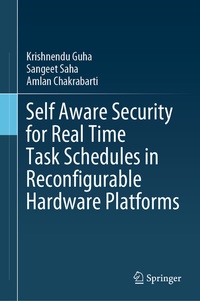
Self Aware Security for Real Time Task Schedules in Reconfigurable Hardware Platforms
Description

More details
Other editions
Additional editions
Persons
Dr. Krishnendu Guha is presently an Assistant Professor (On Contract) at National Institute of Technology (NIT), Jamshedpur, India. Prior to this, he was a Visiting Scientist in Indian Statistical Institute (ISI), Kolkata, India from December 2020-February 2021. He was also an Intel India Research Fellow from December 2019- December 2020. He has completed his Ph.D. from University of Calcutta. In his Ph.D. tenure, he received the prestigious INSPIRE Fellowship Award from the Department of Science and Technology, Government of India and the Intel India Final Year Ph.D. Fellowship Award from Intel Corporations, India. He completed his MTech from University of Calcutta, where he was the recipient of the University Gold Medal for securing the First Class First Rank. His present research arena encompasses embedded security, with a flavor of artificial intelligence and nature-inspired strategies.
Dr. Sangeet Saha
received his Ph.D. degree in Information Technology from the University of Calcutta, India in 2018. He received the TCS Industry Fellowship Award during his Ph.D. After submitting his Ph.D. thesis in 2017, he worked as a visiting scientist at Indian Statistical Institute (ISI) Kolkata, India. Since May 1, 2018 he is a Senior Research Officer in EPSRC National Centre for Nuclear Robotics, based in the EIS Lab, School of Computer Science and Electronic Engineering at University of Essex, UK. Primarily, his research expertise is in embedded systems, with specific interests that include real-time scheduling, scheduling for reconfigurable computers, fault-tolerance, and approximation-based real-time computing.
Prof. (Dr.) Amlan Chakrabarti
is presently Professor and Director of A. K. Choudhury School of Information Technology (AKCSIT), University of Calcutta. Prior to this, he completed his post-doctoral research at Princeton University after completing his Ph.D. from the University of Calcutta in association with ISI, Kolkata. He has been associated with research projects funded by government agencies and industries related to Reconfigurable Architecture, VLSI Design, Security for Cyber-physical Systems, Internet of Things, Machine Learning, Computer Vision and Quantum Computing. He is the Series Editor of Springer Transactions on Computer Systems and Networks and Associate Editor of Elsevier Journal of Computers and Electrical Engineering. His present research interests include Reconfigurable Computing, Embedded Systems Design, VLSI Design, Quantum Computing and Computer Vision. He is a Distinguished Visitor of IEEE Computer Society and Distinguished Speaker of ACM (2017-2020).
