

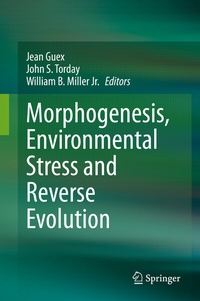
Morphogenesis, Environmental Stress and Reverse Evolution
Description

It is widely acknowledged that life has adapted to its environment, but the precise mechanism remains unknown since Natural Selection, Descent with Modification and Survival of the Fittest are metaphors that cannot be scientifically tested. In this unique text, invertebrate and vertebrate biologists illuminate the effects of physiologic stress on epigenetic responses in the process of evolutionary adaptation from unicellular organisms to invertebrates and vertebrates, respectively. This book offers a novel perspective on the mechanisms underlying evolution.
Capacities for morphologic alterations and epigenetic adaptations subject to environmental stresses are demonstrated in both unicellular and multicellular organisms. Furthermore, the underlying cellular-molecular mechanisms that mediate stress for adaptation will be elucidated wherever possible. These include examples of 'reverse evolution' by Professor Guex for Ammonites and for mammals by Professor Torday and Dr. Miller. This provides empiric evidence that the conventional way of thinking about evolution as unidirectional is incorrect, leaving open the possibility that it is determined by cell-cell interactions, not sexual selection and reproductive strategy. Rather, the process of evolution can be productively traced through the conservation of an identifiable set of First Principles of Physiology that began with the unicellular form and have been consistently maintained, as reflected by the return to the unicellular state over the course of the life cycle.
More details
Other editions
Additional editions
Persons
John S. Torday, PhD, is a Professor on the Faculty of the Evolutionary Medicine Program at UCLA. He received his Bachelor of Arts degree from Boston University (1968), a Master of Science degree from McGill University (1971), a Doctor of Philosophy degree from McGill University (1974), and did post-doctoral training in Reproductive Medicine at the University of Wisconsin-Madison (1974-76). He was previously on the Faculties of Harvard Medical School (1976-91) and the University of Maryland Medical School (1991-98). He has authored more than 100 peer-reviewed articles and 5 monographs on the subject of cellular-molecular evolution.
William B. Miller Jr. MD. attended the Honors Program in Medicine at NorthwesternUniversity, graduating with a B.S. In Medicine (1973) and a Doctor of Medicine (1975). He is a member of the medical honors society, Alpha Omega Alpha. Dr. Miller was a practicing physician for 35 years. During that period, he publishing a number of academic medical articles. A series of observations about the patterns of infectious disease made based on active medical practice spurred an interest in genetics, evolutionary biology and the microbiome and ultimately led to the publication of The Microcosm Within: Evolution and Extinction in the Hologenome (2013). More than two dozen peer-reviewed academic articles on evolution and the microbiome and several more books on those topics as co-author and co-editor have followed.
