

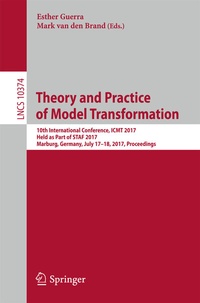
Theory and Practice of Model Transformation
10th International Conference, ICMT 2017, Held as Part of STAF 2017, Marburg, Germany, July 17-18, 2017, Proceedings
Published on 3. July 2017
XIV, 183 pages
978-3-319-61473-1 (ISBN)
Description

This book constitutes the refereed proceedings of the 10th International Conference on Model Transformation, ICMT 2017, held as part of STAF 2017, in Marburg, Germany, in July 2017.
The 9 full papers and 2 short papers were carefully reviewed and selected from 31 submissions. The papers are organized in the following topical sections: transformation paradigms, languages, algorithms and strategies; development of transformations; and applications and case studies.
The 9 full papers and 2 short papers were carefully reviewed and selected from 31 submissions. The papers are organized in the following topical sections: transformation paradigms, languages, algorithms and strategies; development of transformations; and applications and case studies.
More details
Series
Edition
1st ed. 2017
Language
English
Place of publication
Cham
Switzerland
Publishing group
Springer International Publishing
Product notice
Reflowable
Illustrations
XIV, 183 p. 73 illus.
File size
23,86 MB
ISBN-13
978-3-319-61473-1 (9783319614731)
DOI
10.1007/978-3-319-61473-1
Schweitzer Classification
Other editions
Additional editions

Esther Guerra | Mark van den Brand
Theory and Practice of Model Transformation
10th International Conference, ICMT 2017, Held as Part of STAF 2017, Marburg, Germany, July 17-18, 2017, Proceedings
Book
06/2017
Springer
€53.49
Shipment within 10-15 days
Content
- Intro
- Foreword
- Preface
- Organization
- Empowering High Tech Systems Engineering Using MDSE Ecosystems (Invited Talk)
- Contents
- Transformation Paradigms, Languages, Algorithms and Strategies
- Experimentation with a Big-Step Semantics for ATL Model Transformations
- 1 Introduction
- 2 Case Study
- 3 FMA-ATL: An Interpreter for ATL
- 3.1 Focussed Model Actions (FMA)
- 3.2 Initialization
- 3.3 Scheduling
- 3.4 ResolveTemp Expressions and Lazy Rules Call Statements
- 4 Experimentation
- 5 Related Work
- 6 Conclusions
- References
- Reducing the Verbosity of Imperative Model Refinements by Using General-Purpose Language Facilities
- 1 Introduction
- 2 Motivating Example
- 3 Related Work
- 3.1 Refinement as Built-in Language Facility
- 3.2 Refinement Using Higher-Order Transformations
- 4 A Generic Library for Implicit Copies
- 4.1 Conceptual Approach
- 4.2 Language Facilities
- 5 Proof of Concept
- 5.1 Library Implementation Using QVTo
- 5.2 Refinement Implementation Using QVTo
- 5.3 Validation
- 6 Conclusion and Future Work
- References
- Decision Points for Non-determinism in Concurrent Model Synchronization with Triple Graph Grammars
- Abstract
- 1 Introduction
- 2 Model Synchronization with Triple Graph Grammars
- 3 Non-determinism Without Residual Elements
- 4 Non-determinism with Residual Elements
- 5 Discussion
- 6 Conclusion and Future Work
- References
- The Micromapping Model of Computation
- The Foundation for Optimized Execution of Eclipse QVTc/QVTr/UMLX
- 1 Introduction
- 2 Background
- 2.1 Micromappings
- 2.2 Connections
- 2.3 Dependencies
- 3 Compile-Time Analysis and Transformation Chain
- 3.1 Running Example
- 3.2 Automated Analysis
- 3.3 Model of Computation
- 3.4 Micromapping Partitioning
- 3.5 Heads
- 3.6 Global Scheduling
- 4 Results
- 5 Related Work
- 6 Status and Further Work
- 7 Conclusion
- References
- Development of Transformations
- Testing Transformation Models Using Classifying Terms
- 1 Introduction
- 2 Preliminaries
- 2.1 A Running Example
- 2.2 Tracts
- 2.3 Classifying Terms
- 2.4 The USE Model Validator
- 3 A Frame for Testing Transformation Models
- 4 Validation Exercise 1: Families2Persons
- 5 Validation Exercise 2: Java2Graph
- 6 Related Work
- 7 Conclusions and Future Work
- References
- Differencing of Model Transformation Rules: Towards Versioning Support in the Development and Maintenance of Model Transformations
- 1 Introduction
- 2 Motivating Example
- 3 Differencing of Transformation Rules Using SiLift
- 4 Related Work
- 5 Conclusion and Future Work
- References
- Automatic Inference of Rule-Based Specifications of Complex In-place Model Transformations
- 1 Introduction
- 2 Problem Analysis and Motivating Example
- 3 Inference of Transformation Rules
- 4 Integration with an MDE Development Environment
- 5 Case-Based Evaluation
- 5.1 Solving the Motivating Example
- 5.2 Threats to Validity
- 6 Related Work
- 7 Conclusion
- References
- A Survey of Model Transformation Design Pattern Usage
- 1 Introduction
- 2 Research Questions
- 3 Sources and Selection Criteria
- 4 Results
- 4.1 The Extent of Pattern Usage
- 4.2 Benefits of MT Pattern Use
- 4.3 Occurrences of Novel Patterns
- 4.4 Trends and Influences
- 4.5 Patterns in Different MT Languages
- 5 Threats to Validity
- 6 Related Work
- 7 Conclusions and Future Work
- References
- Applications and Case Studies
- Generating Efficient Mutation Operators for Search-Based Model-Driven Engineering
- 1 Introduction
- 2 Framework Overview
- 3 Upper-Tier and Lower-Tier Mutation Operators
- 3.1 Preliminaries
- 3.2 Requirements
- 3.3 Upper-Tier Mutation Operator
- 3.4 Lower-Tier Mutation Operator
- 4 Implementation
- 5 Preliminary Evaluation
- 6 Related Work
- 7 Conclusion and Future Work
- References
- Graph Constraint Evaluation over Partial Models by Constraint Rewriting
- 1 Introduction
- 2 Preliminaries
- 2.1 Motivating Example: Validation of Partial Yakindu Statecharts
- 2.2 Metamodels and Instance Models
- 2.3 Graph Patterns as Logic Formulae
- 3 Formalism of 3-Valued Partial Models
- 3.1 Properties of 3-Valued Logic
- 3.2 Partial Models Based on 3-Valued Logic
- 3.3 Refinement and Concretization
- 3.4 Evaluating Predicates on 3-Valued Partial Models
- 3.5 Rewriting Predicates to Must and May Predicates
- 3.6 Transforming MAVO Uncertainty to 3-Valued Partial Models
- 4 Scalability Evaluation
- 5 Related Work
- 6 Conclusion and Future Work
- References
- BXE2E: A Bidirectional Transformation Approach for Medical Record Exchange
- 1 Introduction
- 2 Background
- 2.1 EMRs, OSCAR and E2E
- 2.2 Bidirectional Transformations
- 3 BXE2E Design
- 3.1 Architecture Overview
- 3.2 Considerations
- 4 Implementation Details
- 4.1 TGG Rule Implementation
- 4.2 Lens Implementation
- 5 Evaluation and Analysis
- 5.1 Correctness
- 5.2 Maintainability
- 5.3 Performance
- 6 Conclusions
- References
- Rule-Based Repair of EMF Models: An Automated Interactive Approach
- 1 Introduction
- 2 Running Example
- 3 Rule-Based Model Repair
- 3.1 A Rule-Based Algorithm for Model Repair
- 3.2 An Example Repair Process
- 3.3 Deriving a Model Transformation System from a Meta-model
- 4 Tool Support
- 5 Related Work
- 6 Conclusion
- References
- Author Index
