

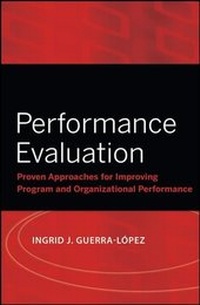
Performance Evaluation
Description

More details
Other editions
Additional editions
Person
Content
Acknowledgments xi
Preface xiii
The Author xv
Part One: Introduction To Evaluation
One: Foundations of Evaluation 3
A Brief Overview of Evaluation History 4
Evaluation: Purpose and Definition 5
Performance Improvement: A Conceptual Framework 8
Making Evaluation Happen: Ensuring Stakeholders' Buy-In 9
The Evaluator: A Job or a Role? 10
The Relationship to Other Investigative Processes 11
When Does Evaluation Occur? 15
General Evaluation Orientations 18
Challenges That Evaluators Face 20
Ensuring Commitment 23
Benefits of Evaluation 24
Basic Definitions 25
Two: Principles of Performance-based Evaluation 27
Principle 1: Evaluation Is Based on Asking the Right Questions 28
Principle 2: Evaluation of Process Is a Function of Obtained Results 32
Principle 3: Goals and Objectives of Organizations Should Be Based on Valid Needs 33
Principle 4: Derive Valid Needs Using a Top-Down Approach 34
Principle 5: Every Organization Should Aim for the Best That Society Can Attain 34
Principle 6: The Set of Evaluation Questions Drives the Evaluation Study 35
Part Two: Models of Evaluation
Three: Overview of Existing Evaluation Models 39
Overview of Classic Evaluation Models 40
Selected Evaluation Models 42
Selecting a Model 43
Conceptualizing a Useful Evaluation That Fits the Situation 44
Four: KIRKPATRICK'S Four LEVELS Of Evaluation 47
Kirkpatrick's Levels 49
Comments on the Model 54
Strengths and Limitations 55
Application Example: Wagner (1995) 56
Five: Phillips's Return-on-investment Methodology 61
Phillips's ROI Process 63
Comments on the Model 67
Strengths and Limitations 70
Application Example: Blake (1999) 70
Six: Brinkerhoff's Success Case Method 75
The SCM Process 77
Strengths and Weaknesses 78
Application Example: Brinkerhoff (2005) 79
Seven: the Impact Evaluation Process 81
The Elements of the Process 83
Comments on the Model 96
Strengths and Limitations 97
Application Example 97
Eight: the Cipp Model 107
Stufflebeam's Four Types of Evaluation 108
Articulating Core Values of Programs and Solutions 111
Methods Used in CIPP Evaluations 112
Strengths and Limitations 113
Application Example: Filella-Guiu and Blanch-Pana (2002) 113
Nine: Evaluating Evaluations 117
Evaluation Standards 119
The American Evaluation Association Principles for Evaluators 120
Application Example: Lynch et al. (2003) 122
Part Three: Tools and Techniques of Evaluation
Ten: Data 133
Characteristics of Data 135
Scales of Measurement 137
Defining Required Data from Performance Objectives 139
Deriving Measurable Indicators 141
Finding Data Sources 152
Follow-Up Questions and Data 155
Eleven: Data Collection 159
Observation Methodology and the Purpose of Measurement 160
Designing the Experiment 186
Problems with Classic Experimental Studies in Applied Settings 188
Time-Series Studies 188
Simulations and Games 189
Document-Centered Methods 191
Conclusion 192
Twelve: Analysis of Evaluation Data: Tools and Techniques 195
Analysis of Models and Patterns 196
Analysis Using Structured Discussion 197
Methods of Quantitative Analysis 199
Statistics 200
Graphical Representations of Data 210
Measures of Relationship 212
Inferential Statistics: Parametric and Nonparametric 214
Interpretation 217
Thirteen: Communicating The Findings 221
Recommendations 222
Considerations for Implementing Recommendations 225
Developing the Report 226
The Evaluator's Role After the Report 235
Part Four: Continual Improvement
Fourteen: Common Errors in Evaluation 239
Errors of System Mapping 240
Errors of Logic 242
Errors of Procedure 244
Conclusion 246
Fifteen: Continual Improvement 249
What Is Continual Improvement? 250
Monitoring Performance 250
Adjusting Performance 253
The Role of Leadership 254
Sixteen: Contracting for Evaluation Services 257
The Contract 258
Contracting Controls 260
Ethics and Professionalism 262
Sample Statement of Work 262
Seventeen: Intelligence Gathering For Decision Making 271
Performance Measurement Systems 273
Issues in Performance Measurement Systems 275
Conclusion 277
Eighteen: the Future of Evaluation in Performance Improvement 279
Evaluation and Measurement in Performance Improvement Today 281
What Does the Future Hold? 282
Conclusion 283
References and Related Readings 285
Index 295
CHAPTER 1
FOUNDATIONS OF EVALUATION
This chapter defines and describes evaluation and sets the frame for this book within the principles of performance improvement. Various kinds of evaluation, as well as some closely related processes, are differentiated from each other. The basic challenges that evaluators face are laid out, and the reason that stakeholder commitment is so important is examined. The benefits of evaluation to an organization are listed. Finally, definitions are provided for some key terms used throughout the book and in the evaluation field.
In our daily lives, we encounter decision points on an almost continuous basis: Should I do this, or should I do that? Should I go right or left? Should I take the highway or the back streets? Should I buy now or later? Should I take my umbrella today or not? Life in an organizational setting is no different: We face decisions about which programs to sustain, which to change, and which to abandon, to name but a few organizational dilemmas. How do members of an organization go about making sound decisions? With the use of relevant, reliable, and valid data, gathered through a sound evaluation process aligned with desired long-term outcomes.
Unfortunately, these data are not always available, and if they are, many decision makers do not know they exist, or do not have access to them, or do not know how to interpret and use them to make sound decisions that lead to improved program and organizational performance. In fact, Lee Cronbach (1980) and others have argued that decisions often emerge rather than being logically and methodically made.
Effective leaders are capable of making sound decisions based on sound data, and evaluators can do much to influence the leadership decision-making process. Evaluation can provide a systematic framework that aligns stakeholders, evaluation purposes, desired results and consequences, and all evaluation activities, so that the evaluation product is a responsive and clear recipe for improving performance. This in essence allows the decision-making process to become clearer and more straightforward. Evaluation is the mechanism that provides decision makers with feedback, whether through interim reports and meetings or a final report and debriefing.
A BRIEF OVERVIEW OF EVALUATION HISTORY
Michael Scriven (1991) describes evaluation as a practice that dates back to samurai sword evaluation. Another type of evaluation was in evidence as early as 2000 B.C.: Chinese officials held civil service examinations to measure the ability of individuals applying for government positions. And Socrates included verbal evaluations as part of his instructional approach (Fitzpatrick, Sanders, & Worthen, 2004).
In response to dissatisfaction with educational and social programs, a more formal educational evaluation can be traced back to Great Britain during the 1800s, when royal commissions were sent by the government to hear testimony from the various institutions. In the 1930s, Ralph Tyler issued a call to measure goal attainment with standardized criteria (Fitzpatrick et al., 2004). And during the 1960s, Scriven and Cronbach introduced formative (used to guide developmental activities) and summative (used to determine the overall value of a program or solution) evaluation, and Stufflebeam stressed outcomes (program results) over process (program activities and resources) (Liston, 1999).
In 1963, Cronbach published an important work, "Course Improvement Through Evaluation," challenging educators to measure real learning rather than the passive mastery of facts. Moreover, he proposed the use of qualitative instruments, such as interviews and observations, to study outcomes. In the latter part of the 1960s, well-known evaluation figures such as Edward Suchman, Michael Scriven, Carol Weiss, Blaine Worthen, and James Sanders wrote the earliest texts on program evaluation.
In 1971, Daniel Stufflebeam proposed the CIPP model of evaluation, which he said would be more responsive to the needs of decision makers than earlier approaches to evaluation were. In that same year, Malcolm Provus proposed the discrepancy model of evaluation. In 1972, Scriven proposed goal-free evaluation in an effort to encourage evaluators to find unintended consequences. In 1975, Robert Stake provided responsive evaluation. In 1981, Egon Guba and Yvonna Lincoln proposed naturalistic evaluation on the basis of Stake's work, feeding the debate between qualitative and quantitative methods (Fitzpatrick et al., 2004).
All of this was occurring in the context of a movement to account for the billions of dollars the U.S. government was spending on social, health, and educational programs (Fitzpatrick et al., 2004; Patton, 1997). In order to address a demand for accountability, those responsible for programs soon began to ask evaluators for advice on program improvement. Thus, the initial purpose of program evaluation was to judge the worthiness of programs for continued funding.
When Sputnik became the catalyst for improving the U.S. position in education, which was lagging compared to other countries, educational entities in particular began to commission evaluations, partly in order to document their achievements. The need for evaluators soon grew, and government responded by funding university programs in educational research and evaluation. In the 1970s and 1980s, evaluation grew as a field, with its applications expanding beyond government and educational settings to management and other areas. Evaluations are now conducted in many different settings using a variety of perspectives and methods.
EVALUATION: PURPOSE AND DEFINITION
While some rightly say that the fundamental purpose of evaluation is the determination of the worth or merit of a program or solution (Scriven, 1967), the ultimate purpose, and value, of determining this worth is in providing the information for making data-driven decisions that lead to improved performance of programs and organizations (Guerra-López, 2007a). The notion that evaluation's most important purpose is not to prove but to improve was originally put forward by Egon Guba when he served on the Phi Delta Kappa National Study Committee on Evaluation around 1971 (Stufflebeam, 2003). This should be the foundation for all evaluation efforts, now and in the future. Every component of an evaluation must be aligned with the organization's objectives and expectations and the decisions that will have to be made as a result of the evaluation findings. These decisions are essentially concerned with how to improve performance at all levels of the organization: internal deliverables, organizational gains, and public impact. At its core, evaluation is a simple concept:
- It compares results with expectations.
- It finds drivers and barriers to expected performance.
- It produces action plans for improving the programs and solutions being evaluated so that expected performance is achieved or maintained and organizational objectives and contributions can be realized (Guerra-López, 2007a).
Some approaches to evaluation do not focus on predetermined results or objectives, but the approach taken in this book is based on the premise of performance improvement. The underlying assumption is that organizations, whether they fully articulate this or not, expect specific results and contributions from programs and other solutions. As discussed in later chapters, this does not prevent the evaluator or performance improvement professional from employing means to help identify unanticipated results and consequences. The worth or merit of programs and solutions is then determined by whether they delivered the desired results, whether these results are worth having in the first place, and whether the benefits of these results outweigh their costs and unintended consequences.
An evaluation that asks and answers the right questions can be used not only to determine results but also to understand those results and to modify the evaluation so that it can better meet the intended objectives within the required criteria. This is useful not only to identify what went wrong or what could be better but also to identify what should be maintained. Through appreciative inquiry (Cooperrider & Srivastva, 1987), evaluation can help organizations identify what is going right. Appreciative inquiry is a process that searches for the best in organizations in order to find opportunities for performance improvement. Here too the efforts are but a means to the end of improving performance. Although the intentions of most evaluators are just that, the language and approach used are charged with assumptions that things are going wrong. For instance, the term problem solving implies from the start that something is wrong. Even if this assumption is not explicit in the general evaluation questions, it makes its way into data collection efforts. Naturally the parameters of what is asked will shape the information evaluators get back and, in turn, their findings and conclusions. If we ask what is wrong, the respondents will tell us. If we ask what went right, again they will tell us. The key point is that evaluation should be as unbiased as possible. Evaluators should ask and answer the right questions, so that the data they get are indeed representative of reality.
In specific terms, before evaluators start to plan, and certainly before they collect data, they must determine why they are conducting an evaluation. Is this their initiative, or were they directed to do this work? What is the motivation for the study? What are they looking to accomplish and contribute as a...
