

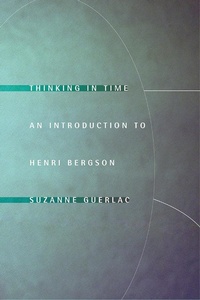
Thinking in Time
Description

"Under the aegis of time Suzanne Guerlac displaces matter, intuition, memory, and vitalism of the early twentieth century into the wake of poststructuralism and the dilemmas of nature and culture here and now. This book is a landmark for anyone working in the currents of philosophy, science, and literature. The force and vision of the work will enthuse and inspire every one of its readers." ¿Tom Conley, Harvard University
"In recent years, we have grown accustomed to philosophical language that is intensely self-conscious and rhetorically thick, often tragic in tone. It is enlivening to read Bergson, who exerts so little rhetorical pressure while exacting such a substantial effort of thought.... Bergson's texts teach the reader to let go of entrenched intellectual habits and to begin to think differently-to think in time.... Too much and too little have been said about Bergson. Too much, because of the various appropriations of his thought. Too little, because the work itself has not been carefully studied in recent decades."-from Thinking in Time
Henri Bergson (1859-1941), whose philosophical works emphasized motion, time, and change, won the Nobel Prize for Literature in 1927. His work remains influential, particularly in the realms of philosophy, cultural studies, and new media studies. In Thinking in Time, Suzanne Guerlac provides readers with the conceptual and contextual tools necessary for informed appreciation of Bergson's work.
Guerlac's straightforward philosophical expositions of two Bergson texts, Time and Free Will (1888) and Matter and Memory (1896), focus on the notions of duration and memory-concepts that are central to the philosopher's work. Thinking in Time makes plain that it is well worth learning how to read Bergson effectively: his era and our own share important concerns. Bergson's insistence on the opposition between the automatic and the voluntary and his engagement with the notions of "the living," affect, and embodiment are especially germane to discussions of electronic culture.
More details
Other editions
Additional editions
Person
Suzanne Guerlac is Professor of French at the University of California, Berkeley. She is the author of Literary Polemics: Bataille, Sartre, Valéry, Breton, cowinner of the Aldo and Jeanne Scaglione Prize for French and Francophone Studies given by the Modern Language Association, and The Impersonal Sublime: Hugo, Baudelaire, Lautréamont, and the Esthetics of the Sublime.
