

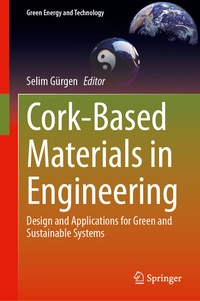
Cork-Based Materials in Engineering
Description

Cork-Based Materials in Engineering Applications
provides a set of case studies investigating cork as an eco-friendly and sustainable engineering material. This natural material has had limited applications in engineering until recent years. Recent regulations by European authorities calling for reducing environmentally hazardous and non-recyclable materials have increased interest in cork-based science. Contributors look at cork-based engineering applications, including crashworthiness applications, anti-impact structures, energy-absorbing systems, and vibration-damping devices. Researchers, scientists, students, and practicing engineers working in advanced materials and natural composites will find this unique book an invaluable reference and introduction to the world of cork-based materials and applications.
More details
Other editions
Additional editions
Person
Selim Gürgen, Ph.D., is an Associate Professor in the Department of Aeronautical Engineering at Eskisehir Osmangazi University. He received his B.Sc. and M.Sc. degrees in Mechanical Engineering from Gazi University and Middle East Technical University, respectively, and his Ph.D. in Mechanical Engineering from Eskisehir Osmangazi University. He was a visiting researcher at the University of Wollongong and worked as a researcher with the School of Transportation at Anadolu University. Before his academic life, he worked as a manufacturing engineer in a joint venture of KMWE-Dutch Aero. Dr. Gürgen has contributed to several industrial and research projects in collaboration with major organizations such as Fiat Automobiles, Turkish Aerospace Industries, the Turkish Air Force, and the Scientific and Technological Research Council of Turkey (TÜBITAK). He has many publications in refereed international journals and conferences and coedited the book Materials, Structures, and Manufacturing for Aircraft (Springer, 2022). He serves as an editorial member for several international journals. He leads a consortium of five universities and one commercial company in a European Union-funded international project investigating cork composites for aerospace applications. Moreover, he has many publications on cork-based products in engineering applications. His primary area of research is material science.
